

India’s women athletes stole the spotlight on the opening day of the Asian U20 Athletics Championships as teenage sprinter Nipam produced a landmark performance to clinch bronze in the women’s 100m final on Thursday. The 18-year-old’s podium finish not only marked a memorable international debut but also ended India’s 25-year wait for a medal in the women’s 100m event at the continental junior championships.
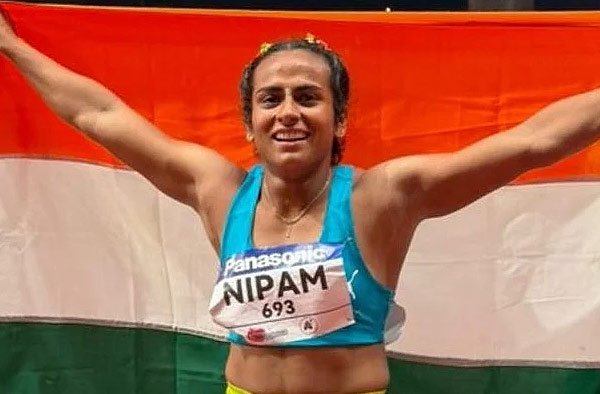
Competing against some of Asia’s fastest young sprinters, Nipam clocked 11.62 seconds to secure third place behind Qatar’s Dana Noor Salem and China’s Xinxuan Chen. Salem won the gold medal with a timing of 11.47 seconds, while Chen claimed silver in 11.54 seconds.
The race highlighted Nipam’s composure and determination under pressure. Despite a slower reaction off the blocks, the young Indian recovered brilliantly during the middle phase of the sprint and surged strongly through the final metres to seal a place on the podium. Her performance immediately became one of India’s standout moments of the championships and reinforced the growing rise of women’s sprinting in the country.
Hailing from Uttar Pradesh, Nipam has rapidly emerged as one of India’s most exciting young track athletes over the past year. Earlier this season, she set the Indian U20 national record in the women’s 100m with a personal best of 11.53 seconds at a domestic competition, announcing herself as a serious prospect for the future.
Her latest achievement continues the encouraging progress of Indian women in athletics, particularly in sprint events where Indian athletes have historically faced tough competition from stronger Asian nations such as China, Japan and Bahrain. In recent years, however, Indian women athletes have increasingly made their presence felt on the continental stage through improved grassroots programmes, better exposure and stronger support systems.
Nipam’s bronze medal also reflected a broader trend of young Indian women athletes stepping confidently onto major international platforms at an early age. The success of stars like Hima Das, Jyothi Yarraji and Dutee Chand has inspired a new generation of sprinters who now view international medals as realistic targets rather than distant dreams.
India’s women athletes continued to impress across multiple events during the opening day. In the women’s 400m heats, Neeru Pathak delivered a commanding performance to top her heat in 54.42 seconds and comfortably qualify for the final. Showing excellent pace, judgment and control through the final stretch, Neeru established herself as one of the contenders heading into the medal race.
Tahura Khatun also secured her place in the final after finishing second in her heat with a timing of 55.06 seconds. Her qualification ensured a double Indian presence in the women’s 400m final and added to the country’s encouraging start in women’s track events.
The performances highlighted the growing depth in India’s women’s athletics programme, particularly at the junior level where several athletes are beginning to emerge across sprint and middle-distance disciplines.
While the women athletes delivered major positives for India, there were mixed results in some of the other events. Vikas Kumar narrowly missed out on a medal in the men’s 3000m after finishing fourth with a personal best timing of 8:24.88.
India also remained hopeful in the decathlon competition, where Rahul Jakhar produced a strong opening day showing to stay in medal contention. Meanwhile, Mohammed Ashfaq failed to advance to the men’s 400m final after finishing fifth in his semifinal race.
In the men’s hammer throw, Ashuvendra Pratap Singh and Aman finished seventh and eighth respectively. However, the strongest narrative of the day undoubtedly belonged to India’s young women athletes, whose performances underlined the increasing confidence and competitiveness of female talent in Indian athletics.
The Asian U20 Athletics Championships have often served as an important stepping stone for future senior stars. Many athletes who have excelled at the junior continental level have later gone on to represent their nations at the Olympics, Asian Games and World Championships.
For Indian women athletes especially, strong performances at such tournaments are increasingly becoming signs of long-term progress rather than isolated achievements. Improved training infrastructure, scientific coaching methods and greater visibility for women’s sport in India have all contributed to the rise of a more fearless generation of female competitors.
Nipam’s medal could therefore carry significance beyond the bronze itself. At just 18 years old, her ability to deliver on the international stage suggests India may have found another exciting sprint talent capable of competing at elite Asian level in the years ahead.
As the championships continue, India will now hope its women athletes can build on the momentum created on the opening day and add more medals to the tally. With several finals still to come, the performances of Nipam, Neeru Pathak and Tahura Khatun have already provided a strong statement about the future of women’s athletics in India.

