

For most athletes, returning from a serious knee injury is as much a mental challenge as a physical one. For India’s premier hurdler Jyothi Yarraji, the journey back to competition has taken nearly a year of rehabilitation, patience and determination. On Wednesday at the 65th National Inter-State Senior Athletics Championships in Bhubaneswar, the national record holder finally took a major step forward, marking her competitive return with a victory that secured her place at the 2026 Asian Games.
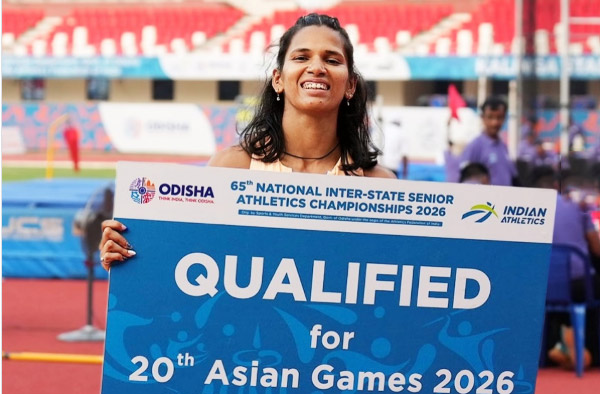
Competing at the Kalinga Stadium with brown kinesiology tape wrapped around her right knee, Yarraji comfortably won her heat of the women’s 100m hurdles in 13.14 seconds. While the timing was below her personal best and national record of 12.78 seconds, the significance of the performance extended far beyond the stopwatch.
The result confirmed her qualification for the 2026 Asian Games in Aichi-Nagoya, where she will aim to build on the silver medal she won at the previous edition in Hangzhou and once again challenge Asia’s best hurdlers.
For Indian athletics fans, the sight of Yarraji back on the track was a welcome one. The 25-year-old has established herself as one of the country’s most successful track athletes over the last few years, consistently breaking barriers in sprint hurdles and helping raise the profile of women’s athletics in India. Her comeback follows one of the most difficult periods of her sporting career.
Last July, Yarraji suffered a devastating anterior cruciate ligament (ACL) injury to her right knee during a training session. The setback abruptly ended a season that had been shaping up as one of the finest of her career.
The injury required surgery and months of intensive rehabilitation. For an athlete whose event depends heavily on explosive speed, rhythm and precise hurdling mechanics, returning to competition after an ACL tear is never straightforward.
Despite completing her rehabilitation programme several weeks before the Inter-State Championships, there remained uncertainty about how she would perform in her first competitive race back. Unlike many athletes returning from injury, Yarraji chose not to participate in smaller preparatory meets before stepping onto the national stage.
Any concerns, however, quickly disappeared once the race began. Yarraji looked composed and confident from the opening strides. By the third hurdle she had already established a clear lead over the field, maintaining smooth technique throughout the race. Most importantly, she cleared all ten hurdles efficiently and showed no visible signs of discomfort. The performance suggested that her rehabilitation process has been successful and that she is gradually rediscovering the form that made her one of Asia’s leading hurdlers.
There was little time for celebration after crossing the finish line. Having secured qualification, Yarraji immediately shifted her focus to the final later in the day, reflecting the competitive mindset that has defined her rise over the years.
Her return comes at a crucial period for Indian athletics. The Inter-State Championships serve as one of the final selection events for the Asian Games, making every performance significant. With several established stars and emerging talents competing in Bhubaneswar, the competition has become a key platform for athletes hoping to secure spots in India’s squad for the continental showpiece.
Yarraji’s qualification ensures that India will once again have a genuine medal contender in the women’s sprint hurdles. The Andhra Pradesh-born athlete has enjoyed a remarkable rise since emerging on the national scene. She first gained widespread attention after consistently breaking national records and dominating domestic competitions. Over the years, she has become synonymous with excellence in Indian hurdling.
Her national record of 12.78 seconds remains one of the most significant achievements in Indian athletics, placing her among the fastest hurdlers in Asia.
Before her injury, Yarraji had been enjoying an exceptional run of form. She opened her season by winning double gold medals in the 100m hurdles and 200m at the National Games. She followed that success with another title at the Federation Cup before taking her dominance onto the continental stage.
One of the highlights of her career came when she won gold at the Asian Athletics Championships, establishing herself as one of the region’s leading sprint hurdlers. Shortly afterwards, she claimed another title at the Taiwan Athletics Open, continuing her impressive momentum. Those achievements made the injury setback particularly frustrating, as many believed she was entering the prime years of her career.
Yet Wednesday’s performance demonstrated that her ambitions remain firmly intact. The upcoming Asian Games will offer Yarraji an opportunity not only to compete for a medal but also to continue her pursuit of a major international title. Having won silver in Hangzhou, she now has her sights set on standing at the top of the podium in Nagoya.
Beyond individual success, Yarraji’s return is also important for Indian athletics as a whole. Her achievements have inspired a new generation of female athletes, particularly in track events where India has historically faced stiff competition from stronger athletics nations.
With several months remaining before the Asian Games, Yarraji now has valuable time to sharpen her fitness, regain race rhythm and continue building confidence. If her performance in Bhubaneswar is any indication, the recovery process is moving in the right direction.
The stopwatch may not yet reflect her record-breaking best, but the victory carried a powerful message. After months away from competition and one of the toughest challenges of her career, Jyothi Yarraji is back on the track, back among India’s elite athletes and firmly back in contention for international success.

