

There are victories that are measured in medals, and there are victories that leave a mark far beyond the podium. The latter are often invisible. They are found in the dreams they ignite, the barriers they dismantle and the lives they quietly transform.
Mary Kom’s greatest legacy may not be her six world titles, an Olympic bronze medal or her Commonwealth Games gold. It may well be that a young boxer from Pakistan, raised in a society where women in combat sports remain a rarity, watched a film about her life and decided to step into the ring.
In a world where India and Pakistan are often defined by political tensions, Fatima Zahra’s heartfelt tribute to Mary Kom offers a powerful reminder that sporting greatness knows no borders.
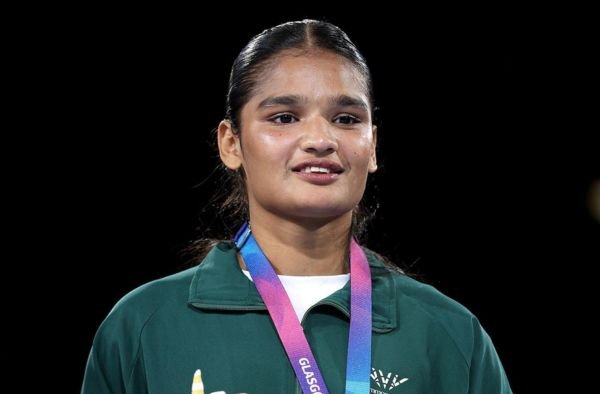
“I am inspired by India’s Mary Kom,” Fatima said after becoming Pakistan’s first female Commonwealth Games boxing medallist at the Glasgow 2026 Games. Her admiration did not stop there.”I used to watch the film made on her life. When I started boxing, I used to watch that movie and train. I have a lot of respect for her and inshallah (God willing) one day I will become like her. I hope I can meet her.”
Those words carry significance beyond boxing. Fatima, 22, scripted history by winning bronze in the women’s 60kg category, becoming the first Pakistani woman ever to win a Commonwealth Games medal in boxing. It is a landmark achievement for a nation whose women’s boxing programme only began competing internationally in 2016. Her achievement also reflects how sporting inspiration travels in unexpected ways.
Growing up in Pakistan’s Punjab province, Fatima had few female boxing icons within her own country. Instead, she found one across the border in India’s most celebrated boxer. The story of Mary Kom, born in rural Manipur, overcoming financial hardship, social prejudice and repeated setbacks to become a six-time world champion resonated deeply with a young athlete facing similar challenges.
Like Mary Kom, Fatima had to fight before she ever entered a boxing ring. “My family was against boxing. They would not let me go for training but I fought with them and continued training,” she recalled. “And now they are more tense than me for my fight and competition.”
The parallels are striking. Mary Kom’s own journey was shaped by resistance. Growing up in a farming family in Manipur, she pursued boxing despite limited resources and societal expectations. Her career became a story of perseverance, one that included six World Championship titles, an Olympic bronze medal at London 2012, Commonwealth Games gold on the Gold Coast in 2018 and countless victories that transformed women’s boxing in India. Her life later reached millions through the 2014 biographical film Mary Kom, starring Priyanka Chopra Jonas, ensuring that her story travelled well beyond India’s borders.
That film has now become part of another athlete’s journey. In many ways, Fatima’s medal represents the ripple effect of representation. Young athletes rarely dream in isolation. They need someone who has already walked the path they hope to follow. For countless girls across South Asia, Mary Kom became that figure. She demonstrated that women could succeed in a sport traditionally viewed as masculine without compromising their identity or ambitions.
Fatima now has the opportunity to become that figure for Pakistan. Her bronze medal comes at a pivotal moment for women’s boxing in the country. Pakistan’s boxing infrastructure remains relatively underdeveloped compared to its South Asian neighbours, particularly for female athletes. Access to coaching, funding and competitive opportunities continues to be limited, while cultural expectations still discourage many young women from pursuing combat sports.
Fatima understands that reality. “I was also just another girl. I joined boxing, trained and worked hard. I want other girls who are told to work at home to come out like me. I have struggled and worked so hard. I want others to get boosted by my performance and get inspired.”
Those words echo the same message Mary Kom carried throughout her career: that success in sport can challenge stereotypes more effectively than speeches ever can. There is another lesson hidden within this story. Sport is often described as a bridge between nations, but such phrases can feel overly romantic in a region where political relations remain strained. Yet moments like these remind us that athletes frequently build connections governments struggle to create.
Fatima never viewed Mary Kom as an Indian boxer first. She saw her as a champion whose story reflected her own aspirations. Inspiration, after all, does not require passports.
At the same Commonwealth Games where India produced its greatest-ever boxing campaign with seven gold medals, Pakistan celebrated a breakthrough that could shape the future of women’s boxing in the country. Both stories are linked by one remarkable athlete who retired from competition years ago but continues to influence the sport in profound ways.
Mary Kom once transformed Indian boxing by proving that women could become global champions. Today, without throwing a single punch, she continues to shape boxing across South Asia. That may be the truest measure of sporting greatness.
Champions are remembered for the medals they win. Legends are remembered for the champions they inspire. In Fatima Zahra’s historic bronze lies evidence that Mary Kom’s legacy is no longer confined to India. It has become part of the sporting imagination of an entire region, reminding us that the most enduring victories are often the ones that inspire someone else to begin.

