

The badminton shuttlecock looks like one of sport’s simplest pieces of equipment. Sixteen feathers, a cork base, a few grams in weight. Yet at the elite level, that small object can determine the speed of a rally, the success of a net shot and even the tactical rhythm of an entire match. That is why the Badminton World Federation’s growing push towards synthetic shuttlecocks is far more consequential than it first appears.
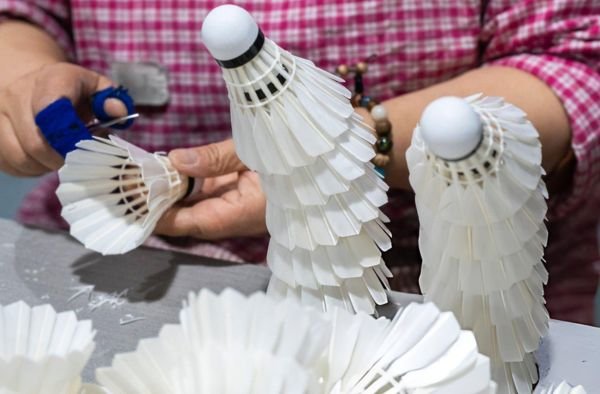
The feather is not disappearing. Not yet, at least. But badminton’s governing body is preparing for a future in which natural and synthetic shuttles coexist, with synthetic products gradually moving towards higher levels of competition if they can prove capable of matching the demands of elite players.
BWF Secretary General Thomas Lund has put a realistic timeline on that transition. “Probably not tomorrow, but within the foreseeable future, not in months, but probably in years. But still, we’re getting there.” That is perhaps the most revealing description of where badminton stands. This is not a revolution that will happen overnight. It is a technical evolution that has already been underway for years. For recreational players, switching from a feather shuttle to a synthetic one may appear relatively insignificant. At international level, it is anything but.
A feather shuttle behaves in a highly specific way. It accelerates, rotates, slows down and falls at a predictable rate. Players build entire techniques around those characteristics. A delicate net tumble, a steep smash, a defensive block or a cross-court clear can depend on how the shuttle responds in fractions of a second. BWF’s own laws reflect how precise those requirements are.
A conventional shuttle uses 16 feathers and must weigh between 4.74 and 5.50 grams, while synthetic versions are permitted provided their flight characteristics generally resemble those of a natural feather shuttle. The regulations also allow a variation in certain measurements because synthetic materials have different physical properties.
The objective is not simply to manufacture something that looks like a feather shuttle. It has to behave like one. “At this level, that’s difficult,” Lund said. “It’s not that easy to become an elite champion. Neither is it that easy to produce this top performance product synthetically,” The BWF’s interest in synthetic technology is not new.
According to Lund, work with manufacturers began around 2016-17. Early products were tested in junior competitions, including in India, but reactions were mixed. The COVID-19 pandemic subsequently interrupted the development programme. The federation has since moved towards a more structured testing process.
In April, BWF announced that synthetic shuttlecocks would be tested in live international senior competition, initially at Grade 3 level. The idea is deliberately cautious. Rather than introducing synthetic products into the biggest tournaments immediately, BWF wants to collect evidence from competitive environments and gradually assess whether they can move up the pyramid.
“We would like to test at higher and higher level to get more and more feedback also from the best players,” Lund said. That approach is important because laboratory testing can only tell part of the story. A shuttle that performs well under controlled conditions still has to survive the intensity of an international match. “It needs to be in a controlled environment,” he said. “And that’s why we want to get test results. If the test results show that we feel we can take the next step, then we will.”
The biggest obstacle may not be manufacturing. It may be trust. Elite badminton players have spent years developing an almost instinctive understanding of feather shuttles. They know how they behave at different temperatures and speeds. They know how much power is required to reach the baseline and how a shuttle will react when brushed at the net.
Even small changes can alter the game. That is why BWF does not intend to reduce the decision to a simple popularity vote among players. “Player acceptance is super important,” Lund said. “But I’m not even sure we have player acceptance of all brands of feather shuttles.”
Instead, the federation is looking at a much broader collection of performance criteria. The shuttle must have appropriate flight and speed characteristics. Shuttles from the same tube need to behave consistently. They must rotate correctly, withstand long rallies and offer sufficient durability. And eventually, manufacturers must be able to produce them in sufficient quantities at a commercially viable price.
“There are a number of criteria that go beyond just players accepting saying, ‘Oh, this is a nice product,’” Lund said. That distinction could determine whether synthetic shuttles become a genuine alternative or remain largely confined to developmental and recreational badminton. There is an understandable tendency to view the synthetic experiment as the beginning of the end for feather shuttles.
“I think it’s inevitable that we move to a combination between the two,” Lund told. That combination could ultimately become badminton’s most realistic future. Feather products may remain dominant at the highest levels where players demand absolute familiarity, while synthetic alternatives gradually expand across other levels of competition.
The technology is already moving in that direction. Synthetic-feather products have begun appearing in more competitive environments, including junior international events, giving manufacturers and governing bodies opportunities to gather real-world feedback.
Lund has personally tested the developing products and acknowledges that they are not yet perfect. “There’s differences in properties and there’s not one that is 100 per cent perfect replacement or having the exact same properties as the one we play with here,” he said. “But they’re getting up to pretty decent quality level that makes us think that it may not be that far away,”
That last phrase is perhaps the most important one. The push for synthetic technology is also linked to a broader question about the badminton supply chain. Natural feathers are a biological product. Their availability can be affected by disease outbreaks, weather, farming conditions and other disruptions. That makes long-term supply less predictable. But replacing feathers would not magically make shuttlecocks cheap.
“Replacing the feather would not suddenly eliminate all those costs. The cork, tape, string, machinery, labour and manufacturing infrastructure will still be a significant part of the costs,” Lund says.
Synthetic materials could, however, eventually offer manufacturers a more predictable production process if they can be produced consistently at scale. “We would like to help and incentivize and work with the industry to get to a point as quickly as possible where there’s a mix,” Lund said.
“That won’t be replacing the natural feather products, that will be slowly introducing a synthetic option in the market.” That is a much more measured proposition than a complete technological takeover. Badminton has changed dramatically over the years. Equipment has become lighter, rackets more powerful and training increasingly scientific. Yet the shuttlecock has remained one of the sport’s most recognisable constants. Changing it is therefore not simply an equipment upgrade. It could influence how the sport is played.
That is why BWF’s cautious approach makes sense. “I’m not even sure that we’ll just move to just synthetic feather in years to come.” The future, then, is unlikely to be a badminton court without feathers. It is more likely to be a court where the feather has competition. The real test will be whether synthetic technology can cross the final gap between being technically impressive and being invisible to the athlete. If a player can pick up a shuttle, step onto court and stop thinking about what it is made from, the experiment will have succeeded.

