
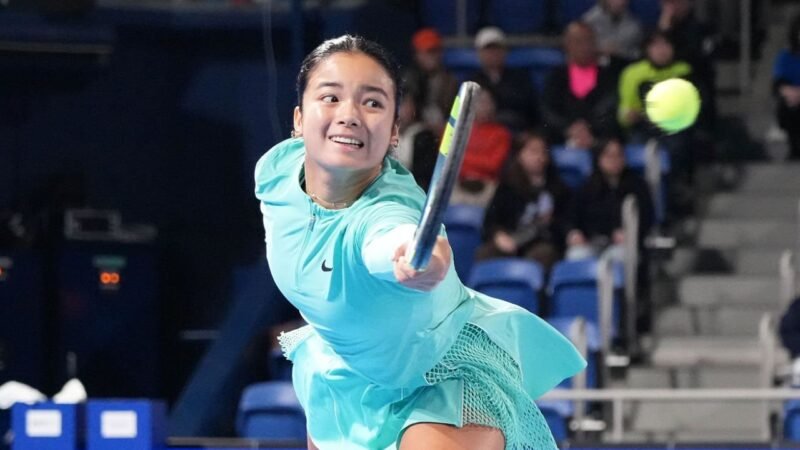

The Filipino star recovered from a set down to defeat Australia’s Talia Gibson 4-6, 6-2, 6-0, keeping her campaign alive at the Pan Pacific Open in Tokyo. Eala will now face third seed Diana Shnaider in the quarterfinals as she looks to build on her breakthrough season.
Alexandra Eala showed resilience and composure under pressure as she fought back from a difficult opening set to secure a convincing three-set victory over Talia Gibson at the Pan Pacific Open 2026 on Wednesday. The World No. 19 dropped the first set 4-6 but raised her level considerably to win the next two 6-2, 6-0 and book her place in the quarterfinals.
For Eala, the victory was particularly important after a recent run of early tournament exits threatened to interrupt her momentum. Against a determined Gibson, ranked World No. 38, the 21-year-old had to work her way back into the contest after struggling to convert opportunities in the opening set. Gibson capitalised on those missed chances to take the early advantage.
Eala, however, responded with greater aggression and improved control in the second set, finding better rhythm from the baseline and putting her opponent under sustained pressure. The shift in momentum became even more evident in the deciding set. Eala dominated the rallies, reduced her unforced errors and prevented Gibson from finding a way back into the match. The Australian failed to win a game in the final set as the Filipino completed a memorable comeback.
She described her improvement as “a gradual increase of level”, adding that the difference came from making small but important adjustments during key moments. “Maybe just a couple of small details that when accumulated make a big difference,” she said. “In one 30-all I went more for my shot or in one deuce I did so and so. “Those little details when all summed up, that’s the difference.”
The turnaround was reflected in the match statistics as well. Eala struck nine aces, won 67 per cent of her break-point opportunities and converted six of nine chances to break Gibson’s serve. She also won 83 per cent of her service games, compared to Gibson’s 50 per cent. These numbers illustrated how effectively the Filipino raised her level after the opening set.
Beyond her performance on court, Eala once again enjoyed strong support from Filipino fans in Tokyo. The 21-year-old has become one of the most followed young athletes in the Philippines, with her progress on the international tennis circuit attracting considerable attention back home. She acknowledged the role played by the crowd in helping her through challenging moments during the match. “Of course the support helps a lot all the time,” said Eala.
“It creates a great atmosphere and I think there was a bit of back and forth within the crowd. “You want to be present, you’re very invested in the match so it comes naturally to focus.” Eala’s growing profile follows a breakthrough period in her career. She made history by becoming the first Filipino player to win a WTA Tour singles title, achieving the milestone in August. Her performances have also helped bring increased attention to tennis in the Philippines, with the young star continuing to establish herself among the sport’s rising names.
The next challenge for Eala will be considerably tougher as she prepares to face Russian third seed Diana Shnaider in the quarterfinals. Shnaider booked her place in the last eight with a 6-3, 5-7, 6-3 victory over Belarusian Aliaksandra Sasnovich. The Russian showed resilience after dropping the second set before regaining control in the decider. The quarterfinal will also offer Eala an opportunity to respond after losing to Shnaider 7-5, 6-4 in the second round of the Ningbo Open just a week earlier. The Tokyo meeting gives the Filipino a chance to turn that result around and move one step closer to the semifinals.
The Pan Pacific Open is a WTA 500 tournament played on outdoor hard courts and forms part of the Asian swing of the women’s tennis calendar. With 500 ranking points on offer to the champion, a deep run in Tokyo would provide a valuable opportunity for Eala to strengthen her position on the tour. For Eala, the significance of this victory extends beyond reaching another quarterfinal. Her ability to recover after losing the opening set, make tactical adjustments and produce a dominant final set reflects an important aspect of her development as a player.
The Filipino has already demonstrated that she can compete against established names on the WTA Tour. The next step is translating that potential into consistent results, particularly during the demanding Asian swing. The quarterfinal against Shnaider will be an important test of that progress. Having lost their previous meeting in Ningbo, Eala now has an opportunity to demonstrate how quickly she can learn from setbacks. Her comeback against Gibson has provided the momentum, but the challenge ahead will demand another composed performance.
