

History was made in European women’s football as BK Häcken etched their name into the record books by becoming the first-ever champions of the UEFA Women’s Europa Cup. The Swedish side secured a 4-2 aggregate victory over domestic rivals Hammarby IF, marking a landmark moment not only for the club but also for Swedish football as a whole.
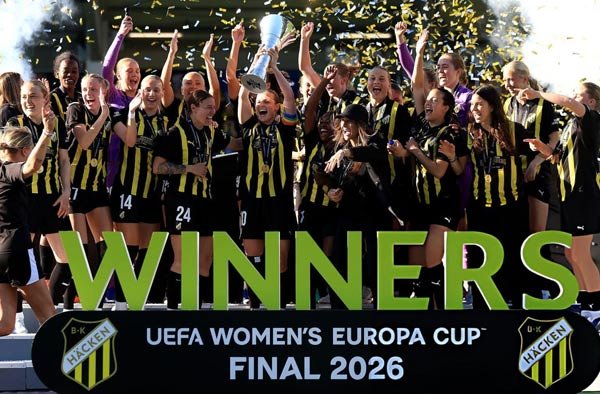
The final, contested over two legs, showcased both tactical discipline and attacking flair. Häcken entered the second leg with a slender advantage after a 1-0 win in Stockholm, courtesy of a decisive strike from rising star Felicia Schröder. The return leg at Hisingen Arena in Gothenburg delivered drama, intensity, and a breakout performance from the young forward, who scored a stunning hat trick in a 3-2 victory to seal the title.
From the opening whistle in the second leg, Häcken demonstrated intent. Within the first ten minutes, Schröder found the net twice, capitalising on quick transitions and clinical finishing. Her early goals shifted the momentum firmly in Häcken’s favour and forced Hammarby to chase the game despite their own strong attacking approach. Hammarby, however, refused to fade. A tactical adjustment early in the match, including the introduction of teenage midfielder Fanny Patterson, injected energy into their play. Their persistence paid off when Svea Rehnberg pulled one back with a well-placed header, giving the visitors renewed belief.
The second half brought even more intensity. Hammarby continued to press and found an equaliser in the second leg through Erin Sørum, again from an aerial situation. At that stage, the aggregate scoreline tightened, and the contest appeared finely balanced. Yet, it was Schröder who once again rose to the occasion. In the 54th minute, she combined effectively with Anna Anvegård before curling a precise finish into the corner, completing her hat trick and restoring Häcken’s control of the tie. Her performance not only secured the trophy but also underlined her status as one of the most promising young forwards in the women’s game. Schröder finished the tournament as the top scorer with eight goals and has been in prolific form overall, having scored 42 goals in 41 matches during the 2025 season. Her ability to deliver in high-pressure moments has quickly made her a player to watch on the European stage.
This triumph carries added historical significance. Häcken became the first Swedish club to win a UEFA women’s club competition since Umeå IK dominated the early 2000s, lifting back-to-back titles in the 2002/03 and 2003/04 UEFA Women’s Cups. With this victory, Sweden now boasts five different clubs that have reached a UEFA women’s club final, surpassing Germany’s previous record of four and highlighting the country’s deep-rooted strength in women’s football.
Häcken’s journey to the title was far from straightforward. After narrowly missing out in the Women’s Champions League qualifying rounds against Atlético de Madrid Femenino, they transitioned into the Europa Cup and dominated the competition. Convincing wins over teams such as Katowice, Inter, Breidablik, and Eintracht Frankfurt showcased their attacking depth and defensive organisation.
Behind this success is head coach Elena Sadiku, whose impact since taking charge in December has been remarkable. A former player forced to retire early due to injury, Sadiku has quickly built a reputation as one of the brightest young coaches in the game. Prior to joining Häcken, she led Celtic to a domestic league title in 2024, and her transition to Swedish football has been seamless. Under her leadership, the team has lost just once in competitive matches, reflecting both tactical clarity and strong squad management. The final itself highlighted contrasting styles. Häcken thrived on quick counter-attacks and efficient finishing, while Hammarby focused on possession and aerial strength. The balance between these approaches made for an engaging contest and a fitting conclusion to the tournament’s inaugural edition.
While the competition has drawn some criticism regarding limited broadcast accessibility and coverage, its conclusion has undeniably provided a platform for emerging talent and clubs outside the traditional European elite. UEFA’s introduction of the Women’s Europa Cup is seen as part of a broader effort to expand opportunities and visibility within the women’s game. For Häcken, this victory is more than just a trophy. It is a statement of ambition and progress, both for the club and for Swedish women’s football. As celebrations begin in Gothenburg, the focus will soon shift to building on this success and competing at an even higher level in European competitions.
For now, though, the spotlight belongs firmly to Häcken and their young star Felicia Schröder, whose unforgettable performance ensured their place in history as the first champions of a new era in European women’s football.

