

As the race for a place in the ICC Women’s T20 World Cup semi-finals intensifies, South Africa delivered a statement performance when it mattered most. Backed by a sensational maiden T20 International century from opener Tazmin Brits, the Proteas overwhelmed the Netherlands by 88 runs in Bristol to keep their qualification hopes firmly alive and set up a dramatic finish in Group 1.
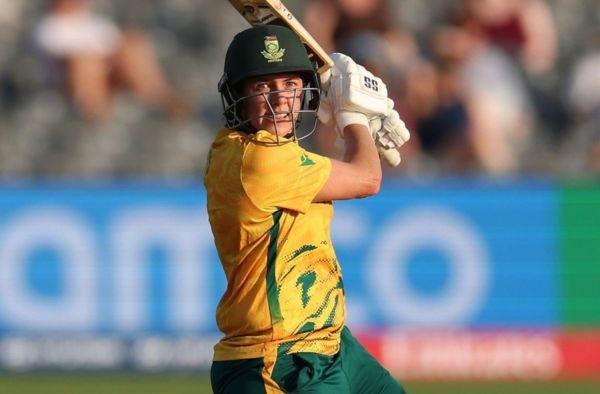
With pressure mounting after mixed results earlier in the tournament, South Africa needed a convincing victory to stay in contention. They responded in emphatic fashion, posting one of their highest totals of the competition before producing a disciplined bowling performance to secure a comprehensive win. The star of the evening was undoubtedly Brits, whose unbeaten 114 off 69 deliveries was the innings of her career and one of the finest knocks seen in this edition of the Women’s T20 World Cup.
Opening the innings alongside captain Laura Wolvaardt, Brits showed positive intent from the very beginning. She attacked the Netherlands bowlers with authority, finding gaps with ease and punishing anything loose. By the end of the powerplay, she had already raced to 37 runs, helping South Africa reach a strong platform from which they never looked back.
Her innings was a masterclass in controlled aggression. Mixing elegant strokeplay with calculated power-hitting, Brits struck 15 boundaries and three sixes while carrying her bat through the entire innings. Her hundred came in the 18th over when she launched a delivery over long-on for her first six of the innings, bringing up a memorable milestone in style.
The century was particularly significant given the journey behind it. Making her 82nd T20I appearance since debuting in 2018, Brits had long been one of South Africa’s most reliable batters without reaching three figures in the format. The landmark innings also saw her become only the second South African woman after Laura Wolvaardt to surpass 2,000 career T20I runs.
The opening partnership between Brits and Wolvaardt laid the foundation for South Africa’s imposing total. The duo added 121 runs for the first wicket, frustrating the Dutch bowlers and ensuring there was no early breakthrough.
Wolvaardt, who has been among the most consistent batters in international cricket over the last few years, contributed a fluent 45 before falling just short of another half-century. Her partnership with Brits showcased the understanding and chemistry that has become one of South Africa’s greatest strengths in white-ball cricket.
Even after Wolvaardt’s departure, the momentum never slowed. Annerie Dercksen provided valuable support with a brisk 37, adding another 87 runs alongside Brits. The pair accelerated in the latter stages, pushing South Africa beyond the 200-run mark and effectively taking the game away from the Netherlands before the chase had even begun.
The final total reflected South Africa’s dominance and underlined why they remain one of the strongest contenders in world women’s cricket.
To their credit, the Netherlands refused to surrender quietly. Openers Phebe Molkenboer and Sanya Khurana approached the chase positively, taking advantage of the batting-friendly conditions and scoring at a healthy rate during the powerplay. Their aggressive intent briefly raised hopes of a competitive pursuit as they brought up 50 runs in the first six overs.
The Netherlands continued to fight through contributions from Sterre Kalis, currently the only full-time professional cricketer in the Dutch squad. Kalis played with composure and helped steady the innings as the European side crossed the 100-run mark in the 15th over.
At 100 for 1, the Netherlands had shown resilience and determination despite the daunting target. However, the required run rate had climbed well beyond reach, forcing the batters into increasingly risky strokes.
That pressure eventually triggered a dramatic collapse. South Africa’s experienced bowling attack tightened its grip and exposed the middle and lower order. The Netherlands lost seven wickets for just 20 runs as the chase unravelled rapidly. Veteran seamer Ayabonga Khaka led the attack brilliantly, returning figures of 3 for 19. Her accuracy and ability to strike at crucial moments prevented any chance of a late fightback.
Meanwhile, one of the tournament’s most inspiring stories continued as Shabnim Ismail enhanced her remarkable legacy. Having come out of retirement specifically for this World Cup campaign, the pace spearhead claimed another wicket to take her tally to 48 Women’s T20 World Cup wickets, equalling the all-time tournament record held by Australian fast bowler Megan Schutt.
The victory has major implications for the semi-final race. South Africa’s superior net run rate and convincing win mean they remain firmly in contention heading into the final round of group matches. Their fate is now closely linked to the outcome of India’s clash against Australia. Should India fail to defeat the defending champions, South Africa will have a strong opportunity to advance, particularly if they complete the job against Bangladesh in their final group-stage fixture.
For South Africa, the win was about far more than two points. It was a reminder of the team’s ability to deliver under pressure, the value of experience in major tournaments, and the growing influence of players such as Tazmin Brits.
On a night when every run mattered, Brits produced an innings for the ages. Her unbeaten century not only powered South Africa to a commanding victory but also ensured the Proteas remain firmly in the hunt for a place in the Women’s T20 World Cup semi-finals.

