

For India, the 2026 Hockey World Cup will not simply be a test of how well they can survive the knockout rounds. It will be a test of how well they can build momentum from the very first match.
The reason is simple: the traditional quarterfinal safety net is gone. The FIH Hockey World Cup, jointly hosted by the Netherlands and Belgium from August 15 to 30, will feature 16 teams in both the men’s and women’s competitions. But unlike the 2018 and 2022 editions, the tournament will not move directly from the opening pools into quarterfinals. Instead, teams will have to navigate a second group stage before the semifinals.
The change fundamentally alters the stakes of the opening week. The 16 teams are divided into four pools of four. The top two teams from each pool advance to the second stage, where they are split into two groups of four. Teams from Pools A and D will form one group, while those from Pools B and C will form the other. The top two teams from each of those second-stage groups will then reach the semifinals. India’s men’s team has been drawn in Pool D alongside England, Pakistan and Wales. The women’s side, meanwhile, will face China, England and South Africa in Pool D.
That makes the opening three matches particularly important. India men’s head coach Craig Fulton has already underlined why the first phase cannot be treated as a mere qualification exercise. “The format of this tournament has obviously changed drastically – from having quarterfinals to not having them.
So the emphasis on the pool games is really, really important, because it’s obviously the top two that go through. And the head-to-head result between those two teams matters: if one beats the other, those three points carry into the next round, and that puts you in the driving seat to get out of the next group and into the semifinals,” said Fulton.
The crucial detail is the carry-over system. In the second group stage, each team plays two new opponents, while its result against the team it has already faced in the opening pool is carried forward. That means a strong opening performance can provide an advantage later, while an early defeat could continue to haunt a team even after it qualifies.
For India, this gives the Pool D encounters against England, Pakistan and Wales added significance. The objective will not merely be to finish among the top two. Finishing strongly could determine how favourable their position is when the second phase begins.
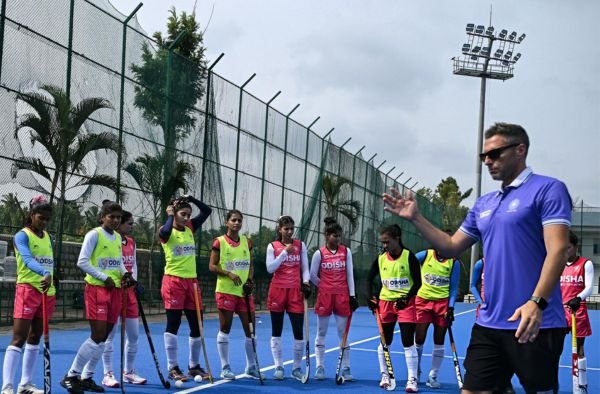
The women’s tournament follows exactly the same structural principle. India are grouped with China, England and South Africa, with the top two progressing into the second stage. Sjoerd Marijne, who returned as India’s women’s head coach earlier this year, has questioned whether removing the quarterfinals takes away one of the most compelling elements of a World Cup.
“It’s an interesting draft schedule, but my preference is to have quarterfinals in a tournament format. I understand that for higher-ranked teams in the world they will prefer this, but I think quarterfinal matches are among the most exciting matches in a tournament,” said Marjine, who is back in-charge of the team since the start of the year. The new system is not entirely unfamiliar to international hockey.
The FIH had previously experimented with a 16-team format involving pool stages and crossovers before the quarterfinal system was used in recent editions. The 2018 World Cup, for instance, featured four pools of four, with the pool winners progressing directly to the quarterfinals and teams finishing second and third playing crossover matches for the remaining quarterfinal places.
This year’s format instead prioritises sustained performance across multiple matches. The tournament will also have a distinctive setting, with Amsterdam’s iconic Wagener Stadium and the new Belfius Hockey Arena in Wavre serving as the principal venues. Both the men’s and women’s World Cups will be staged alongside the inaugural FIH Para Hockey World Cup, adding another dimension to an event that FIH has positioned as a celebration of hockey across disciplines.
For India, however, the equation remains straightforward. Win early. Avoid unnecessary dropped points. And, above all, make sure the opening pool matches create an advantage rather than a problem.
Under the new World Cup format, there may be no quarterfinal to rescue a slow start. Every point earned in the opening pool could eventually become a step towards the semifinal. And every mistake could follow India further than expected.

