

For 15 years, Indian women’s doubles waited for another World Championships medal. On Saturday, Treesa Jolly and Gayatri Gopichand did more than end that drought. They challenged an assumption that has quietly followed Indian badminton for years: that the country’s biggest breakthroughs will always come from singles.
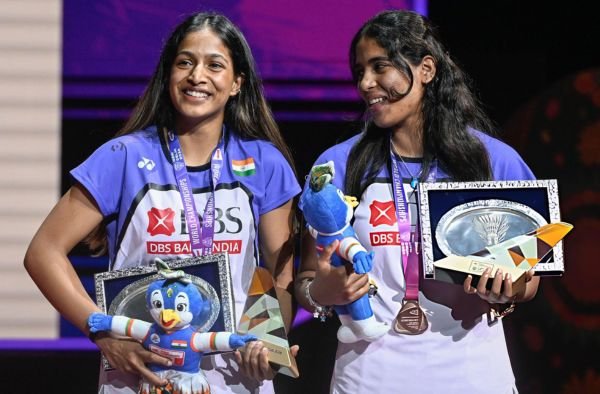
Their bronze medal at the BWF World Championships in New Delhi is therefore not simply another entry in India’s medal tally. It is a statement about where Indian badminton can go next. The unseeded Treesa-Gayatri combination reached the semifinals before losing to world No. 1 and defending champions Liu Sheng Shu and Tan Ning of China. The Indians won the opening game 21-18 before the Chinese pair recovered to win 13-21, 8-21.
They lost the semifinal But they won the larger battle. The significance of Treesa and Gayatri’s bronze lies beyond the medal itself. Indian badminton has spent years building a reputation around singles stars, while women’s doubles has often been treated as a secondary success story. This run should force a rethink. The next generation of Indian doubles players needs the same investment, patience and belief that helped create the country’s singles revolution. The timing makes the achievement even more striking.
Treesa returned to competitive badminton after an ankle injury suffered in April, while the pair entered the World Championships ranked 39th in the world and without a seeding. They were hardly the obvious candidates for a podium finish. Yet, over the course of the tournament, they defeated three seeded pairs on their way to the semifinals, turning what could have been a routine home appearance into one of India’s most memorable performances of the championships.
Their quarterfinal victory over Japan’s seventh-seeded Rin Iwanaga and Kie Nakanishi was particularly important. They won in straight games, putting themselves one victory away from a medal and demonstrating that their campaign was not built simply on favourable draws.
Then came the semifinal. For one game, the possibility of an even greater upset was real. Against the world’s best pair, Treesa and Gayatri played with the freedom that had characterised their run. They took the first game 21-18 and suddenly the defending champions were under pressure. But this is where the gap between promising contenders and established champions became visible. Liu and Tan adjusted.
The Chinese pair increased the pressure, forced the Indians into more defensive positions and gradually took control. After the Indians lost momentum in the second game, the third became increasingly one-sided. The final scoreline, 21-18, 13-21, 8-21, tells the story of a contest in which India came close enough to believe, but not yet close enough to finish the job.
And perhaps that is the most valuable part of the experience. Treesa and Gayatri have now seen what the very top of women’s doubles demands. The Chinese pair are not simply technically superior. Their ability to change pace, maintain attacking pressure and punish small lapses is precisely what separates world champions from challengers. Liu and Tan have been one of the dominant combinations in the discipline, and their aggressive style has become a benchmark for the modern women’s doubles game. For India, the lesson is not that Treesa and Gayatri are far away.
The bronze also ends a long wait. India’s previous women’s doubles medal at the World Championships came in 2011, when Jwala Gutta and Ashwini Ponnappa won bronze in London. Fifteen years later, Treesa and Gayatri have put another Indian women’s doubles pairing on the podium. That gap should not simply be celebrated. It should be questioned.
Why did India have to wait so long?
The answer is complicated, involving the enormous popularity and commercial pull of singles, the demands of doubles-specific training and the need to develop partnerships that can survive the pressures of international competition. But this medal provides evidence that the investment is worth making.
Gayatri carries her own unusual burden as the daughter of former All England champion and national coach Pullela Gopichand. Her coach B Sumeeth Reddy has spoken about the weight attached to that surname and the expectations surrounding her career. This medal gives Gayatri something more valuable than recognition as someone’s daughter: an achievement entirely her own.
For Treesa, meanwhile, the medal represents resilience of another kind. Returning from injury and immediately producing a World Championships run of this magnitude requires physical recovery, but also belief.
India’s chief national coach Pullela Gopichand has credited the pair’s breakthrough to six weeks of focused preparation, tactical adjustments, patience and confidence. That detail should matter to Indian sport. Breakthroughs rarely happen overnight. They are usually the visible result of months and years of work that nobody sees. The bronze medal is therefore not the end of Treesa and Gayatri’s story. It may be the beginning of its most interesting chapter.
They have beaten seeded opponents. They have reached a World Championships semifinal. They have taken a game off the world’s No. 1 pair on the biggest stage. Most importantly, they now know that they belong there. There is nothing wrong with celebrating this achievement. In fact, India should celebrate it loudly. But the purpose of a breakthrough is to create belief for what comes next.
Treesa and Gayatri have already shown that they can challenge the world’s best. Now they must learn how to finish the job. And Indian badminton must ensure they do not have to wait another 15 years for company on that podium.

