

The US Open is doing something increasingly rare in modern sports: rebuilding its most important stadium without tearing it down. Arthur Ashe Stadium, the 24,000-seat centrepiece of the Billie Jean King National Tennis Center, is undergoing an $800 million transformation that will continue through the 2027 US Open.
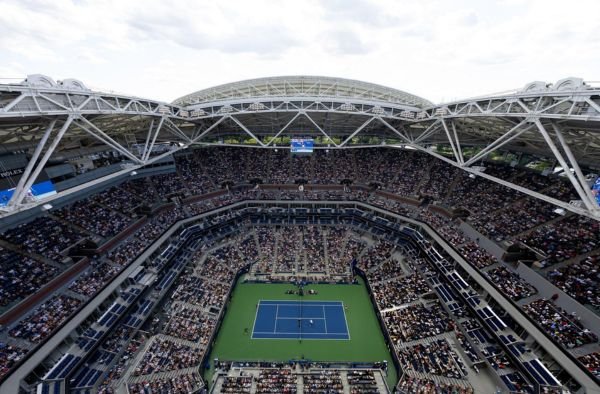
The project is the largest single investment in US Open history and is being funded entirely by the United States Tennis Association, without public or taxpayer money. Combined with the previous transformation completed in 2018, the USTA says its investment in the tournament and its home has approached $2 billion. That is not simply a stadium renovation. It is a statement about how the world’s biggest sporting events increasingly have to think about their venues.
The most impressive part of the Ashe project is not the $800 million price tag. It is the decision to evolve an iconic venue rather than replace it. The US Open understands that a modern sports stadium has to serve three audiences simultaneously: the fan, the athlete and the commercial partner. Arthur Ashe is being redesigned around all three, while preserving the identity that made it special in the first place. The 2025 US Open attracted a record 1,144,562 spectators across the three weeks, a 9 per cent increase from the previous year and the second consecutive year the tournament crossed the one million attendance mark.
When more than a million people pass through a sporting campus in three weeks, a stadium can no longer be designed simply around what happens for the two or three hours of a match. The experience begins before the first serve. It continues through food, retail, hospitality and entertainment and it ends long after the final point. That is the thinking behind the transformation of Ashe.
TB he project is being delivered in three phases so that the US Open can continue operating throughout construction. The current phase includes a rebuilt courtside bowl and new suite levels, while the final phase will deliver modernised concourses, additional escalators and elevators, improved food and beverage areas, retail spaces and expanded restroom access.
One of the most visible changes for fans in 2026 is the addition of 2,000 courtside seats, expanding the courtside experience from 3,000 to 5,000 seats. The promenade-level concourse is also being expanded by 40 per cent. But this is where the project becomes particularly interesting. The USTA is not simply adding capacity. It is moving people closer to the action and creating more premium experiences around them.
HOK, which has worked with the USTA since 1990 and was involved in the original Arthur Ashe Stadium, the campus master plan and the stadium’s retractable roof, describes the current work as an in-place transformation. Rather than demolishing Ashe, major sections of the existing structure are being rebuilt between tournaments.
That is an extraordinary logistical exercise. The stadium has to remain recognisable to fans while simultaneously becoming almost entirely different beneath them. And the philosophy extends beyond the stadium itself. Alongside the renovation is a $250 million Player Performance Center, scheduled to be ready for the 2027 tournament.
The facility will bring fitness, recovery, medical care, dining, locker rooms and player lounges together in one purpose-built location next to the practice courts. That shift is important because elite sport is no longer just about the competition arena. Athlete preparation has become an industry in itself. Sleep, recovery, nutrition, strength training, physiotherapy, mental preparation and performance analytics all influence what happens on court. The new centre is being designed around that reality.
The USTA has already signalled where this is heading through its partnership with Oura, which will become a founding partner of the Player Performance Center and operate a dedicated wellness and recovery area when the facility opens. The message is clear: the modern Grand Slam venue must optimise not only the spectacle for spectators, but the conditions in which athletes perform.
There is also a commercial logic to the transformation. Premium hospitality is becoming an increasingly important part of the economics of major sporting events. Arthur Ashe will eventually feature two dedicated suite levels and nine new courtside clubs with bars and dining areas.
The expanded concourses are being designed to encourage fans to spend more time on the grounds rather than simply move between their seats and the exits. As HOK’s designers have argued, sports venues are increasingly being designed around the fan’s entire day rather than just the match itself. At the US Open, spectators can spend six hours or more on the grounds, making dining, circulation, entertainment and social spaces almost as important to the experience as the seat itself. This is where the US Open has perhaps been more forward-thinking than many traditional sporting venues.
The tournament has gradually transformed its campus from a collection of tennis courts into a sports and entertainment destination. More than 85 per cent of the National Tennis Center was remade during its earlier decade-long master plan, while the campus expanded from 42 to 46 acres. The retractable roof added in 2016 solved one of the tournament’s biggest operational problems without changing the building’s fundamental identity. The current project follows the same principle: improve the infrastructure while preserving the icon.
That is what makes the $800 million investment more interesting than its headline number. The USTA is not betting that fans will come because Arthur Ashe is new. It is betting that they will come because Arthur Ashe remains Arthur Ashe, only better. The first glimpse of that future arrives at the 2026 US Open. The complete transformation will be unveiled in 2027. By then, the stadium should look different, feel different and function differently. But the court will remain where it has always been.

