

Barcelona’s defence of the Women’s Champions League title will begin with an old rival waiting on the other side of the draw.
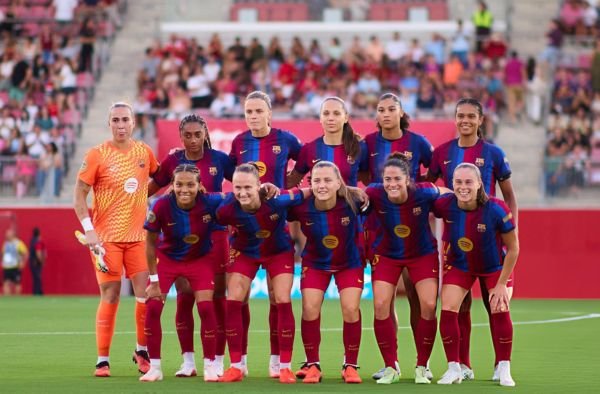
The holders have been paired with Arsenal in the 2026-27 league phase, setting up an early rematch of the 2025 final and immediately giving Europe’s revamped competition one of its most anticipated fixtures. The draw in Nyon on Friday placed Barcelona alongside Arsenal, Paris FC and Servette at home, while the Spanish champions will travel to Bayern Munich, Roma and HB Køge. Arsenal, meanwhile, have been handed home fixtures against OL Lyonnes, Benfica and HB Køge, with trips to Barcelona, Paris FC and Inter Milan completing their six-match schedule.
For Arsenal, the Barcelona trip will carry an obvious sense of unfinished business. The Gunners have established themselves among Europe’s elite in recent seasons, but Barcelona’s dominance has repeatedly stood between them and continental glory. The latest draw means Arsenal will not have to wait until the knockout rounds for another examination against the reigning champions. Barcelona enter the campaign as the holders and the top seeds, but this is not quite the same Barcelona that dominated Europe in recent years.
The Catalan club will begin their first European campaign without Alexia Putellas, who has been central to Barcelona’s rise and had appeared in at least one Champions League match in each of the club’s previous 14 European campaigns. Barcelona won last season’s final 4-0 against OL Lyonnes in Oslo to claim their fourth Women’s Champions League crown. That transition gives the draw an added layer of intrigue. Barcelona remain the team to beat, but their opponents will now have greater reason to believe that the gap can be closed. Arsenal will have the opportunity to test that theory when the two sides meet on November 11 at Barcelona.
Arsenal’s opening assignment, however, comes much earlier. They begin their league phase at home against HB Køge on September 22 before travelling to Paris FC on September 30. Benfica visit North London on October 28, followed by the trip to Barcelona, a home meeting with OL Lyonnes on November 19 and an away game against Inter on December 16.
That schedule offers little room for complacency. OL Lyonnes, the eight-time champions and last season’s runners-up, have also received a difficult set of fixtures. The French side will visit Arsenal, Juventus and Servette while hosting Chelsea, Häcken and Inter. Chelsea, meanwhile, face Paris Saint-Germain, Roma and Austria Wien at home, with away fixtures against OL Lyonnes, Häcken and OH Leuven. Manchester City will host Paris Saint-Germain, Real Madrid and Austria Wien and travel to Bayern Munich, Häcken and Inter. Real Madrid’s route is arguably one of the most demanding. They will host both Paris clubs and Inter while travelling to Bayern Munich, Roma and Manchester City.
The league phase format means every match carries greater importance than a traditional group-stage fixture. The 18 clubs have been divided into three seeding pots, with each team drawn against two opponents from each pot. Each club plays three matches at home and three away, facing six different opponents rather than playing the same three teams twice. The opening round takes place on September 22 and 23, with the second matchday following on September 30 and October 1. The league phase continues through October and November before concluding with a simultaneous final matchday on December 16.
The stakes are straightforward. The top four teams in the final league table qualify directly for the quarter-finals. Teams finishing fifth through 12th enter the knockout phase play-offs, where the remaining four quarter-finalists will be decided. The competition will then accelerate towards the business end, with the quarter-finals scheduled for March and April, the semi-finals in May and the final set for Warsaw’s National Stadium on May 28, 29 or 30, 2027. It will be the first UEFA women’s club competition final staged in Poland.
The most intriguing storyline from this draw is not simply Barcelona versus Arsenal. It is whether Barcelona can remain Europe’s undisputed standard during a period of transition. The holders have dominated the competition to an extraordinary degree, reaching six consecutive finals and winning four titles. Yet the departure of Putellas changes the texture of the challenge. Barcelona still possess elite quality, but their opponents will believe that a team undergoing change can be exposed. Arsenal, therefore, could not have asked for a more revealing fixture.
Their meeting in November will provide an early measurement of whether the European hierarchy is shifting. Arsenal have already shown they can compete at this level, while OL Lyonnes, Bayern Munich, Chelsea, Manchester City, Paris Saint-Germain and Real Madrid all have ambitions of their own. And that is what makes this new league phase so compelling.
There are no easy stretches of European football anymore. Six matches, six different opponents and a league table that rewards consistency mean one poor night can have consequences months later.

