

P.V. Sindhu began her Arctic Open campaign with a commanding straight-games victory, while Tharun Mannepalli and Rounak Chouhan battled through qualifying to keep India’s men’s singles hopes alive at the BWF Super 500 tournament. For Sindhu, the opening round in Finland was less about survival and more about making a statement. The two-time Olympic medallist and former world champion produced a clinical performance against Canada’s Wen Yu Zhang, winning 21-8, 21-11 in just 28 minutes to advance to the women’s singles second round.
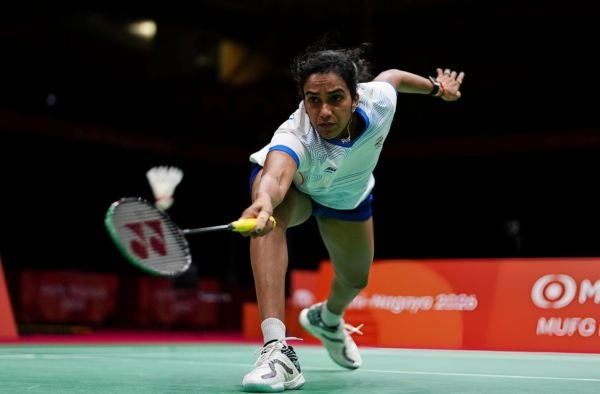
Sindhu immediately established control of the contest, using her height, reach and attacking game to keep Zhang under pressure. The Indian rarely allowed her opponent to settle into long exchanges and moved through the opening game with considerable authority. The second game followed a similar pattern. Zhang attempted to stay within touching distance, but Sindhu’s consistency and ability to accelerate rallies ensured there was no late comeback. The victory continues an encouraging phase for Sindhu, who won the Japan Open in July and remains one of India’s most experienced players on the BWF World Tour.
Her next challenge will be either Chinese Taipei’s Lin Hsiang Ti or Japan’s Riko Gunji. For Sindhu, the Arctic Open represents another opportunity to build momentum against a field featuring several established names. The tournament is part of the BWF World Tour, where Super 500 events sit in the second tier of regular World Tour tournaments behind the Super 1000 and Super 750 categories. The BWF World Tour structure brings together the leading players across the season and offers ranking points and prize money crucial to qualification for the season-ending World Tour Finals.
Unnati Hooda, Ashmita Chaliha fall in tight contests. While Sindhu progressed comfortably, India’s other women’s singles players endured very different fortunes. Unnati Hooda was involved in one of the closest matches of the day before losing to China’s Han Qian Xi 16-21, 21-15, 22-24. The Indian fought back after dropping the opening game and forced a deciding game, where neither player was able to establish a decisive advantage.
Hooda eventually fell narrowly at 22-24, leaving China with a hard-earned victory. Ashmita Chaliha suffered a similarly close defeat against seventh seed Line Christophersen of Denmark. Chaliha lost 7-21, 21-14, 24-26 after recovering strongly from a one-sided opening game. The two defeats highlighted the fine margins separating the Indian contingent from progression, with both players taking their opponents deep into deciding games.
Malvika Bansod, meanwhile, came through qualifying after defeating Chinese Taipei’s Sung Shuo Yun 21-15, 14-21, 21-14. Her main-draw campaign, however, ended in the opening round against Scotland’s Kirsty Gilmour, who prevailed 21-18, 21-13. Tharun, Rounak battle into men’s singles main draw. India’s men’s singles campaign received a boost as Tharun Mannepalli and Rounak Chouhan successfully negotiated qualifying.
Mannepalli produced one of the more notable results of the qualifying rounds by defeating Belgium’s second seed Julien Carraggi 21-12, 19-21, 21-13. After dropping the second game, Mannepalli regained control in the decider and closed out the match to book his place in the main draw. He will next face Denmark’s Magnus Johannesen.
Chouhan also needed three games to secure qualification, overcoming Israel’s Daniil Dubovenko 18-21, 21-17, 21-19. His reward is a difficult main-draw assignment against China’s Weng Hong Yang. The progression of both Mannepalli and Chouhan gives India additional representation in the men’s singles draw, particularly as the tournament moves towards the more demanding stages.
Sindhu’s experience meets India’s next generation. The most interesting storyline from India’s opening day is the contrast between Sindhu’s established experience and the emerging generation fighting for their place on the international circuit. At 31, Sindhu remains one of India’s biggest names in badminton and has already experienced the pressure of Olympic finals, World Championships and major BWF World Tour events.
Her straight-games victory showed the value of that experience, particularly in an opening-round match where the expectation is firmly on the higher-ranked player. At the other end of the spectrum, Mannepalli and Chouhan are attempting to establish themselves at precisely these tournaments. Their victories in qualifying may not carry the same headline value as Sindhu’s win, but progressing through a Super 500 event represents an important opportunity to test themselves against higher-ranked opposition.
The day also exposed the narrow margins in international badminton. Hooda and Chaliha were both within two points of victory in their deciding games, while Mannepalli and Chouhan demonstrated the ability to recover after losing their opening games. For Sindhu, however, the immediate objective is clear.
Having dispatched Zhang in 28 minutes, she now turns her attention to the second round with the expectation that the level of opposition will increase. India’s Arctic Open campaign has therefore begun with contrasting narratives: Sindhu’s experience delivering a routine victory, young Indian players battling through qualifying and several close defeats leaving the women’s singles draw thinner than expected.
With the tournament progressing, Sindhu will remain India’s biggest singles hope in Finland. But the emergence of Mannepalli and Chouhan offers another storyline to follow as India’s next generation looks to make an impression on the BWF World Tour.
