
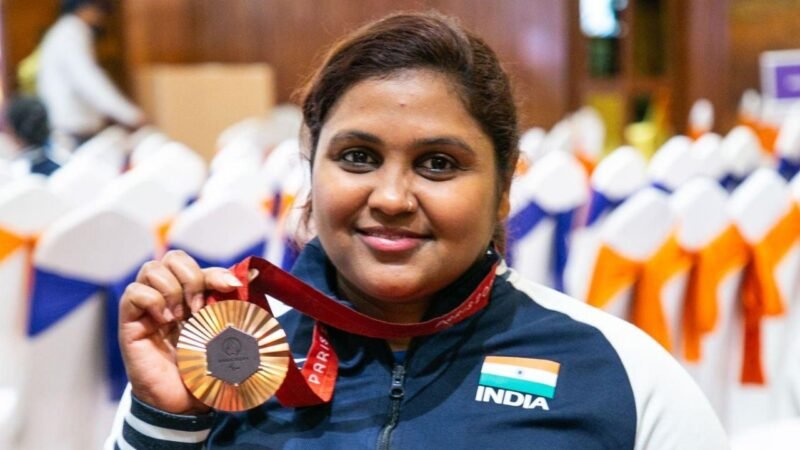

India’s Mona Agarwal continued her remarkable run at the Aichi-Nagoya 2026 Asian Para Games by rewriting the world record in the women’s 50m rifle 3 positions SH1 final on Friday. The Indian para-shooter scored 357.5 at the Aichi Prefecture General Shooting Gallery to secure her second gold medal of the competition, surpassing Sweden’s Anna Benson’s previous world record of 356 set in Novi Sad in July 2026.
The 38-year-old’s latest triumph also bettered the Asian record of 355.7 set by South Korea’s Lee Yunri in Changwon last month. China’s Zhang Cuiping claimed silver with 353.7 points, while South Korea’s Kim Miyoung took bronze with 344.4. India’s Avani Lekhara finished fourth with 333.2 points.
For Agarwal, the victory was another statement of her growing stature in international para shooting. Having already claimed gold in the women’s 10m air rifle standing SH1 event earlier in the Games, she added another title through a performance built on consistency, composure and precision.
Agarwal’s route to gold was particularly impressive given that she had qualified sixth for the final with a score of 566-17x. Lekhara, meanwhile, topped the qualification standings with 580-24x, setting an Asian Para Games qualification record. However, the final presented a different challenge, and Agarwal produced her best when the stakes were highest.
She began with 101.4 in the kneeling series before moving to 203.5 after the prone series. The standing rounds then became crucial as the Indian shooter continued to build her score and maintain pressure on the field. Agarwal progressed through cumulative scores of 256.5 and 307.3 in the early standing stages before continuing her climb through 317.7, 328.0, 338.1 and 347.7. Her final series took her to 357.5, confirming a record-breaking victory.
The margin at the top was significant. Zhang’s 353.7 left her 3.8 points behind the Indian, while Kim finished further back in third. The result also made Agarwal the first Indian woman to win an Asian Para Games medal in the women’s 50m rifle 3 positions event, according to tournament coverage. Agarwal’s latest achievement followed her victory in the women’s 10m air rifle standing SH1 event, where she scored 250.0 to win gold and establish a Games record.
Lekhara finished second with 249.6, giving India a one-two finish in the event. The two gold medals highlight Agarwal’s ability to deliver across different rifle disciplines. While the 10m air rifle event tests precision over a shorter distance, the 50m rifle 3 positions competition requires athletes to perform in kneeling, prone and standing positions, placing a premium on control, adaptability and sustained concentration.
The SH1 classification is for athletes with certain upper or lower limb impairments who can support the firearm themselves without a shooting stand or gallows. It is a demanding discipline in which technical consistency and the ability to manage pressure can determine the outcome.
Agarwal’s rise in para shooting has been swift. Born in Sikar, Rajasthan, and based in Jaipur, she contracted polio as an infant, affecting both her lower limbs and leaving her dependent on a wheelchair. Before taking up rifle shooting in December 2021, she competed at state level in shot put, discus throw, javelin and weightlifting.
Her transition into shooting opened a new chapter in her sporting career. She made her international breakthrough at the 2023 World Cup in Osijek, Croatia, and followed it with a gold medal and an Asian record at the 2024 World Cup in New Delhi. At the Paris 2024 Paralympic Games, she won bronze in the women’s 10m air rifle standing SH1 event, a result documented by the International Paralympic Committee.
Her latest double-gold performance in Japan adds another defining chapter to that journey and reinforces India’s growing presence in international para shooting. Mona Agarwal’s world record is not just a medal-winning performance. It is a powerful example of how elite sport rewards preparation, adaptability and the ability to deliver when the pressure is greatest.
Her sixth-place qualification position could have made the final an uphill task, but she transformed the contest through a measured performance across all three positions. That ability to peak when it matters is what separates a strong competitor from a champion. The wider significance lies in the visibility such performances bring to para sport. Agarwal’s achievement deserves recognition not only for the record and gold medal, but also for what it represents for aspiring athletes who may see a pathway into elite competition through her journey.
As India continues its campaign at the Asian Para Games, her two gold medals provide a major boost to the shooting contingent. More importantly, they reinforce the need to sustain investment in coaching, facilities, international competition and pathways for para-athletes. For Agarwal, the immediate reward is a place in the record books. For Indian para shooting, her performance is another reason to look ahead with ambition.

