
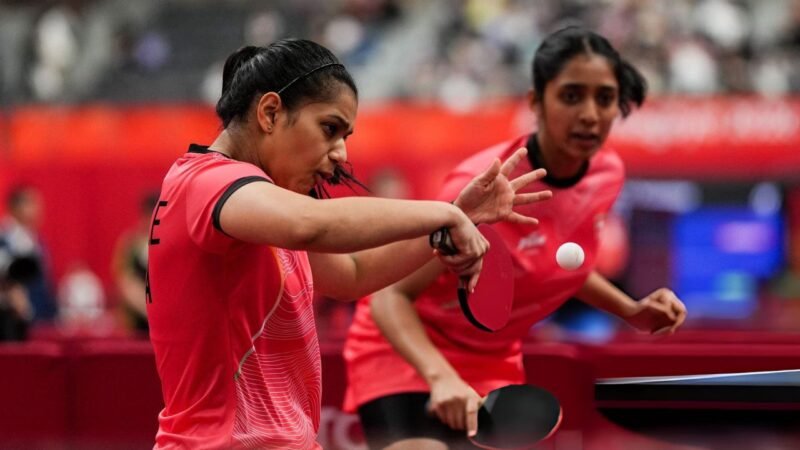

India’s wait for a mixed doubles medal at the Asian Table Tennis Championships finally came to an end in Tashkent as Yashaswini Ghorpade and Harmeet Desai produced a determined comeback to secure a historic podium finish on Friday. The Indian pair defeated South Korea’s Park Ganghyeon and Lee Daeun in a gripping five-game quarterfinal, ending a 72-year drought in the event and delivering a significant moment for Indian table tennis.
Ghorpade and Desai prevailed 11-6, 8-11, 8-11, 11-9, 11-9 in a contest that lasted more than 42 minutes. After surrendering their early advantage and falling behind in games, the Indians recovered their composure to win the final two games and book their place in the semifinals of the 2026 Asian Table Tennis Championships in Uzbekistan. The quarterfinal began positively for the Indian combination, who took the opening game 11-6 with an assured performance. However, the South Korean pair responded strongly, winning the next two games 11-8 and putting the Indians under pressure.
With their opponents moving within one game of victory, Ghorpade and Desai needed to regain control of the rallies and find a way to disrupt South Korea’s momentum. They delivered when it mattered, taking the fourth game 11-9 to force a decider. The deciding game proved equally competitive, with both pairs battling for every point. The Indian duo held their nerve to close out another 11-9 game, completing a 3-2 victory and ensuring a medal for India.
Their route to the semifinals also included victories over Chinese Taipei’s Hsien-Chia Hsu and Ying Syuan Wu in the round of 16, and Indonesia’s Citra Rasmi and Muhammad Negara in the round of 32. The result carries historical significance for Indian table tennis. Before Ghorpade and Desai’s achievement, India’s previous mixed doubles medals at the Asian Table Tennis Championships came in the tournament’s early editions.Kalyan Jayant and Gool Nasikwala won gold in 1952, while Yatin Vyas and Meena Parande secured silver in 1954. The latest result marks India’s return to the continental mixed doubles podium after more than seven decades.
The achievement is particularly noteworthy given the strength of Asian table tennis, where countries such as China, Japan and South Korea have consistently fielded formidable competitors. Reaching the last four against that level of opposition demonstrates the Indian pair’s ability to compete in high-pressure knockout matches. The Indian duo’s next challenge was scheduled to come against Japan’s Sora Matsushima and Miwa Harimoto, a highly regarded combination ranked ninth in the world, according to tournament coverage.
A semifinal victory would send Ghorpade and Desai into the final and give them an opportunity to upgrade their guaranteed bronze medal to silver or gold. Regardless of the eventual outcome, their quarterfinal triumph had already secured India’s historic podium finish. India’s other mixed doubles pairing, Syndrela Das and Payas Jain, missed out on a medal after losing to China’s Chen Yi and Huang Youzheng in the quarterfinals. The contrasting outcomes underlined the demanding nature of the competition and the significance of Ghorpade and Desai’s achievement.
The 72-year gap makes this more than an individual doubles result. It is a reminder of both the potential within Indian table tennis and the importance of converting promising performances into sustained international success. Ghorpade and Desai showed that composure and tactical resilience can make the difference against established continental opponents. Their comeback from a 1-2 deficit was a defining moment, demonstrating their ability to respond when the contest appeared to be slipping away.
The next challenge for Indian table tennis is to build on such milestones through consistent international exposure, strong domestic competition and continued investment in emerging players. A historic medal is an achievement worth celebrating, but its lasting value will be measured by whether it helps inspire the next generation and strengthens India’s competitiveness at future championships.
For now, Ghorpade and Desai have delivered a memorable chapter in India’s table tennis history, ending a 72-year wait and giving the country fresh reason to believe in its mixed doubles ambitions.

