
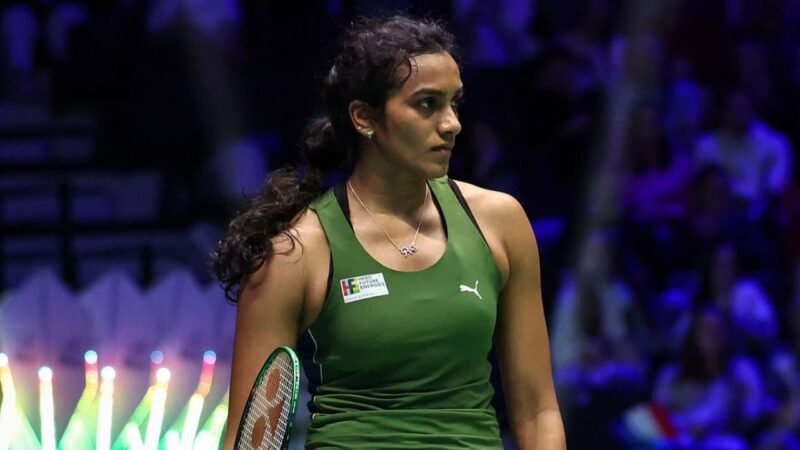

India’s PV Sindhu came within reach of a landmark victory over world No. 1 An Se Young, but the South Korean’s resilience and tactical adjustments proved decisive as the Indian shuttler finished runner-up at the French Open Super 750 badminton tournament in Paris on Sunday.
Sindhu claimed the opening game with an aggressive display before An fought back to register a 16-21, 21-11, 21-12 victory in the women’s singles final. The 31-year-old Indian, a two-time Olympic medallist and former world champion, showed that she could trouble the reigning Olympic champion with her attacking strokes, reach and sharp net play. However, An’s ability to absorb pressure, improve her defensive coverage and capitalise on crucial points eventually extended her winning record against Sindhu to 11 matches.
The victory gave An her fourth French Open title and continued a remarkable 2026 campaign for the South Korean, who entered the final as the dominant force in women’s badminton. Sindhu began the final with intent, using powerful smashes, deceptive drops and angled cross-court returns to disrupt An’s rhythm. The Indian looked confident in the early exchanges, engaging the world No. 1 in lengthy rallies and sharp net battles. The contest remained closely fought as the players moved from 4-4 to 7-7, with neither willing to surrender control of the rally.
Sindhu then began exploiting her reach and attacking angles to gain an advantage. An’s occasional judgement errors near the backline further helped the Indian build momentum. Sindhu moved ahead 15-11 before extending her lead to 19-14. A disguised slice earned her six game points, and although An saved two with a deceptive drop and an angled cross-court return, another shot from the Korean sailed long. Sindhu sealed the opening game 21-16 in 20 minutes. It was a significant moment for the Indian, as it marked only the second time in their 11 meetings that she had managed to win a game against An.
The opening-game performance offered a glimpse of the tactical approach required to challenge the world’s top-ranked player. The momentum shifted after the change of ends. An came out strongly in the second game, taking an early lead and using her defensive consistency to blunt Sindhu’s attacking play. Sindhu attempted to respond with cross-court smashes and body-directed shots, but An’s movement and precision at the net allowed her to maintain control. A 30-shot rally underlined the intensity of the contest, while two well-executed smashes helped the South Korean establish a four-point advantage at the interval.
With Sindhu struggling to find the same attacking rhythm, An accelerated away. Nine of the next 10 points went the Korean’s way, taking her to a commanding 17-8 lead. Sindhu saved three game points, but An eventually closed out the game 21-11 to level the match. The turnaround highlighted An’s ability to adjust during a contest. After being unsettled by Sindhu’s early aggression, she became more composed in defence and more effective at turning long rallies into opportunities to attack.
The deciding game brought renewed hope for Sindhu, who continued to fight despite the Korean’s growing control. Both players produced impressive rallies, testing each other’s movement and shot selection in a contest where small margins began to matter. A 36-shot rally ended with Sindhu sending the shuttle wide, but she quickly regrouped to establish an 8-5 lead. The Indian appeared to have an opportunity to put An under pressure again. However, the world No. 1 responded with a smash to draw level at 8-8 before moving ahead 9-8 with an aggressive interception at the net.
An’s attacking precision and ability to exploit gaps in Sindhu’s defence proved decisive. She converted the Indian’s three-point advantage into an 11-9 lead at the interval and carried that momentum into the remainder of the game. The South Korean continued to apply pressure, moving ahead 13-9 before extending her advantage to 18-10. Sindhu struggled to regain control as An approached the finish line, eventually sealing the deciding game 21-12 to claim the championship. The 61-minute contest once again demonstrated the fine margins separating Sindhu from a breakthrough victory against her formidable opponent.
Speaking after the match, Sindhu acknowledged that she had fought hard but identified the second game and the missed opportunity to maintain her lead in the decider as key turning points. “I fought for every point, I could win the first game and I was happy about it. But the second game, it was equal until five all or 5-4. After that, she took a lead and then maintained the lead. “Even in the third set, I should have maintained the lead from 8-5. But unfortunate that she converted that into 11-9. So that’s where I felt the difference was. But a lot of positives to take from this match. Going forward, I need to work on them,” said the Indian great.
Despite the defeat, Sindhu’s run to the final represented another encouraging result in her 2026 season. She had also won the Japan Open Super 750 title in July, defeating Japan’s Akane Yamaguchi in the final. Her performance in France reinforced her ability to compete deep into major tournaments, even against opponents who have consistently challenged her in recent years.
Sindhu’s French Open final should be viewed as both an encouraging performance and a reminder of the demands of elite badminton. Her opening-game victory showed that her attacking range, experience and ability to vary her strokes can trouble even the world’s best players. The turning point was not simply An’s superior consistency across the match, but Sindhu’s inability to protect her advantage when she led 8-5 in the decider. Against an opponent of An’s calibre, maintaining composure and converting promising positions into sustained pressure can determine the outcome.
For Indian badminton, the takeaway is that Sindhu remains capable of reaching the biggest stages. The next challenge is to translate such competitive performances into victories against the players who dominate the international circuit.

