
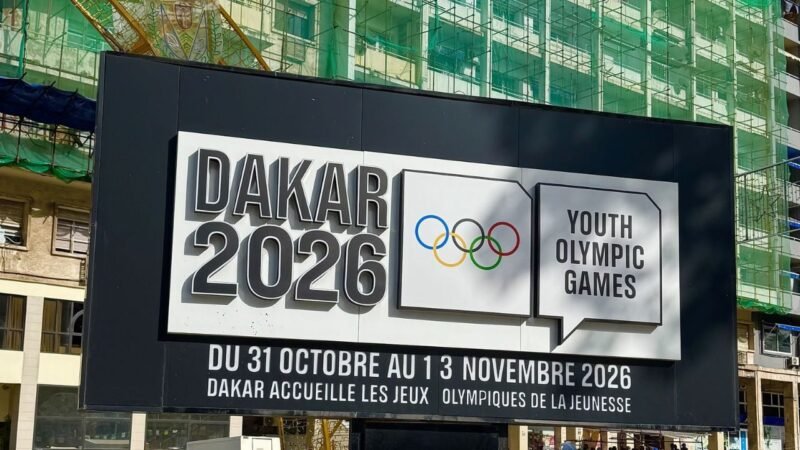

India’s next generation of sporting talent is set to take centre stage in Senegal, with table tennis player Syndrela Das and swimmer Dhinidhi Desinghu among the leading names in a 17-member Indian contingent for the Dakar 2026 Summer Youth Olympic Games.

With the country increasingly focused on building pathways towards future Olympic success, the competition presents an important opportunity for its young athletes to test themselves against international opposition. The Games will run from October 31 to November 13, bringing together approximately 2,700 athletes from 207 delegations across 25 sports. Dakar 2026 will also mark a historic milestone as the first Olympic sporting event to be held on African soil, giving the event significance beyond the medals and results.
For India, the focus will be on competitive performances, international exposure and the development of athletes who could eventually progress to senior championships. The contingent will compete across 11 sports, including athletics, swimming, table tennis, badminton, boxing, archery, equestrian, judo, sailing, beach wrestling and wushu. At 17, Syndrela Das heads to Senegal with valuable experience from senior international competition.
The young paddler represented India at the Asian Games in Japan, competing in the women’s team and doubles events. India’s women’s team reached the quarterfinals, while Das and Sreeja Akula advanced to the round of 16 in doubles. Her participation in Dakar will provide another opportunity to build her experience against international opponents and develop the tactical discipline required at the highest levels of table tennis. Table tennis demands quick reactions, precise placement and the ability to adapt rapidly to an opponent’s changing patterns.
For a young player such as Das, competing in a multi-sport event of this scale can help strengthen those qualities while providing exposure to the pressures of representing India on a major international stage. The Youth Olympics are designed to combine elite competition with learning and cultural exchange, making the event an important step in the development of emerging athletes. Swimming will be another key discipline for India, with Dhinidhi Desinghu expected to lead the country’s challenge in the pool.
The Bengaluru-based swimmer has already established herself as one of India’s most promising young aquatic athletes, combining national-record performances with experience at major international competitions. At the 2026 Asian Age Group Championships in Thailand, Desinghu won gold in the women’s 200m freestyle, clocking 2:01.81 to set a national record. She also secured bronze in the 400m freestyle with a national-record time of 4:21.56.
Earlier, she established another national mark in the women’s 100m freestyle at the Senior National Aquatics Championships, clocking 56.57 seconds. Her experience extends beyond age-group competitions. Desinghu represented India at the Paris 2024 Olympic Games, becoming the youngest member of the country’s contingent. That exposure to the Olympic environment could prove valuable as she prepares for another major international assignment in Dakar.
At the Youth Olympics, Desinghu is scheduled to compete in the women’s 100m freestyle, 200m freestyle and 200m individual medley. Her participation across three events will provide opportunities to measure her progress against some of the world’s leading young swimmers. The aspirations of India’s young athletes extend well beyond Dakar. Table tennis player Sarthak Arya views the Youth Olympics as an important step towards competing at the Commonwealth Games and the senior Olympic Games.
“The Youth Olympics will be a stepping-stone in my journey. I dream of representing India at the Commonwealth Games in Ahmedabad in 2030 and then at the Olympic Games in Brisbane in 2032. Looking further ahead, if India gets the opportunity to host the Olympic Games in 2036, competing at home and hopefully winning an Olympic medal for my country would be truly special,” said Sarthak. His ambitions reflect the wider purpose of the Youth Olympic Games: creating a bridge between junior competition and senior international sport.
While success in Dakar would be significant, the experience gained through competing against athletes from different countries could be equally important for the athletes’ long-term development. Indian Olympic Association president P. T. Usha also highlighted the significance of the event for the country’s future sporting ambitions.
“Dakar 2026 is an important milestone for our young athletes. They represent the future of Indian sport, and among them may be the champions who will represent India at Brisbane 2032 and beyond. “Hosting the first Olympic event on the African continent is a historic moment for the Olympic Movement, and we look forward to sharing this landmark occasion with Senegal and the wider Olympic community,” she added.
India’s participation in the Dakar 2026 Youth Olympic Games should be viewed as more than an opportunity to add medals to the national tally. It is a test of how effectively the country is developing athletes capable of progressing from promising juniors to consistent senior international performers. Das brings international table tennis experience, while Desinghu arrives with national records and Olympic exposure.
Their journeys illustrate two important aspects of athlete development: learning to compete under pressure and building the technical consistency required to succeed at the highest level. The wider challenge for Indian sport will be to ensure that the experience gained in Dakar translates into sustained progress through coaching, competition opportunities and long-term athlete support.
With the 2030 Commonwealth Games and Brisbane 2032 on the horizon, the performances of India’s young contingent will be worth following closely. For these athletes, Dakar is not the destination. It is another opportunity to build towards the biggest stages in world sport.

