

India’s gymnastics story has often been told through a handful of familiar names and disciplines. Artistic gymnastics has dominated the conversation, with athletes such as Dipa Karmakar and Pranati Nayak carrying much of the country’s international attention. But in Tagaytay City, a different branch of the sport has given India a new reason to look beyond the obvious. Ariha Pangambam has done what no Indian senior woman had done before. She has won gold in the individual event at the Aerobic Gymnastics Asian Championships.
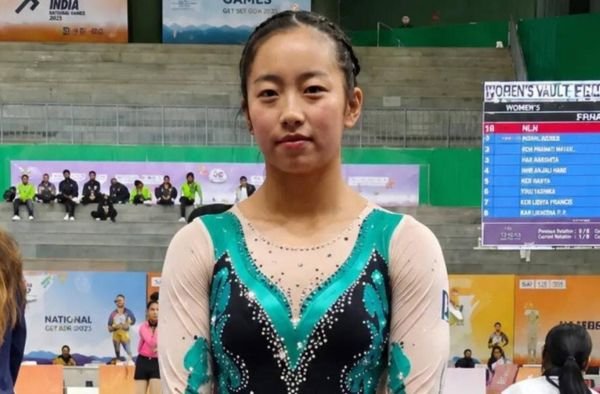
Competing at the 10th Senior Aerobic Gymnastics Asian Championships in the Philippines, Pangambam scored 19.100 points to claim the title, producing 8.650 for artistry, 7.600 for execution and 2.850 for difficulty. The championships, held from August 5 to 7 at the Tagaytay City Velodrome, brought together athletes from across Asia in individual, pairs, trios, groups, aerobic dance and aerobic step events.
It is tempting to treat the result simply as another medal for India’s growing sporting list. That would undersell what has happened. This was a breakthrough in a discipline in which India has historically had far less visibility than countries such as Vietnam, Japan and South Korea. More than 350 foreign delegates were expected at this year’s championships, with athletes from 13 countries competing across the various categories. Pangambam’s victory therefore represents not merely a personal milestone, but an indication that India’s gymnastics ecosystem can produce international-level performers outside its traditional spotlight.
Pangambam was already representing India in aerobic gymnastics as a young athlete. A Maharashtra Amateur Gymnastics Association bulletin from 2018 lists her among India’s selected individual women’s competitors for the inaugural Asia Cup in Aerobic Gymnastics in Ulaanbaatar.
That detail matters because breakthroughs rarely happen overnight. The gold medal may have arrived in 2026, but the foundation was being built years earlier. Pangambam’s journey illustrates one of the less visible realities of elite sport: by the time an athlete becomes a headline, years of training, competition and incremental improvement have already taken place.
Her performance in Tagaytay was also a reminder of what makes aerobic gymnastics different. Unlike disciplines where difficulty can dominate the conversation, aerobic gymnastics demands a combination of physical power, flexibility, rhythm, precision and artistry. The scoring itself reflects that balance, with artistry, execution and difficulty all contributing to the final result.
For India, expanding its presence in such disciplines could prove valuable. The country has made progress in artistic gymnastics in recent years. Pranati Nayak, for instance, won her third Asian Championships bronze in women’s vault in 2025, continuing India’s presence on the continental podium.
But the broader objective should not be to produce one medal-winning discipline at a time. It should be to build an ecosystem capable of creating athletes across gymnastics’ different formats.
That is where Pangambam’s achievement becomes particularly significant. ” A great achievement for us. Did very well. Kudos to her and her coach.” said Gymnastics Federation of India president Sudhir Mital. The praise is deserved, but the moment should also prompt a bigger question: what happens next?
India has often celebrated sporting breakthroughs without always turning them into sporting systems. One athlete winning a historic medal is inspiring. Creating the conditions for the next ten athletes to compete at the same level is development. That requires coaches, competition opportunities, international exposure, specialised facilities and long-term financial support. It also requires visibility. Sports that remain outside the mainstream conversation struggle to attract the same attention, sponsorship and grassroots participation as cricket or even better-established Olympic disciplines.
Her achievement has already drawn recognition from Manipur Chief Minister Yumnam Khemchand Singh, who congratulated her for “scripting history” and called the result “a moment of immense pride for Manipur and the entire nation”. The significance of Manipur in India’s sporting landscape also deserves attention. The state has repeatedly produced athletes who have represented India at the highest level across multiple sports. Pangambam’s achievement adds another chapter to that tradition. But the most important legacy of this medal may be what it makes possible for the athletes who come after her.
When an Indian athlete becomes the first to win a particular Asian title, the next generation no longer has to imagine whether it can be done. It has a name, a score and a gold medal to point towards. Her 19.100 in Tagaytay is now part of India’s gymnastics record book. The challenge for Indian sport is to ensure it does not remain an isolated entry.

