

For years, athletes have been told that their voices matter. But increasingly, the demand is not simply for athletes to have opinions. It is for them to have the right opinion, immediately, publicly and in a language that fits neatly into someone else’s political narrative.
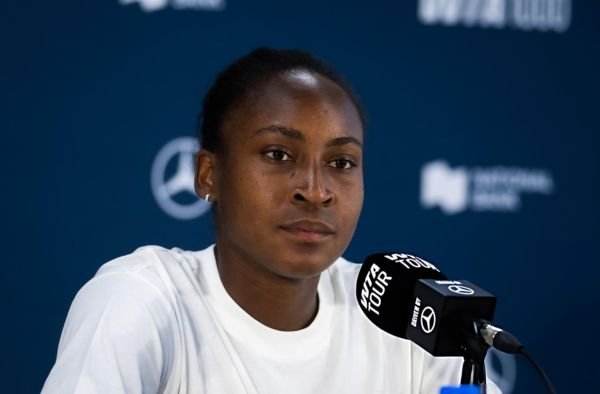
Coco Gauff‘s response in Toronto offered a different model. Asked about the WTA’s newly introduced one-off genetic testing requirement for players, the 22-year-old world No. 4 did something that is becoming increasingly rare in sports conversations: she admitted the issue was complicated.
“I know it’s been something that’s been talked about a while,” Gauff, 22, said. “But I’ve talked to a couple other players, and a lot of them didn’t find out until the press release. So, I do think that’s something that could have been more transparent amongst like players across the tour.”
That first point is important. Before discussing the politics surrounding transgender participation in women’s sport, Gauff questioned the process itself. Players, she suggested, should not be discovering major eligibility changes at the same time as the public.
The WTA’s current Women’s Eligibility Policy already sets out detailed criteria governing participation, including provisions concerning biological sex, gender identity and differences of sex development. The policy says its objective is to maintain meaningful competition while also providing a safe and supportive environment free from harassment and discrimination. The newly introduced genetic testing requirement has nevertheless pushed the conversation into a new and particularly sensitive territory.
And Gauff refused to pretend she had a simple answer. “I mean, I understand the reasoning behind it,” Gauff continued. “I do think that this kind of conversation has created a lot of animosity towards the trans community, which I’m not really a big fan of, but I also understand the need to – I guess, the biological difference and the need to protect that and preserve that. So, I think it’s a conversation that is very nuanced, and I need to have a nuanced answer.”
There is a lesson in that sentence that extends beyond tennis. Athletes are often treated as convenient translators of complicated social issues. They are expected to turn questions involving biology, policy, medicine, law and human rights into a 20-second answer beside a locker-room entrance.
“So, yes, I guess, I kind of agree with trying to protect the fairness in women’s sports,” Gauff continued. “But I also do not like the attack that it is creating. People who don’t really care, but just want to use this as a reason to attack the trans community. So, I’m not really a big fan of that, either. I don’t really know how to answer this question in a way that people aren’t going to spin it. But as far as where I stand, I definitely support the trans community, but I also support the need of creating fairness in sport, too.”
It is precisely the kind of answer that social media is designed to flatten. One sentence becomes a headline. A qualification disappears. A 90-second explanation becomes a ten-second clip. Nuance becomes inconvenient because outrage travels faster. That dynamic has become particularly visible in women’s basketball.
Indiana Fever guard Sophie Cunningham’s comments about transgender participation in women’s sports recently turned the WNBA into a much larger political battleground. Other players and coaches, including Caitlin Clark, Cheryl Reeve and Natalie Nakase, were subsequently asked to respond. Clark’s decision to defer the issue to leagues and governing bodies was criticised by some and praised by others. But her answer also highlighted an uncomfortable reality: being the most recognisable athlete in a sport does not automatically make someone an expert on every political, medical or regulatory question.
“I understand that she’s the most popular player in the league and that people are looking for somebody who is 23 or 24 years old to be a spokesperson on everything,” Jemele Hill said on CNN in reference to Clark’s statement. “But I actually have a sincere appreciation for athletes who understand when they’re out of their depth, and there’s things they don’t want to speak about. She’s not required to do that.”
“It’s funny they’re putting this pressure on her to say something because wasn’t this the same crowd – correct me if I’m wrong – who also stood firmly behind ‘shut up and dribble’?” Hill added.
Athletes have historically been criticised for speaking about politics, only to be criticised later when they refuse to speak. Women’s sport is particularly vulnerable to this cycle because its athletes are increasingly visible beyond competition, but are still expected to remain accessible, agreeable and available for commentary. Gauff’s answer offers another possibility: speak when you have something to say, acknowledge what you do not know, support people without pretending every question has an easy solution, and leave policy-making to the organisations responsible for it.
The WTA itself says its eligibility policy is subject to periodic review as scientific and other developments evolve. Its safeguarding programme also explicitly states that the organisation does not tolerate abuse, harassment or discrimination based on gender identity. Those principles do not magically resolve the debate. They do, however, demonstrate why the subject requires more than athlete soundbites.
Women’s sport deserves serious discussion about competitive fairness. Transgender people deserve protection from harassment and dehumanisation. Players deserve transparency about policies that affect their careers. None of those principles has to cancel out the others. She did not present herself as an authority. She did not pretend to have solved the issue. She simply refused to abandon empathy in the pursuit of certainty.
In an era when athletes are increasingly being pulled into culture wars they did not create, that might be the most responsible form of sporting leadership available.

