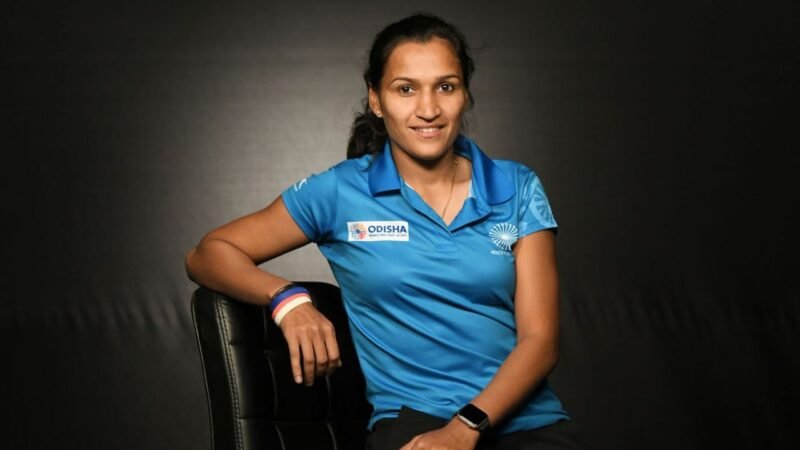

The inclusion of celebrated Indian hockey players in Hockey India’s electoral process has brought athlete representation into focus ahead of the federation’s December 5 elections. Former India captain Rani and Olympic medallist Vandana Katariya are among four sportspersons of outstanding merit named in the draft electoral roll for the 2026-30 term, alongside Lalit Kumar Upadhyay and Gurjant Singh.
The draft, released on Thursday, October 22, lists 58 names against 60 available positions, with two nominations from Manipur Hockey still pending. The elections will determine the office-bearers and executive committee members responsible for overseeing Indian hockey’s administration for the next four-year term. The process is being conducted under the National Sports Governance Act, 2025, and the National Sports Governance (National Sports Bodies) Rules, 2026, which establish a framework for representation, elections and accountability within national sports federations.
The four players listed under the sportspersons of outstanding merit category are Lalit Kumar Upadhyay, Gurjant Singh, Vandana Katariya and Rani. Their inclusion provides a formal place for athletes with distinguished competitive records in the federation’s electoral structure. Rani, a former captain of the Indian women’s hockey team, has been one of the country’s prominent players over several international campaigns. Vandana Katariya, meanwhile, played a key role in India’s historic fourth-place finish at the Tokyo 2020 Olympic Games, becoming the first Indian woman to score a hat-trick at the Olympics.
On the men’s side, Lalit Kumar Upadhyay and Gurjant Singh have been part of India’s successful international campaigns, including the bronze-medal-winning team at the Tokyo 2020 Olympics. The inclusion of two male and two female players fulfils the gender representation requirement for sportspersons of outstanding merit under the 2026 rules. The framework requires at least four such athletes in the general body of a national sports body, with women accounting for half of this category.
According to the draft electoral roll, 56 representatives are to be drawn from 28 state and Union Territory hockey associations, with each association allocated two positions, one male and one female. The four sportspersons of outstanding merit bring the total number of designated positions to 60. While 27 associations have submitted both representatives, Manipur Hockey is the only permanent member association yet to fill its two positions. The draft electoral roll records “No Name Received” against both entries.
The inclusion of all 28 permanent member associations in the draft provides the basis for representation across the federation’s affiliated units, although Manipur’s pending nominations leave the provisional list incomplete.
Hockey India has invited members seeking additions, deletions or alterations to the draft electoral roll to submit their objections to the Electoral Officer by 5 pm on November 6. The draft will be followed by the prescribed electoral process ahead of the December 5 elections. The official Hockey India elections page carries the election calendar and relevant documents, including the draft electoral roll.
The elections come as Indian sports administration transitions to the statutory framework established by the National Sports Governance Act, 2025. The rules notified in January 2026 set out provisions governing athlete representation, the composition of national sports bodies and the procedures for conducting elections.
The presence of Rani, Vandana Katariya, Lalit Kumar Upadhyay and Gurjant Singh on the draft electoral roll is an important step towards incorporating athletes into the governance of Indian hockey. However, representation on paper is only the starting point. The larger test will be whether athletes have a meaningful voice in decisions affecting player welfare, grassroots development, domestic competitions and the future direction of the sport.
With the December 5 elections approaching, the completion of the electoral roll and adherence to the prescribed rules will be crucial to ensuring a transparent process. The next leadership will have to balance administrative accountability with the needs of players who represent India on the international stage.
