
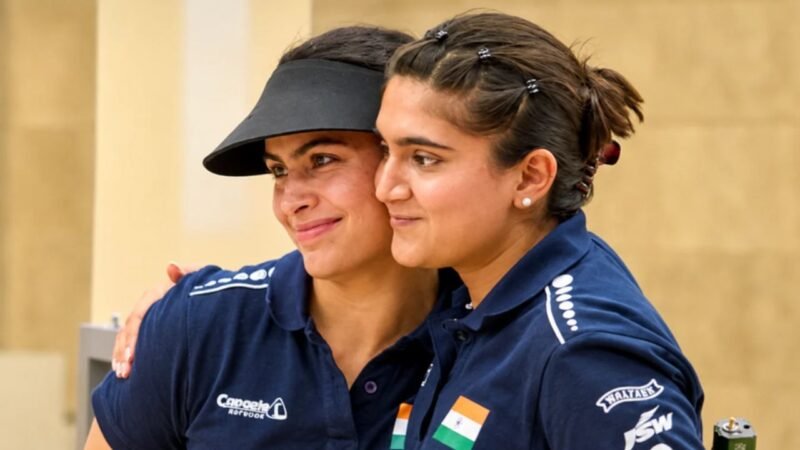

India’s women’s 25m pistol shooters experienced contrasting fortunes at the ISSF World Championships in Doha, with a team gold medal overshadowed by missed individual podium opportunities and another setback in the race for Los Angeles 2028 Olympic qualification. Double Olympic medallist Manu Bhaker came agonisingly close to an individual medal, finishing fourth, while Esha Singh endured a difficult final to finish eighth as neither Indian secured an Olympic quota place on Tuesday.
South Korea’s Yang Jiin emerged as the standout performer, producing a world-record score of 44 hits to claim the gold medal. Vietnam’s Trinh Thu Vinh finished just one hit behind with 43 to take silver, while China’s Zhang Yueyue secured bronze with 34. All three medal winners also earned Olympic quota places for their respective National Olympic Committees. For India, the outcome was a frustrating end to what had been a promising qualification campaign.
Both Esha and Manu had entered the eight-shooter final after finishing third and sixth respectively in qualification, raising hopes of adding another quota place to India’s tally. However, the final proved a different challenge, with neither shooter managing to convert qualification form into a podium finish. Manu emerged as India’s best performer in the individual final, but the double Olympic bronze medallist narrowly missed the opportunity to secure another world championship podium. The 24-year-old finished fourth with 27 hits after surviving multiple elimination stages and shoot-offs.
Despite showing resilience to remain in contention, she eventually fell short of the three medal positions. For Manu, the result represents a missed opportunity to add an individual world championship medal to her growing international record. Having won bronze in the women’s 10m air pistol and 10m air pistol mixed team events at the Paris 2024 Olympics, she remains one of India’s most established pistol shooters.
Esha, meanwhile, endured a difficult outing in the final. The 21-year-old was the first shooter eliminated, finishing eighth with 11 hits from four series of 1, 5, 3 and 2. The result was particularly disappointing considering her strong qualification performance and recent success at the Asian Games, where she had won individual silver in the women’s 25m pistol event. While the Indian shooters struggled to find consistency in the final, Yang produced a commanding performance to take the world title.
The South Korean shooter accumulated 44 hits to establish a new world record, finishing ahead of Trinh Thu Vinh by a single hit. China’s Zhang Yueyue completed the podium. The three medal winners also secured quota places for their respective countries for the Los Angeles 2028 Olympics. The Doha World Championships are particularly significant because they mark the beginning of the shooting qualification pathway for LA28.
A total of 36 Olympic quota places are available across 12 individual events, with three places awarded in each event. These quota places are allocated to National Olympic Committees rather than automatically guaranteeing an individual athlete’s selection for the Games. Despite the disappointment in the individual final, India had reason to celebrate after Esha, Manu and Divya Subbaraju combined to win the women’s 25m pistol team gold medal.
The Indian trio accumulated 1761 points to finish ahead of South Korea, which secured silver with 1748, while Vietnam claimed bronze with 1745. Esha led the Indian challenge with an impressive 590, followed by Manu with 587 and Divya with 584. Esha’s performance was particularly noteworthy considering her recovery in the Rapid round. After scoring 292 in Monday’s Precision round, she responded with series of 100, 98 and 100 to register 298 in Rapid and finish with an overall tally of 590.
Manu also recovered from a relatively modest Precision score of 289, producing three strong Rapid series of 99, 99 and 100 to finish with 587. The qualification performances had placed both Indian shooters in contention for individual honours. Esha finished third, while Manu secured sixth position. Divya narrowly missed the final, finishing 10th. However, the inability to sustain that momentum in the final meant India had to settle for team honours without an individual medal or an additional Olympic quota place.
The missed opportunity in the women’s 25m pistol final adds pressure to India’s ongoing Olympic qualification campaign. Jaypal Malviya has so far secured India’s only LA28 shooting quota place at the Doha championships after winning silver in the men’s 10m air pistol event. The Indian campaign has otherwise witnessed mixed performances across rifle, pistol and shotgun disciplines. While the pistol shooters have delivered important medals, India’s rifle events have produced inconsistent results.
The disqualification of rifle shooter Sambhavi Kshirsagar following an equipment-related issue has also added to the concerns surrounding the campaign. The performances have brought renewed attention to India’s high-performance programme, particularly the challenge of translating investment, technical support and international exposure into consistent results under pressure.
With 36 Olympic quota places available at the Doha championships, every individual final carries considerable significance. With the women’s 25m pistol event concluded, India’s attention now shifts towards the trap competitions, where the remaining Olympic qualification opportunities will be crucial.
However, the women’s trap team experienced a difficult opening day in qualification, with Asian Games double gold medallist Neeru Dhanda struggling to find consistency across her first two rounds. Neeru, who won both the individual and mixed team gold medals at the Aichi-Nagoya Asian Games, managed scores of 20 and 19 to finish with 39 hits from 50 targets. She was placed 69th among 77 competitors after the opening two rounds.
Pragati Dubey was India’s best-placed shooter, occupying 18th position with 46 hits after recording 24 and 22 in her two rounds. Manisha Keer stood 41st with an aggregate of 43, having registered scores of 23 and 20. The opening-day results leave the Indian trio with considerable ground to recover if they are to challenge for a place in the eight-shooter final. The qualification competition will continue with two more rounds of 25 targets each on Wednesday, followed by the fifth and final round on Thursday. The eight highest-ranked shooters will advance to the final.
For India, the remaining rounds will be crucial in keeping their Olympic qualification hopes alive. India’s women’s 25m pistol team gold is undoubtedly a significant achievement, but the inability of two leading shooters to convert their qualification performances into individual medals raises important questions. Manu’s fourth-place finish and Esha’s eighth-place result highlight the unpredictable nature of shooting finals, where qualification scores offer no guarantee of success. The difference between reaching a final and winning an Olympic quota place can come down to a handful of targets.
For Manu, the challenge will be to turn her experience at the highest level into greater consistency in decisive moments. Esha, meanwhile, will look to build on her strong qualification performance and Asian Games success. The concerns extend beyond the pistol events. Neeru Dhanda’s difficult start in trap qualification illustrates how quickly India’s Olympic hopes can come under pressure across disciplines. The larger issue is not India’s ability to produce medal-winning performances, but its capacity to sustain them across qualification rounds and high-pressure finals.
With the LA28 qualification cycle only beginning in Doha, there is still time for India to recover. However, the remaining competitions will demand greater consistency, technical precision and composure from the shooting contingent. For now, the team gold offers a moment of celebration, but India’s individual Olympic qualification race remains a work in progress.

