

For nearly two decades, Indian badminton has searched for the player who could seamlessly bridge the era of pioneers and champions. Saina Nehwal broke barriers. PV Sindhu sustained India’s presence on the biggest stages. Now, another teenager has quietly announced that the future may already be here. Tanvi Sharma’s victory at the BWF Taipei Open Super 300 is not merely another tournament win. It is a statement about India’s evolving badminton ecosystem, where young athletes are no longer content with promise. They are arriving ready to win.
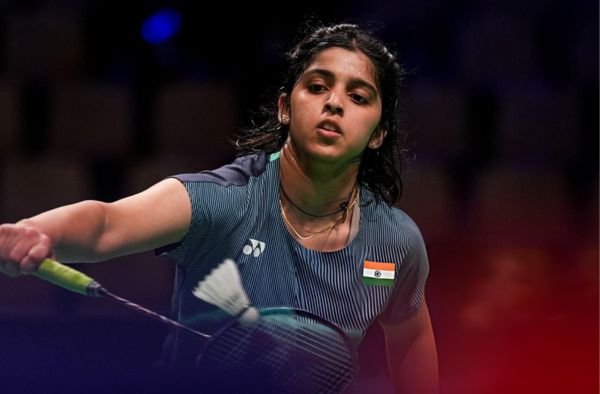
The 17-year-old from Punjab defeated Vietnam’s sixth seed Nguyen Thuy Linh 21-16, 21-16 in a remarkably composed 36-minute final to claim her maiden BWF World Tour title. In doing so, she became the first Indian woman since Saina Nehwal in 2008 to win the women’s singles title at the Taipei Open, bringing an 18-year wait to an end.
The scoreline alone does not tell the story. Tanvi’s badminton throughout the tournament reflected qualities rarely associated with teenagers. She repeatedly disguised delicate drop shots with the same preparation as her full-blooded smashes, leaving experienced opponents frozen at the net. Against Nguyen, she dictated the pace almost from the opening rally, forcing errors through deception rather than brute force.
Her occasional lapses, understandable for a player still in her teens, never unsettled her rhythm. Each time Nguyen threatened to narrow the gap, Tanvi responded with maturity beyond her years, rediscovering her attacking instincts and regaining control of the rallies.
Perhaps the biggest influence behind this transformation has been Park Tae-sang. The former South Korean international, best known for guiding PV Sindhu to medals at the Tokyo Olympics and World Championships, has been instrumental in refining Tanvi’s attacking game while encouraging her natural creativity. The partnership appears to be paying immediate dividends. After the title-winning point, Tanvi removed her gold medal and placed it around Park’s neck, an emotional gesture that symbolised the trust between coach and player.
Records have followed naturally. At 17 years and 222 days, Tanvi became the youngest finalist in the history of the Taipei Open, surpassing Korean doubles legend Lee Yong Dae’s previous benchmark. More importantly, she has now converted years of junior excellence into a breakthrough on the senior circuit. That progression has been carefully built rather than suddenly discovered.
She was a former World Junior No. 1, became the first Indian to win two medals at a single edition of the BWF World Junior Championships with a silver in girls’ singles and bronze in the mixed team event, and also played a vital role in India’s historic gold medal at the Asian Team Championships. Before Taipei, she had already reached the US Open Super 300 final at just 16 years of age while finishing runner-up at both the Odisha Masters and Guwahati Masters.
Those results suggested enormous potential. Taipei has now provided validation. Indian badminton, however, has often witnessed gifted juniors struggle with the transition to elite senior competition. Physical demands become greater, tactical battles become longer, and consistency becomes the defining characteristic of champions.
That is precisely why Tanvi’s victory matters. She did not simply overpower lower-ranked opposition. She defeated seasoned international players using tactical awareness, patience and shot variation. Throughout the week, she looked increasingly comfortable handling pressure rather than being burdened by it.
Her rise also reflects a broader shift in Indian badminton. The country’s development structure has expanded significantly over the past decade through improved academies, scientific coaching, international exposure and experienced foreign mentors. Young players are entering the World Tour with better preparation than any previous generation. Tanvi is perhaps the strongest example yet of this new pathway producing athletes capable of challenging established names before their twentieth birthday.
Still, perspective remains essential. One Super 300 title does not make a global champion. Ahead lie the Super 500s, Super 750s, Super 1000 tournaments and eventually the World Championships and Olympic Games, where expectations become exponentially greater.
Yet every great sporting journey begins with one breakthrough that changes perception. For Saina Nehwal, it came in her teenage years. For PV Sindhu, it arrived through fearless performances against the world’s best. For Tanvi Sharma, Taipei may well become that defining chapter. Indian badminton has celebrated this moment because another title has been added to its growing collection. But the greater significance lies elsewhere.
This was not simply the arrival of another talented teenager. It was the emergence of a player who appears equipped with the technical intelligence, coaching support and competitive temperament to shape India’s next era in women’s badminton.
Taipei was the destination this week. For Tanvi Sharma, it may ultimately be remembered as the starting line.

