

India’s bid to defend their Chess Olympiad titles ended with two more medals in Samarkand, but the colour of the medals told two very different stories.
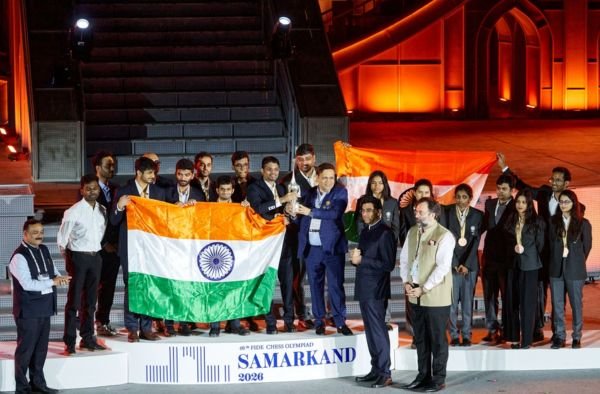
The men’s team were left to settle for silver after a 2-2 draw against Hungary, while the women’s side held Georgia to the same score to secure bronze on the tiebreak. The final round brought both Indian teams to the podium, but not to the top step. Uzbekistan reclaimed the open section gold on home soil after defeating Ukraine 2.5-1.5, finishing the 11-round tournament with 20 match points. India finished on 18, level with Germany, but a superior tiebreak placed the defending champions second, with Germany taking bronze.
For India, the men’s final-round draw was shaped by a mixture of strong individual performances and one costly setback. R Praggnanandhaa drew with Richard Rapport, while Arjun Erigaisi delivered India’s only win of the match by defeating Peter Leko. Nihal Sarin was held by Benjamin Gledura, leaving the match delicately poised at 1.5-1.5. On the fourth board, however, world champion Gukesh D was beaten by Hungary’s Gleb Dudin. That result ended India’s hopes of retaining the title they won in Budapest in 2024.
Gukesh, who had produced a spectacular individual performance in the previous Olympiad, also missed out on individual gold this time, settling for silver on board four. Praggnanandhaa, meanwhile, secured an individual bronze medal for his performance. The Uzbek victory meant the hosts completed a memorable campaign by winning their second Olympiad title, following their triumph in Chennai in 2022. Four of the five players from that victorious team returned to the squad in Samarkand, with Nodirbek Abdusattorov also claiming individual gold on board one after recording a 2869 performance rating.
The women’s section followed a similarly dramatic script for India. China secured gold after defeating Vietnam 3-1, finishing on 20 match points. Kazakhstan took silver, while India finished third after drawing 2-2 with Georgia. India had entered the competition as defending champions and top seeds, but the final round left them needing the tiebreak to secure a place on the podium. Koneru Humpy gave India the ideal start with a victory over Nana Dzagnidze. But Divya Deshmukh lost to Bella Khotenashvili, while Vantika Agrawal drew with Lela Javakhishvili. That left B Savitha Shri with the crucial task of holding her position against Meri Arabidze.
The 20-year-old had been one of India’s most consistent performers throughout the tournament, and once again she delivered when the team needed her. Savitha secured the draw that ensured India’s 2-2 scoreline and ultimately the bronze medal. FIDE confirmed that Savitha also won the individual gold medal on board five. Her performance was particularly important given India’s campaign. Savitha finished with nine points from 10 games, emerging as one of the team’s most reliable scorers. Humpy and Vantika also collected individual bronze medals, while Divya took individual silver.
India’s women’s team had entered Samarkand with considerable expectations. FIDE had listed them as the top seeds, ahead of Georgia, China and Kazakhstan, with Humpy returning to lead a squad that included Divya, Vantika and Savitha. The final standings therefore represented a significant shift from Budapest, where India had won both the Open and Women’s sections. Yet neither team left Samarkand empty-handed. India’s double podium finish reflects both the depth of its chess programme and the difficulty of sustaining dominance at the Olympiad. The men’s silver came after a campaign in which they remained among the leading teams but could not repeat their 2024 title-winning run.
The women’s bronze was secured through resilience on the final day, with Savitha Shri’s unbeaten contribution proving decisive when the team needed half a point most. The broader picture is equally significant. India arrived as defending champions in both sections, while Uzbekistan were competing on home soil with a squad built around several players from their 2022 title-winning team. The hosts ultimately converted that advantage into another Open gold, while China reclaimed the women’s crown.
For India, the medals now become part of a changing Olympiad story. The country’s established stars continue to deliver, but the emergence of players such as Savitha adds another layer to a rapidly expanding chess ecosystem. The gold medals may have gone elsewhere in Samarkand. India, however, still leaves the 46th Chess Olympiad with silver, bronze and several individual medals, evidence that its position among the world’s leading chess nations remains firmly established.

