

The India women’s national under-17 football team moved to the brink of a historic quarterfinal qualification at the 2026 AFC U-17 Women’s Asian Cup after a commanding 4-0 victory over Lebanon women’s national under-17 football team in their final Group C match in Suzhou, China, on Friday.
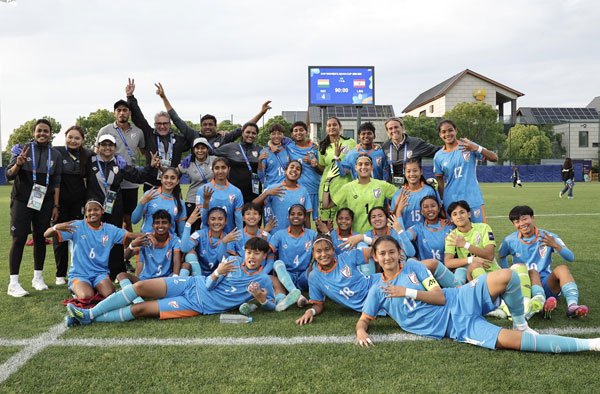
A dominant performance from the Young Blue Tigresses saw Pritika Barman score twice, while Alva Devi Senjam and Joya added one goal each to seal India’s biggest-ever win at the tournament. The result significantly boosted India’s hopes of reaching the knockout stages for the first time in the competition’s history.
India entered the contest under pressure after suffering heavy defeats against Japan and Australia in their opening two matches. However, the side produced an inspired response against Lebanon, showing composure, attacking intent and confidence throughout the 90 minutes. The breakthrough arrived in the first half when Pritika Barman capitalised on defensive hesitation to put India ahead. Alva Devi Senjam soon doubled the advantage with a composed finish, giving the Indian side full control heading into halftime.
India continued their dominance after the restart. Pritika added her second goal of the night with a clinical strike before Joya completed the emphatic victory late in the match. The four-goal margin proved especially important due to the tournament’s qualification scenario, dramatically improving India’s goal difference.
The victory lifted India’s goal difference to -1, placing them ahead of Group C rivals Philippines women’s national under-17 football team and Chinese Taipei women’s national under-17 football team in the race for one of the best third-placed qualification spots. Before their meeting later on Friday, the Philippines stood at -13 while Chinese Taipei were at -14. India could only be eliminated if either side secured an extraordinary victory margin of 12 goals or more.
The AFC U-17 Women’s Asian Cup introduced an expanded format for the 2026 edition, allowing the top two teams from each group and the two best third-placed teams to advance into the quarterfinals. The revised structure has opened the door for emerging nations like India to challenge for knockout-stage places.
For India, qualification would represent a landmark achievement in the development of women’s youth football. The nation returned to the continental stage this year after a gap of 21 years, making their performances in China particularly significant for the future of the women’s game in the country.
Despite losses to traditional Asian powerhouses Japan women’s national under-17 football team and Australia women’s national under-17 football team earlier in the tournament, India showed notable resilience and improvement across the group stage. Head coach Pamela Conti has consistently emphasised long-term development and exposure to elite competition as key objectives for the squad.
The convincing win over Lebanon highlighted the progress India has made at youth level in recent years. The team displayed greater tactical discipline, sharper finishing and improved defensive organisation compared to their earlier matches. Several players also emerged as standout performers during the campaign, particularly Pritika Barman, whose brace underlined her attacking quality on the continental stage. Should India officially secure qualification, they will face hosts China women’s national under-17 football team in the quarterfinals on May 11. China have emerged as one of the strongest teams in the tournament after dominating Group A with three consecutive victories.
The quarterfinal clash would provide India with an opportunity to test themselves against one of Asia’s elite football nations while continuing their dream run in Suzhou.
The 2026 AFC U-17 Women’s Asian Cup also serves as a qualification pathway for the FIFA U-17 Women’s World Cup, with the top four teams earning direct qualification to the global tournament.
For now, India can celebrate a memorable and potentially historic night in Suzhou, where the Young Blue Tigresses delivered one of the finest performances in the history of Indian women’s youth football.

