

India’s dream run at the AFC U17 Women’s Asian Cup 2026 came to an emotional end on Monday night as the Young Tigresses suffered a 0-3 defeat against hosts China PR in the quarterfinals at the Suzhou Sports Centre Stadium. While the result denied India a historic qualification to the FIFA U17 Women’s World Cup Morocco 2026, the tournament still marked a significant milestone for Indian women’s football with the team reaching the knockout stage of the continental championship for the first time ever.
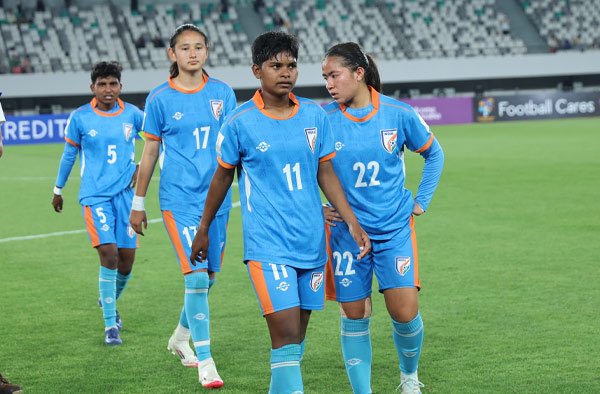
Coming into the match with confidence after a dominant 4-0 victory over Lebanon in the group stage, India faced a difficult challenge against one of Asia’s strongest youth sides. China, backed by a packed home crowd and carrying the pressure of expectations, produced a clinical performance to book their place in the semifinals and secure direct qualification for the FIFA U17 Women’s World Cup.
Despite the defeat, India’s campaign under head coach Pamela Conti has been widely praised for showcasing the rapid progress of women’s youth football in the country. The Young Tigresses displayed resilience, attacking intent and defensive discipline throughout the tournament, particularly during their memorable win over Lebanon which sealed their historic quarterfinal berth.
For the knockout clash, Conti made one change to the side that defeated Lebanon, bringing Joya into the starting lineup in place of Anushka Kumari. India began cautiously against a Chinese side determined to dominate possession from the opening whistle.
China immediately tested the Indian defence with quick passing combinations and aggressive movement in the final third. India, however, showed strong organisation early in the game. Defender Abhista Basnett produced a crucial block in the fourth minute to deny Li Yaqi from close range and prevent an early breakthrough.
The hosts continued to control possession and nearly opened the scoring midway through the first half when Wang Chenxi cut inside from the left flank before curling a shot against the crossbar. India struggled to maintain possession for long periods but remained compact defensively and looked dangerous on the counterattack.
One of India’s best moments arrived near the half-hour mark. Pritika Barman delivered a dangerous ball into the penalty area for Joya, whose effort was blocked at the last moment before troubling the Chinese goalkeeper. It was a reminder that India could still threaten despite spending most of the game without the ball. China eventually found the breakthrough in the 38th minute through a well-constructed team move. Liu Yuxi received possession inside the box before cutting the ball back intelligently for Huang Qinyi, who finished calmly from close range to put the hosts ahead.
The goal shifted momentum heavily in China’s favour and India found themselves pinned deep inside their own half during the closing minutes of the first period. Just before halftime, China doubled their lead after Ritu Badaik brought down Liu Yuxi inside the penalty area. Liu converted the resulting penalty confidently, sending goalkeeper Munni the wrong way with a low finish into the corner.
India attempted to respond with greater urgency after the break but found it difficult to break through China’s disciplined defensive structure. The Young Tigresses lacked the physicality and pace needed to consistently trouble the hosts, while China continued to create the more dangerous opportunities. Goalkeeper Munni remained one of India’s standout performers during the second half. She produced an excellent save in the 66th minute to stop Wu Yichen’s powerful strike from distance and later denied Cheng Wandi with another sharp intervention in the closing stages of the match.
China eventually sealed the result in the final minute of regulation time. Wu Yichen delivered a dangerous cross from the left and after confusion inside the Indian box, Li Qixian reacted quickest to score from close range and make it 3-0.
Although the scoreline reflected China’s superiority, India’s overall tournament performance has been regarded as a breakthrough moment for the country’s youth football system. The Young Tigresses had entered the competition as underdogs but managed to compete strongly against established Asian nations. Their quarterfinal qualification was India’s best-ever finish at the AFC U17 Women’s Asian Cup since the tournament’s inception.
Head coach Pamela Conti, who has overseen major improvements in India’s youth structure since taking charge, had repeatedly spoken about the importance of exposing young players to high-level international competition. Under her guidance, the team displayed tactical discipline and confidence throughout the tournament, particularly in matches against Lebanon and Uzbekistan during the group stage.
Several Indian players also emerged as exciting prospects during the campaign. Pritika Barman impressed with her attacking contributions and ability to create chances, while goalkeeper Munni earned praise for her performances under pressure. Midfielders like Alva Devi Senjam and defenders including Abhista Basnett also showcased composure against stronger opposition.
India’s exit means Asia’s semifinalists for the tournament are China PR, Japan, Australia and DPR Korea, all of whom have secured qualification for the FIFA U17 Women’s World Cup Morocco 2026. While the Young Tigresses fell short of a World Cup spot, the campaign has offered valuable experience to a generation of players expected to form the backbone of India’s future women’s national teams. The performances in Suzhou also reinforced the growing momentum behind women’s football in India and highlighted the potential of the country’s emerging young talent on the continental stage.

