

The 146th IOC session is scheduled to be held at the SwissTech Convention Centre in Lausanne, Switzerland, on June 24th and 25th. On June 24, Wednesday, the International Olympic Committee approved amendments to the Olympic Charter to reinforce sport’s political neutrality.
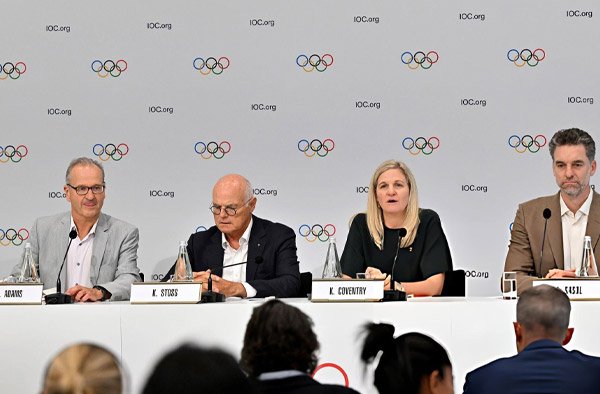
The changes emphasise that sports should be free from political aspects. One stresses the IOC’s role in making sure neutrality is maintained, “at all times, free from governmental, cultural, societal or economic pressure”.
The committee also accepted changes regarding the sports programme. Starting with the 2032 Brisbane Games, individual disciplines rather than the entire sport will be evaluated for selection in both the summer and winter games. According to the IOC, the decisions regarding it will be made in a few months or by the start of the next year. The IOC also stated that the neutrality reforms are reinforced to ensure that athletes are not affected by outside noise and that the Olympics are not used for political purposes.
When asked about the Russian athletes, President Kirsty Coventry stated that they need time to understand how the changes would be implemented regarding the athletes.
“This commitment is about protecting what makes the Olympic Games unique, bringing the world together through sport and peaceful competition,” said IOC President Kirsty Coventry.
Russian athletes have faced sanctions for a state-backed doping scandal linked back to the 2014 Sochi Winter Games, in 2022 the IOC also recommended athletes from Russia and Belarus be banned after the invasion of Ukraine. The Russian Olympic Committee was suspended in October 2023 after recognising regional Olympic councils in Russian-occupied areas of Ukraine, which according to the IOC violated the Olympic Charter and Ukraine’s territorial integrity.
Last month, the governing body lifted all sanctions against the Belarusian athletes, there have been speculations that the same could be done for athletes from Russia.
Sports Minister and ROC Chairman Mikhail Degtyarev stated in April that Russia was “doing everything possible” to ensure its athletes’ full return to international competitions.
The IOC has also announced a $10,000 grant for players competing in an edition of the Olympics. The athletes can apply for it. Pau Gasol Saez, chair of the IOC athletes’ commission said this move came as a response to the athletes’ feedback about wanting direct support for their journey. He told members, “This is a win for all of us.”
They have also set a target date of 2029 to select which country will host the 2036 Olympic Games.
According to the IOC member, Tony Estanguet, including games based on their discipline rather than by sport would be better for preserving the quality of the competition and ensuring affordability.
Under the new changes, a discipline is defined as one or more events within a sport that require either a dedicated field of play or a significant modification of a shared field of play involving specialised equipment.
IOC Sports Director Pierre Ducrey told Reuters, for example, while World Aquatics is the international federation overseeing aquatic sports, the Olympic programme comprises five related disciplines: swimming, diving, artistic swimming, water polo and open water swimming.
Each sport would be assessed individually, which could make way for new games being added. Ducrey said, “There’s a lot of sports out there that are dreaming to be on the Olympic programme and never had an opportunity to do so.”
A decision like this is not without any warnings. David Lappartient, President of Union Cycliste Internationale, warned that some sports could lose their place because of this change. He called for data-driven decisions and not ad hoc ones, “If you have to remove (a) sport in the Olympic programmes, it has a lot of consequences for the athletes themselves, for the NOCs (National Olympic Committees), for the international federations.”
Further, the President of the Modern Pentathlon governing body, Rob Stull, stated this was a wake-up call for sports like his to remain relevant and they should think about saving the sport for upcoming generations.
According to the IOC, any sports removed from the competition would receive financial assistance for the transition period. The final decision rests with the IOC session, based on recommendations from the IOC Executive Board. The newly added disciplines must remain in the Olympics for at least two cycles while their performance is assessed.

