

With the 2026 Asian Games in Aichi and Nagoya approaching, the Union Ministry of Youth Affairs and Sports has reaffirmed that representing India at major multi-sport events will be based strictly on merit rather than participation. Sports Minister Mansukh Mandaviya has made it clear that the government will not approve athletes or officials who do not meet the prescribed performance standards, emphasizing that international events are meant to deliver results rather than provide exposure.
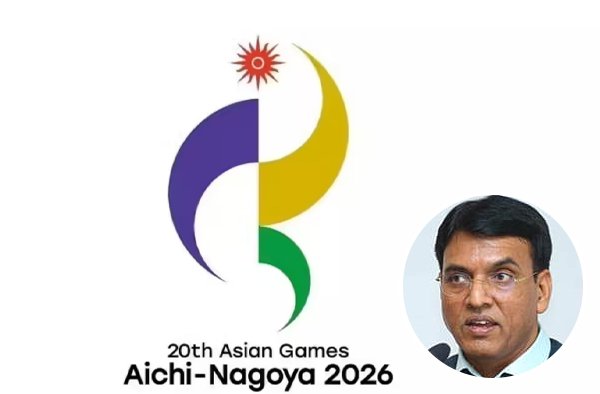
The statement comes as National Sports Federations (NSFs) begin finalizing their squads for the 20th Asian Games, scheduled to be held in Japan from September 19 to October 4, 2026. India heads into the continental showpiece after recording its best-ever Asian Games performance at Hangzhou in 2023, where the country won a historic 107 medals, including 28 gold, raising expectations for another strong campaign.
Speaking during an interaction on Thursday, Mandaviya reiterated that the ministry’s focus is on fielding athletes capable of competing for podium finishes rather than increasing the size of the contingent. “Asian Games or Commonwealth Games is not for exposure, it is a platform for athletes who can make the country proud. That is why we have the selection criteria saying only the top six in continental rankings would be considered. Exposure can be gained elsewhere, there is enough time and competition through the years.
“The ministry will never stop anyone from that. If federations prepare a training or exposure plan for LA 2028 and submit it to us now, they will have our full support for the next two years. Even individual athletes who wish to train anywhere in the world will be given assistance. But going to Asian Games simply for participation means jobs will not be cleared,” he declared.
The minister’s remarks underline the government’s broader strategy of prioritizing performance-based funding and long-term Olympic preparation. With the 2028 Los Angeles Olympics less than two years away after the Asian Games, the ministry wants federations to focus on structured development programmes instead of treating major championships as learning opportunities.
According to the current selection guidelines, athletes generally need to be ranked among the top six in Asia or demonstrate realistic medal-winning potential to qualify for government approval. While National Sports Federations conduct the initial selection process, the final authority rests with the Sports Ministry after a multi-layer verification procedure. Mandaviya also outlined the selection mechanism designed to ensure fairness and transparency across all sports.
“Videography in the presence of a government observer is mandatory. The selected names are then sent to the IOA, which forwards it to Sports Authority of India for vetting. That list then comes to the ministry for final clearance and only those will be allowed,” he added.
The process begins with the respective federation conducting selection trials under government supervision. These trials must be recorded through videography and monitored by an official observer to minimize disputes and ensure transparency. The selected names are then forwarded to the Indian Olympic Association (IOA), followed by scrutiny from the Sports Authority of India (SAI), before reaching the ministry for final approval.
Officials stressed that inclusion in a federation’s provisional list does not automatically guarantee a place in India’s official contingent.
Ministry sources also indicated that stricter controls will be imposed on non-playing members accompanying teams to Japan. In previous editions of international competitions, concerns had been raised over the inclusion of parents, relatives or unnecessary officials travelling as coaches, managers or support staff.
To address those concerns, the ministry has clarified that only individuals explicitly approved through the government’s sanction process will be recognized as part of the official delegation.
“A federation’s list does not constitute the final contingent. Only those athletes, coaches and support staff whose names are included in the ministry’s Sanction Order shall be treated as official members,” ministry sources said. The Indian contingent for the Asian Games is expected to be capped at around 560 athletes, significantly lower than the total number of entries submitted by several federations.
The move reflects the government’s intention to maintain a lean, competitive delegation while ensuring resources are directed toward athletes with genuine medal prospects.
India’s record-breaking performance at the Hangzhou Asian Games has elevated the country’s ambitions ahead of Aichi-Nagoya. Athletics, shooting, wrestling, badminton, boxing, archery, hockey and cricket are once again expected to contribute heavily to the medal tally, while emerging disciplines such as squash, rowing and sailing are also targeting podium finishes.
The Sports Ministry has simultaneously encouraged federations to submit long-term international exposure and training proposals as part of preparations for the Los Angeles Olympics. Mandaviya assured that financial assistance would not be a hurdle for athletes seeking overseas training or competition opportunities if such plans align with India’s high-performance objectives.
The government’s approach reflects its broader vision of building a sustainable sporting ecosystem in which athletes receive international exposure throughout the Olympic cycle rather than relying solely on marquee events. By separating developmental tours from medal-oriented competitions, officials believe resources can be allocated more effectively while maintaining high standards of accountability.
As India prepares for another significant chapter in its sporting journey, the message from the Sports Ministry is unequivocal: selection to the Asian Games will be earned through performance, transparency and the ability to compete at the highest level. With every place in the contingent expected to be fiercely contested, only athletes who meet the required benchmarks will have the opportunity to wear the national colours in Japan later this year.

