

Para athletics is the largest parasport which includes tracks, field, and marathon events for athletes with visual, physical, or intellectual impairments, and they’re governed by World Para Athletics.
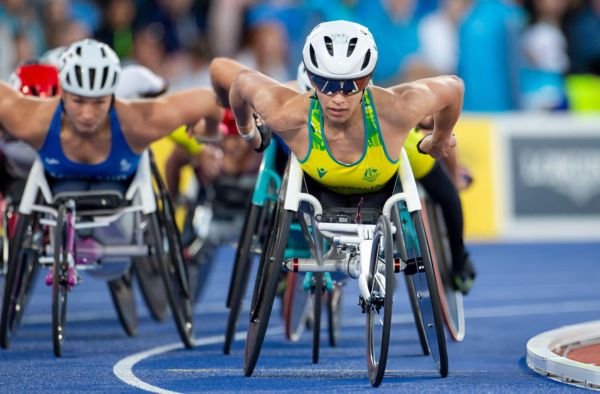
Categories:
- Track Events: Sprints, middle and long-distance races, and wheelchair racing using specialised racing chairs.
- Field Events: Jumps (high jump, long jump) and throws (shot puts, discus, javelin, and club throw).
* Guides and Assistive Gear: Visually impaired runners use sighted guides, while others use customized prosthetics or throwing frames
Understanding the Coding System:
Athletes are grouped using a standardized coding system. In total there are 10 eligible impairment types, which translates into 30 distinct sport classes.
T = Track and Jump events (Running, Wheelchair Racing, Long Jump, High Jump)
F = Field events (Shot Put, Discus, Javelin, Club Throw)
The first digit represents the type of impairment, while the second digit indicates the degree or severity of limitation (a lower second digit generally signifies a higher degree of impairment).
| Class Code | Impairment Category | Description & Examples |
| T/F 11 – 13 | Vision Impairment | 11: Fully or nearly fully blind (compete with a guide); 12–13: Partial visual impairment. |
| T/F 20 | Intellectual Impairment | Athletes with recognized intellectual disabilities. |
| T/F 31 – 34 | Ataxia, Athetosis, Hypertonia | Wheelchair events for athletes with coordination disorders or cerebral palsy. |
| T/F 35 – 38 | Ataxia, Athetosis, Hypertonia | Ambulatory (standing/running) events for athletes with coordination disorders or cerebral palsy. |
| T/F 40 – 41 | Short Stature | Athletes with dwarfism or reduced standing height. |
| T/F 42 – 44 | Lower Limb Impairment | Standing events for athletes with impaired muscle power, range of motion, or leg length differences (without prostheses). |
| T/F 45 – 47 | Upper Limb Impairment | Standing events for athletes with arm/shoulder amputations, impaired muscle power, or limited arm mobility. |
| T/F 51 – 57 | Seated / Wheelchair Athletes | Seated field events (F51–57) and wheelchair track events (T51–54) for athletes with spinal cord injuries or paraplegia. |
| T/F 61 – 64 | Lower Limb Prostheses | Standing events specifically for athletes competing with lower-limb prostheses (e.g., blade runners). |
In addition to these standard categories, you may occasionally see:
RR1 – RR3 (Frame Running): Track events using a three-wheeled running frame with a saddle and handlebar for athletes with severe balance impairments.
T54 / T11 Universal Relay: Mixed-gender and multi-classification relay teams consisting of athletes across four distinct classes (Vision, Wheelchair, Movement Disorder, Limb Impairment).
Which Para Athletic Events are being held at the 2026 Glasgow Commonwealth Games?
| Women’s Events | Men’s Events |
| 100m T38 (Coordination / CP — T37/38) | 100m T12 (Vision Impairment — T11/12) |
| 100m T38 (Coordination / CP — T37/38) | 100m T38 (Coordination / CP — T37/38) |
| 200m T38 (Coordination / CP — T37/38) | 100m T47 (Limb Impairment — T45/46/47) |
| 400m T54 (Wheelchair Racing — T53/54) | 1500m T20 (Intellectual Impairment — T20) |
| 1500m T54 (Wheelchair Racing — T53/54) | 1500m T54 (Wheelchair Racing — T53/54) |
| Long Jump T38 (Coordination / CP — T37/38) | Long Jump T20 (Intellectual Impairment — T20) |
| Shot Put F57 (Seated Field — F55/56/57) | Shot Put F57 (Seated Field — F55/56/57) |
| Discus F42–44 / F61–64 (Lower Limb / Prosthetic — Raza Points system) | Discus F42–44 / F61–64 (Lower Limb / Prosthetic — Raza Points system) |
When was Para Athletics first included at the Commonwealth Games?
During the 1994 Canada Games, Para-sports (including athletics) made their initial appearance as exhibition/demonstration events.
It was during the 2002 Manchester Games when Para athletics became fully integrated into the official medal program for the first time in the history of the Commonwealth Games.
Who Were the First Women to Win Medals?
The first women’s medal in Para athletics came at the 2002 Manchester Games in the Women’s 800m T54 Wheelchair Race:
- Gold (First Winner): Chantal Petitclerc (🇨🇦 Canada) — Won in 1:52.93, becoming the first-ever female para-athlete to win an official Commonwealth Games gold medal.
- Silver: Louise Sauvage (🇦🇺 Australia)
- Bronze: Eliza Stankovic (🇦🇺 Australia)
All female para-athletics gold medalists at the Commonwealth Games till now:
* Games Records (GR), World Records (WR)
| Games | Event | Winner / Athlete | Country | Winning Mark / Record |
| 2002 Manchester | 800m T54 | Chantal Petitclerc | Canada | 1:52.93 (GR) |
| 2006 Melbourne | 100m T54 | Chantal Petitclerc | Canada | 16.00 (GR) |
| 800m T54 | Chantal Petitclerc | Canada | 1:48.98 (GR) | |
| Shot Put Seated (F53–F58) | Njideka Iyiazi | Nigeria | 10.10 m (1088 pts) (GR) | |
| 2010 Delhi | 100m T13 | Oluchi Joyce Ndagu | Nigeria | 12.82 (GR) |
| 1500m T54 | Diane Roy | Canada | 3:53.95 (GR) | |
| Shot Put Seated (F32–F34/52–53) | Louise Ellery | Australia | 6.17 m (1110 pts) (GR) | |
| 2014 Glasgow | 100m T12 | Libby Clegg | Scotland | 12.20 (GR) |
| 1500m T54 | Angela Ballard | Australia | 3:59.20 | |
| Long Jump F37/38 | Jodi Elkington | Australia | 4.39 m (GR) | |
| Discus Throw F42–44 | Danre Liebenberg | South Africa | 33.33 m (GR) | |
| 2018 Gold Coast | 100m T35 | Isis Holt | Australia | 13.58 (GR) |
| 100m T38 | Sophie Hahn | England | 12.46 (GR) | |
| 1500m T54 | Madison de Rozario | Australia | 3:34.06 (GR) | |
| Marathon T54 | Madison de Rozario | Australia | 1:44:00 (GR) | |
| Long Jump T38 | Olivia Breen | Wales | 4.86 m (GR) | |
| Javelin Throw F46 | Hollie Arnold | Wales | 44.43 m (WR / GR) | |
| 2022 Birmingham | 100m T34 | Hannah Cockroft | England | 16.84 (GR) |
| 100m T38 | Olivia Breen | Wales | 12.82 | |
| 1500m T54 | Madison de Rozario | Australia | 3:53.03 | |
| Marathon T54 | Madison de Rozario | Australia | 1:56:00 | |
| Discus Throw F42–44/61–64 | Goodness Nwachukwu | Nigeria | 36.56 m (WR / GR) | |
| Shot Put F57 | Eucharia Iyiazi | Nigeria | 10.03 m (GR) |

