

She was not supposed to be here. She was not part of India’s original Asian Games squad, had lost the selection trial in June and arrived in Japan only after an unexpected change in the team. Yet when the biggest moment arrived, Naorem Roshibina Devi once again stood on the Asian Games podium.
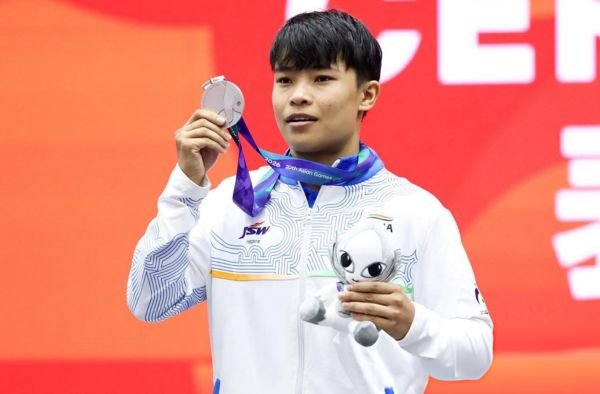
The 25-year-old Manipuri wushu star secured her third consecutive Asian Games medal on Thursday, winning silver in the women’s 60kg sanda category after losing 0-2 to China’s Zhang Xiaoyu in the final at the Aichi Prefectural Martial Arts Hall. The achievement makes Roshibina the first Indian wushu athlete to win medals at three successive Asian Games.
But the silver came after a final in which the Chinese fighter established control almost immediately. All five judges awarded Zhang a 5-0 decision in both two-minute rounds, with her side-kicks proving particularly difficult for Roshibina to counter. Zhang dominated the opening round, with the five judges’ scores reading 6-2, 6-3, 6-2, 6-2 and 8-2 in her favour.
The Chinese fighter was even more commanding in the second, with scores of 10-2, 8-3, 7-3, 7-3 and 6-1. Roshibina struggled to impose her own attacking game and remained subdued for large portions of the bout as Zhang’s speed, aggression and technical execution dictated the contest.
“I have won silver earlier and this time also, I could win only silver. I could not give the gold medal to the Indian people. I could not give what everyone wanted,” Roshibina said after the bout. The disappointment, however, cannot overshadow the remarkable circumstances surrounding her campaign.
Roshibina had initially lost her place in the Indian squad after Divyanshi Choudhary defeated her in the selection trials in Srinagar in June. Divyanshi was subsequently withdrawn after the Wushu Association of India cited a high-grade ACL injury, opening the door for Roshibina’s return. The selection change triggered a controversy, with Divyanshi making allegations against Roshibina that the latter chose not to engage with. The Wushu Association maintained that the replacement was based on medical grounds.
“I will ignore it (the accusation). I just want to focus on my goal,” said Roshibina. The Manipuri had barely enough time to prepare for the opportunity that came her way. She said she learnt of her inclusion around September 10 and travelled directly from Manipur to join the Indian contingent.
“I came to know of my inclusion in the team around September 10 and straightway came here from home (from Manipur) without training much,” she said. “There was a lot of disturbance when I came here for the Asian Games. I did not get much time to prepare. But, my coach (Amit Pal) supported me a lot to reach here. I will try my best in the upcoming Games, learn from my mistakes and come back,” said the Manipuri.
Once competition began, however, Roshibina quickly put the uncertainty behind her. She defeated Bangladesh’s Shika Khatun in the pre-quarterfinals, followed that with a 5-0 win over Macao China’s Chu Man Sin in the quarterfinals and then defeated Indonesia’s Thania Kusumaningtyas 2-0 in the semifinal to assure herself of a medal. Her latest medal adds to the bronze she won at the 2018 Jakarta Asian Games and the silver she claimed at Hangzhou in 2023. At Hangzhou, she had also reached the 60kg sanda final before finishing runner-up.
For Roshibina, the journey to this podium has also been rooted in considerable sacrifice. Hailing from Kwasiphai Mayai Leikai in Manipur’s Bishnupur district, she grew up in a farming family. Her father, Naorem Damu Singh, initially had reservations about her taking up wushu but eventually supported her ambitions, even selling a piece of land to help fund her training and travel during the early stages of her career.
Reflecting on the final, Roshibina acknowledged the difference between herself and Zhang. “She (Chinese player) is a new player, I have not fought against her. She was good in her side kicks. I also tried to defend. I tried to throw her, but she did better. I will do my best for India in the upcoming Games.” Her coach Amit Pal also pointed to the lack of preparation as a factor.
“The Chinese fighter was very good, something lacking (in Roshibina). But also, Roshibina did not get much time to prepare. She was out of the national camp for one and half months. After trials in June in Srinagar, she left for her home since she lost. After Divyanshi’s ACL injury, Roshibina was named in the team on September 10. She had little training (in between) and straightaway came here,” he said.
Roshibina’s silver is more than another medal on India’s growing Asian Games tally. It is a story of what happened after selection uncertainty, limited preparation and a difficult build-up. The gold medal escaped her once again, and her final exposed the gap between Roshibina and a Chinese opponent who controlled the contest from the opening exchange.
Yet reaching the final after entering the squad at the last moment underlines the consistency of an athlete who has now medalled at three successive Asian Games. India’s campaign in Aichi-Nagoya has already produced medals across shooting, weightlifting, badminton, MMA, rowing and wushu, with Roshibina’s silver adding another podium finish on Day 6.
For Roshibina, though, the target remains unchanged. The bronze from Jakarta became silver at Hangzhou. The silver has come again in Aichi-Nagoya. The Asian Games gold is still missing from her collection, and after another medal on the continental stage, the Manipuri now has another four years to chase the one that got away.

