

Neeru Dhanda turned precision into history on Tuesday, producing a composed performance under pressure to win the women’s individual trap gold at the 2026 Asian Games and become the first Indian woman to claim the continental title in the event. The 26-year-old Indian shooter struck 28 targets in the final, breaking the previous Asian Games record of 24 and adding India’s fifth gold medal at the Aichi-Nagoya Games. China’s Sun Yunong finished with 26 hits for silver, while Kuwait’s Hajar Abdulmalik took bronze with 21.
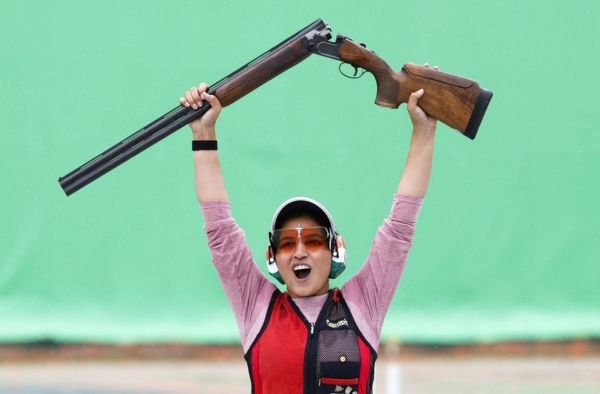
The result capped an extraordinary year for Dhanda, who has steadily moved from being a promising name in Indian shooting to becoming one of the country’s leading trap shooters. Making her Asian Games debut, Dhanda entered the individual final with significant momentum. She had finished joint-top in qualification with Qatar’s Ray Bassil after producing 118 points, a score that equalled the Games qualification record. Her performance had already helped India secure silver in the women’s trap team event alongside Aashima Ahlawat and Manisha Keer.
The final demanded even greater composure. Dhanda opened with a perfect first series, hitting all five targets. She suffered a miss in the second series but did not allow the mistake to derail her rhythm. As the pressure intensified, the Indian remained composed and continued to find her targets, eventually finishing on 28 to pull clear of Sun and Abdulmalik. Her gold also ended a long wait for India in the women’s trap event. The victory is India’s first individual women’s trap gold at the Asian Games, making Dhanda the latest Indian shooter to break new ground on the international stage.
From World Cup breakthrough to Asian Games glory. Dhanda’s Asian Games triumph is not an isolated achievement. In July, she became the first Indian woman to win an individual ISSF World Cup gold in women’s trap, triumphing at the Shotgun World Cup in Lonato, Italy. She shot 27 out of 30 in the final to defeat a world-class field, marking India’s first-ever women’s trap gold at the ISSF World Cup. That victory followed her Asian Championships success and her national-level performances, establishing a clear upward trajectory heading into the Asian Games. Dhanda also represents the Indian Army’s Army Marksmanship Unit and serves as a Naib Subedar. She hails from Haryana’s Jind district and represents Madhya Pradesh in national competitions.
Dhanda’s gold is significant not simply because it adds another medal to India’s tally, but because of where it comes in India’s shooting journey. Indian shooting has traditionally produced strong performances at the Asian Games, but women’s trap has remained an area where the country had been waiting for a breakthrough. Dhanda has now supplied that breakthrough with an Asian Games record and a performance that follows her historic World Cup victory. The sequence is particularly encouraging: World Cup gold in July, team silver at the Asian Games, followed by individual Asian Games gold.
For Indian shooting, the performance points to a growing depth beyond the country’s more established rifle and pistol names. For women’s sport, it is another reminder that India’s medal prospects are increasingly spreading across disciplines and athletes. Dhanda’s gold also gives India a second significant shooting storyline at Aichi-Nagoya after the country’s strong start in the sport. Her victory combines experience, consistency and the ability to deliver when the final targets matter most. And on a day when every shot carried the weight of an Asian Games medal, Dhanda missed only twice across the decisive final.

