

The Canada Open 2026 final has produced a matchup that feels less like a conclusion and more like a referendum on two contrasting versions of modern women’s tennis. Elena Rybakina arrives in Toronto with momentum, resilience and a Grand Slam title already secured this season. Iga Swiatek arrives chasing her first singles title of 2026. When they meet on Thursday night, the head-to-head will be perfectly balanced at 6-6, but neither player will want the past to dictate what happens next.
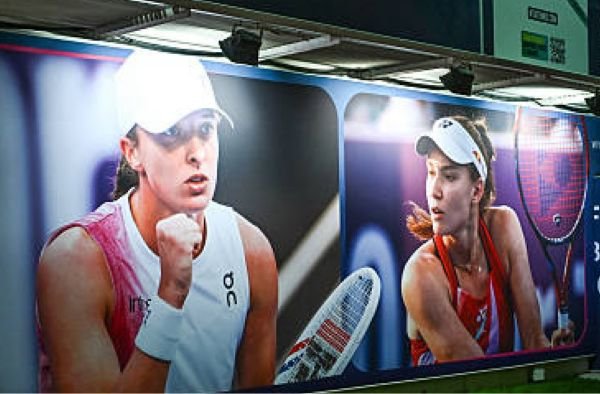
World No. 2 Rybakina is bidding for her third title of the season and seventh career WTA 1000 final, while No. 8 Swiatek has reached her first main-draw final of 2026. Their previous meeting came in the Australian Open quarterfinals in January, where Rybakina won in straight sets. Now, eight months later, Toronto offers Swiatek the chance to level the score on a much bigger stage. This is also a contest between two players who have had very different journeys to the championship match.
Rybakina’s route to the final has been anything but straightforward. After receiving a first-round bye, the Kazakh defeated Daria Kasatkina 6-3, 5-7, 6-4 before overcoming Ann Li in straight sets. She then needed three sets again to beat Liudmila Samsonova, 6-4, 4-6, 6-4. The real test came in the quarterfinals against Naomi Osaka. Rybakina dropped the opening set 4-6 and fell behind at crucial stages of the second. Yet she survived a dramatic tiebreak before eventually winning 4-6, 7-6(5), 6-4. The victory was another reminder that her game is not simply about the power that comes from her serve and groundstrokes. She can absorb pressure too.
The reward was another demanding semifinal against Coco Gauff. Rybakina again lost the opening set, 4-6, but responded emphatically, taking the next two 6-2, 6-2 to book her place in the final. The comeback against Osaka was particularly revealing. Rybakina had to recover from multiple deficits and was just two points from losing the second-set tiebreak before turning the match around.
As Rybakina herself put it: “She has been playing well. It’s going to again be a very difficult match, and we know each other so well. We play so many times. So in my case, I feel it’s more again about the recovery after so many hours on the court, and bring as much energy as I can.”
There is a practical concern behind those words. Rybakina has spent long stretches on court during this run, and the final will test whether her physical reserves can match her shot-making.
Her confidence, however, is obvious. “I guess the adrenaline and so many hours on the court helped a bit. In the third set also, few moments I felt like I was just swinging, and some crazy return at 30-all, and it went my way. So, I got my opportunities, I took them. I was trying not to think about the score, just going a point at a time. Also on the serve, I was just picking the targets. Even if she knew where I’m serving, I was just going for it, and it worked today.”
Swiatek’s road has looked considerably cleaner. The Pole began with a bye before dispatching Sara Bejlek 6-0, 6-3 and Viktorija Golubic 6-2, 6-1. Marta Kostyuk provided her first real test, taking the opening set 6-3, but Swiatek responded with a 6-1, 6-2 turnaround. She then dismantled Diana Shnaider 6-2, 6-1 before beating Elina Svitolina 6-3, 1-6, 6-3 in the semifinal.
The Svitolina match mattered beyond simply reaching the final. Swiatek had lost to the Ukrainian in Rome earlier this season, making the Toronto victory another indication that the former world No. 1 is finding solutions against opponents who have troubled her. It also means Swiatek has collected three top-20 victories at one event for the first time since her 2024 Roland Garros triumph.
Her own explanation for the turnaround is revealing. “For sure it was just comfortable. From the beginning we felt like we have still a lot of time until the tournament, so the practices were not focused on the tournament, they were just to develop my game. Later on obviously it switched more to just preparing for the opponents.”
There has also been a tactical shift. “Well, that was the goal from the beginning when I started working with Francis. Playing on clay, and with all this fuss around that I usually have there, sometimes it’s not helping. I didn’t have so much clarity in my head to always keep doing the stuff that he wanted me to do. Here, I feel it’s already got more into my habit, and it became more natural. That’s definitely how I want to play, to have this patience. I feel I was playing a little bit too flat and too fast sometimes last year, making risky decisions. This is more my game, so, like, what I’m trying to do now is more my game.”
Rybakina’s greatest weapon remains her ability to take time away from an opponent. Her serve can produce cheap points, while her first strike tennis can turn neutral rallies into winners almost instantly. Swiatek’s advantage is her ability to build pressure through movement, depth and relentless consistency. If she can extend rallies and prevent Rybakina from dictating early, the final could become a test of patience rather than raw power.
The head-to-head offers no obvious psychological advantage. Six wins apiece means there is little separating them historically, although Rybakina’s most recent victory in Melbourne gives her a recent edge. The Toronto conditions should also matter. The National Bank Open is played on outdoor hard courts and is one of the WTA’s 1000-level events. The tournament features a 96-player singles draw and offers 1,000 ranking points to the champion.
When and where to watch the final
The women’s singles final will be played on Thursday, August 13, at Sobeys Stadium in Toronto. The doubles final between Katerina Siniakova/Zhang Shuai and Sara Errani/Nicole Melichar-Martinez is scheduled first at 3:30 p.m. local time, with Rybakina vs Swiatek not before 6 p.m. local time. For Indian viewers, the singles final is scheduled for 3:30 a.m. IST on Friday, August 14, subject to any schedule changes. The official National Bank Open broadcast partners in Canada are Sportsnet and TVA Sports, while WTA TV is the official online streaming service for WTA tournaments.
What is at stake?
The champion will collect $1,085,200 from the tournament’s total prize purse of $7,433,076 and earn 1,000 WTA ranking points. The runner-up will receive $564,920 and 650 points. For Rybakina, victory would mean a third title of the season and another major statement during a season in which she has already established herself as one of the tour’s most dangerous hard-court players.
For Swiatek, it would mean something different. It would be her first singles title in 11 months and the latest evidence that her game is evolving beyond the dominant patterns that once made her almost unbeatable on clay. The final, then, is not simply about who has played better in Toronto. It is about which version of each player survives when the margins disappear.
