

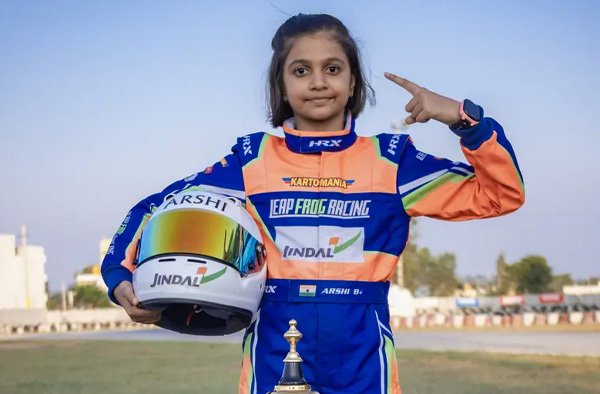
At an age when most children are balancing school homework and playground games, nine-year-old Arshi Gupta is competing against some of the best young karting talents in the world. The young racer from Faridabad is rapidly becoming one of the brightest names in Indian motorsport after another standout performance at the TVKC Championship 2026 Round 2 at the iconic PF International circuit in the United Kingdom.
Arshi’s recent success has once again placed Indian karting on the global map. Competing at one of Europe’s most competitive karting venues, the youngster impressed with her pace, composure and fearless driving style against an international field of racers. Her performances at PF International have further strengthened her reputation as one of the most promising talents in junior motorsport. PF International, home to the Trent Valley Kart Club, is regarded as one of the premier karting circuits in the world and regularly hosts elite international competitions. The achievement adds another chapter to what has already been a historic journey for the Indian prodigy. In 2025, Arshi created history by becoming the youngest national karting champion after winning the FMSCI National Karting Championship in the Micro Max category. The title made her the first Indian female racer to win a national karting championship in the Rotax series’ 21-year history.
What makes her rise even more remarkable is that karting operates in a mixed-gender environment, where boys and girls compete together under identical racing conditions. There are no separate grids, no concessions, and no advantages. Results are decided purely by speed, racecraft and consistency. In Arshi’s case, her performances have consistently spoken louder than expectations.
Born in Faridabad in 2016, Arshi began karting at the age of seven and quickly established herself as one of India’s standout young racers. Racing under Leapfrog Racing, she showcased her potential throughout the 2025 season with commanding performances in Chennai, Coimbatore and Bengaluru. Her ability to adapt quickly to different circuits and racing conditions became one of her biggest strengths during the championship campaign.
Behind the trophies and headlines lies an intense training routine that reflects the level of dedication required in modern motorsport. Speaking to The Times of India, Arshi described her demanding schedule by saying, “I wake up at 5 am, have breakfast, and I’m on the track from 8.30 am to 4 pm.” Such discipline has become part of her daily life. Before leaving for the UK, her training sessions reportedly became even more rigorous as she prepared to compete against experienced international racers. Family members told TOI that despite the physically and mentally exhausting schedule, Arshi continued pushing herself simply because she genuinely loved being behind the wheel.
Her recent performances in Britain have also highlighted the growing global exposure of Indian motorsport talent. British karting circuits such as PF International are considered major proving grounds for future Formula drivers and have hosted numerous international championships over the years. Motorsport UK regularly streams and supports major karting competitions at the venue, further underlining its importance within world motorsport.
Arshi’s emergence also carries wider significance for women in motorsport. Female participation in racing continues to grow globally, but success stories at such a young age remain rare. By competing and winning in mixed-gender championships, she is inspiring a new generation of girls to enter a sport traditionally dominated by male racers. Despite her growing popularity and mounting achievements, Arshi’s focus appears firmly fixed on improvement rather than attention. Coaches and observers have frequently praised her maturity, consistency and calmness under pressure, qualities rarely seen in drivers of her age group.
For Indian motorsport, Arshi Gupta represents more than just a young champion. She symbolises a changing landscape where talent, ambition and opportunity are beginning to break long-standing barriers.

