

Champions are often judged by the medals they win. Great champions, however, are remembered for knowing which battles matter most. As Saikhom Mirabai Chanu prepares to defend her Commonwealth Games title in Glasgow, the expectation from Indian fans is simple: another gold medal. Yet behind that familiar objective lies a far more calculated mission.
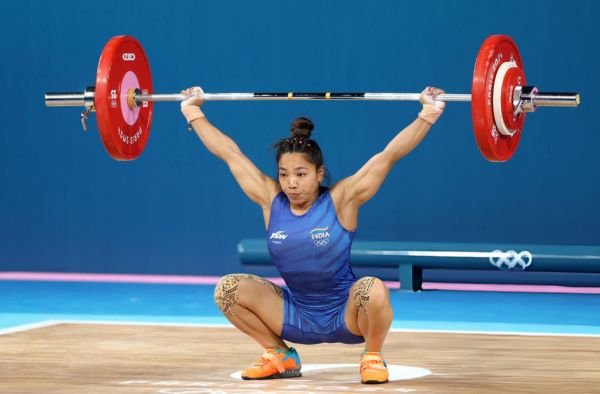
For India’s Olympic silver medallist, the Commonwealth Games are not the final destination of the season but an important milestone on the road to the Asian Games in Aichi-Nagoya, where the one medal missing from her glittering collection continues to motivate her.
At 31, Mirabai no longer competes to prove she belongs among the world’s best. She competes to preserve a legacy built through extraordinary resilience, meticulous planning and an unwavering commitment to excellence. Every lift now is measured not only in kilograms but in longevity, fitness and preparation for the challenges that matter most.
That is precisely why India’s national chief coach Vijay Sharma believes Glasgow should be approached with caution rather than aggression. “For Mira, the CWG will be like a practice event before the Asian Games. A total of 190-195kg should be enough for her to win the CWG gold medal. Irrespective of the total, a gold is a gold. Her main target is medalling at the Asian Games,” Vijay said.
Those words reflect the evolution of an athlete who has already achieved what few Indian weightlifters have managed.
Mirabai enters the 2026 Commonwealth Games seeking her third consecutive Commonwealth Games gold medal and an unprecedented fourth Commonwealth Games medal overall, achievements that would further cement her status as one of India’s greatest weightlifters.
Her Commonwealth journey began with a silver medal at the 2014 Games in Glasgow, where she announced herself as one of India’s brightest young prospects. Four years later on the Gold Coast, she dominated the women’s 48kg competition with a Commonwealth Games record performance, winning gold by an overwhelming margin while breaking records in both the snatch and total lift.
She repeated the feat at Birmingham 2022, once again standing atop the podium and reaffirming her consistency at the highest level. Few athletes have displayed such sustained excellence across multiple Commonwealth Games cycles.
Mirabai’s career extends far beyond the Commonwealth stage.
Born in Nongpok Kakching in Manipur, Mirabai’s story has become one of the defining narratives of Indian sport. Growing up in a modest household, she displayed remarkable physical strength from an early age, famously carrying bundles of firewood that many adults struggled to lift. That natural ability eventually guided her towards weightlifting, where she steadily progressed through national competitions before emerging on the international stage.
Her breakthrough came in 2017, when she captured the World Championship title in Anaheim, becoming only the second Indian woman after Karnam Malleswari to win a gold medal at the World Weightlifting Championships.
The triumph established her among the world’s elite, but it was her performance at the Tokyo Olympics in 2021 that transformed her into a household name.
Lifting a combined total of 202 kilograms, Mirabai secured the Olympic silver medal, ending India’s 21-year wait for an Olympic medal in weightlifting. It was not merely a personal achievement but a landmark moment for Indian sport, inspiring a new generation of athletes to pursue weightlifting as a serious competitive discipline.
Her journey, however, has never been straightforward. The disappointment of failing to register a successful lift at the Rio Olympics in 2016 remains one of the defining setbacks of her career. Many athletes struggle to recover from such heartbreak. Mirabai responded by rebuilding herself physically and mentally, eventually returning stronger than ever to conquer the World Championships, Commonwealth Games and the Olympic podium. That resilience has become the hallmark of her career.
Once again, injury management has emerged as a key consideration. Earlier this year, Mirabai lifted 205kg at the National Championships in Modinagar, demonstrating encouraging form before withdrawing from the Asian Weightlifting Championships in Gandhinagar due to a shoulder injury. Rather than risking aggravation, the decision reflected a carefully managed long-term approach centred on peak performance later in the season.
Unlike the Commonwealth Games, where Mirabai has consistently dominated her category, the Asian Games present an altogether different level of competition. Lifters from China, North Korea, Chinese Taipei and other Asian nations regularly occupy the world’s highest rankings, making the event arguably more competitive than even the Olympics in certain weight categories.
Remarkably, despite her extraordinary achievements, an Asian Games medal continues to elude Mirabai. That reality makes the upcoming Games in Aichi-Nagoya particularly significant.
Success there would complete one of the most decorated careers in Indian sporting history by filling the only major gap in an already remarkable medal collection. It also explains why her coaching team has no interest in chasing unnecessary records in Glasgow. Winning efficiently has become more valuable than winning spectacularly. India’s overall weightlifting campaign also carries additional challenges this year.
Following four positive doping tests, including that of gold medal hopeful N. Ajith, India’s quota for the Commonwealth Games was reduced, leaving the 12-member squad with fewer opportunities to replicate the impressive 10-medal haul achieved at the Birmingham Games in 2022.
To maximise preparation, the Indian contingent spent more than three weeks training at the University of Wolverhampton in Birmingham before relocating to Glasgow. The camp allowed athletes to adapt to local conditions while fine-tuning their lifting schedules ahead of competition.
Her influence stretches far beyond medals. She has inspired increased participation in weightlifting across India, particularly in the North East, where aspiring athletes now see a realistic pathway to international success. Her humility, discipline and consistency have made her one of India’s most admired sporting ambassadors.
As Glasgow approaches, the temptation will be to focus solely on whether Mirabai can defend her Commonwealth title. The more intriguing question is whether this carefully managed campaign will position her for the challenge that has remained unfinished throughout her remarkable career. For an athlete who has conquered the Commonwealth Games, become a world champion and stood on the Olympic podium, the pursuit of an Asian Games medal has become the final frontier.
Another Commonwealth gold would undoubtedly add another chapter to Mirabai Chanu’s extraordinary legacy. But if Glasgow serves as the stepping stone towards finally conquering Asia, it may ultimately be remembered not as the destination, but as the beginning of her most meaningful campaign yet.

