

For years, Indian boxing has relied on familiar names to deliver medals on the biggest stages. Mary Kom inspired a generation. Lovlina Borgohain carried that legacy into the Olympic era. But every successful sporting nation eventually reaches a moment when one generation begins to hand over the gloves to the next.
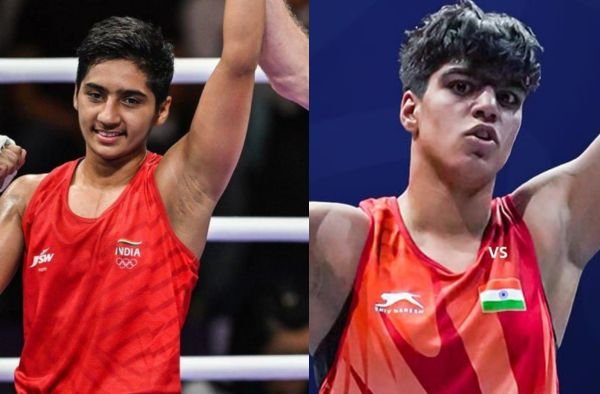
At the 2026 Commonwealth Games in Glasgow, that transition is unfolding in real time. While Olympic medallist Lovlina continues to lead the squad, it is the emergence of Preeti Pawar and Priya Ghanghas that may prove to be one of India’s biggest victories at these Games. Their quarter-final wins, which guaranteed at least bronze medals, were not merely additions to India’s medal tally. They were statements that Indian women’s boxing has evolved beyond dependence on a handful of stars. It now possesses genuine depth, backed by a pipeline capable of producing world-class talent across multiple weight categories.
Competing at the Scottish Event Campus, world No. 3 Preeti Pawar looked every bit the elite boxer her ranking suggests. The 21-year-old outclassed Northern Ireland’s Nicole Clyde in the women’s 54kg quarter-final with a clinical 5-0 unanimous decision. From the opening bell, Preeti dictated the pace, forcing Clyde into a standing count in the first round before repeating the feat in the second with crisp combinations and relentless pressure. By the final round, there was little doubt over the result as the judges unanimously awarded her the contest, setting up a semi-final against Zambia’s Catherine Mwape.
It was the kind of performance that reflected maturity rather than raw aggression. Preeti’s rise has been anything but accidental. The Maharashtra boxer has steadily climbed through the international ranks over the past two years, winning medals at the Asian Games before establishing herself among the world’s top-ranked boxers. Earlier this year, she captured gold at both the Asian Elite Boxing Championships and the prestigious Grand Prix Usti nad Labem, defeating quality international opponents with remarkable consistency.
If Preeti’s victory showcased technical superiority, Priya Ghanghas’ win highlighted something equally valuable in championship boxing: resilience. Facing Scotland’s Niamh Mitchell in front of a vocal home crowd, Priya lost the opening round and briefly found herself on the back foot. Many young boxers struggle to recover when momentum swings against them in hostile conditions.
Priya responded differently. She gradually wrestled control of the contest, increased her work rate and forced Mitchell onto the defensive. After claiming the second round, she produced an even stronger final three minutes to earn a 4-1 split-decision victory and secure her place in the women’s 60kg semi-finals, where England’s Lucy Kings-Wheatley awaits. Championship boxing is often decided less by flawless performances than by the ability to solve problems under pressure.
Priya demonstrated exactly that. Her comeback reflected the growing confidence within India’s boxing programme, where athletes are increasingly exposed to high-quality international competition before stepping onto major championship stages. Like Preeti, Priya entered Glasgow after an outstanding season that included gold medals at both the Asian Elite Championships and the Grand Prix Usti nad Labem, victories that established her among India’s most reliable prospects.
India’s encouraging day inside the ring did not end there. World No. 8 Jadumani Singh Mandengbam added another assured performance in the men’s 55kg division, defeating Zambia’s Mwengo Mwale by a unanimous 5-0 decision to secure another guaranteed bronze medal. After edging a competitive opening round, the Manipuri boxer took complete control, displaying the composure that has made him one of India’s brightest male prospects. He will now face Namibia’s Philip Haoseb for a place in the final.
Not every contest, however, went India’s way. Parveen Hooda’s campaign ended in heartbreak after a narrow 3-2 split-decision defeat to England’s Sacha Hickey despite finishing strongly and winning the final round unanimously. Kapil Pokhariya also bowed out following a 5-0 defeat against Scotland’s Robert McNulty in the men’s 90kg quarter-finals. Their exits served as reminders of the fine margins that separate success and disappointment at elite level.
Yet, despite those setbacks, India now has four guaranteed boxing medals in Glasgow, with Lovlina Borgohain having already secured a place in the semi-finals through a direct entry. The overall picture remains overwhelmingly positive.
What makes Preeti Pawar and Priya Ghanghas particularly significant is not simply that they are winning medals. It is how they are winning them. Preeti’s clinical precision and ability to dominate opponents from the outset point towards a boxer capable of controlling contests against the world’s best. Priya’s adaptability and fighting spirit reveal an athlete comfortable overcoming adversity. These are qualities that often separate podium finishers from champions.
Their performances also validate the investment made in India’s revamped boxing structure. Regular international exposure, scientific coaching methods and increased competition through national and continental tournaments have created a generation that arrives at major events already accustomed to high-pressure contests. The recent success of Indian boxers at the Asian Championships and the Grand Prix Usti nad Labem was not an isolated achievement. Glasgow is proving it was a sign of things to come.
For Indian boxing, the Commonwealth Games have traditionally been both a proving ground and a launchpad. Several Olympic medallists first announced themselves on this stage before progressing to world championships and the Olympic podium. Preeti Pawar and Priya Ghanghas now stand at that same crossroads. Their guaranteed bronze medals already represent personal milestones. But with semi-finals still to come, they have the opportunity to turn promising campaigns into defining ones.
More importantly, they are helping rewrite the story of Indian boxing. It is no longer a narrative built around one iconic champion carrying the nation’s hopes. Instead, it is becoming a story of depth, continuity and a new generation ready to keep India among the world’s boxing powers. In Glasgow, Preeti Pawar and Priya Ghanghas have not just secured medals. They have announced that the future of Indian boxing has already stepped into the ring.

