

Sakshi Chaudhary’s latest performance at the Commonwealth Games in Glasgow was a timely reminder that sometimes the most convincing victories are also the quietest.
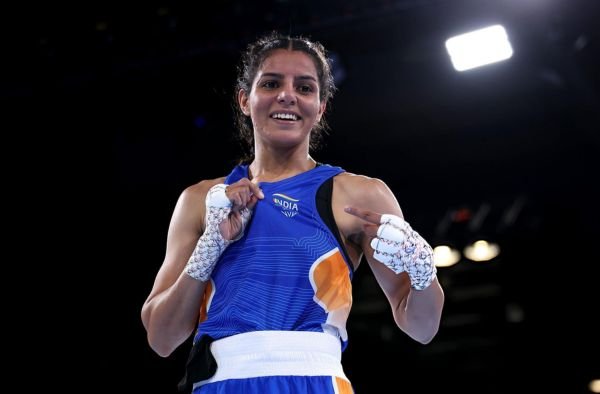
In booking her place in the women’s 51kg semifinals with a comprehensive 5-0 unanimous decision over Northern Ireland’s Caitlin Fryers, Sakshi did more than guarantee India another Commonwealth Games medal. She demonstrated the maturity of a boxer who appears increasingly comfortable carrying the weight of expectation. At just 24, she boxed not like an athlete chasing her first major podium but like someone who already understood exactly how championship bouts are won.
The quarterfinal was never going to be straightforward. Fryers entered the ring with an aggressive game plan, attempting to overwhelm the Indian from the opening bell. Powerful hooks, constant forward movement and repeated attempts to close the distance signalled her intention to unsettle Sakshi before she could establish her rhythm. The opening exchanges were physical, with several clinches forcing repeated interventions from the referee. For a brief period, the contest threatened to become exactly the kind of fight Fryers wanted, scrappy, close and uncomfortable.
Instead of matching aggression with aggression, she relied on timing and precision. A sharp left hand to Fryers’ head drew applause from the Glasgow crowd and marked the turning point of the contest. From that moment onward, the Indian boxer gradually took control through cleaner combinations, superior movement and calculated shot selection. All five judges awarded her the opening round, reflecting not just her effectiveness but also her command of the ring.
If the first round established control, the second showcased complete tactical superiority. Sakshi’s footwork became her greatest weapon. She repeatedly stepped outside Fryers’ range, neutralising the Northern Irish boxer’s left hooks before responding with crisp combinations to both head and body. A perfectly timed one-two encapsulated the gulf in class between the two competitors. Every attack seemed measured, every defensive movement purposeful.
There was a brief interruption when both fighters lost balance during an exchange and fell to the canvas. It could have disrupted the rhythm of the bout. Instead, Sakshi simply resumed where she had left off, calmly dictating the pace while sweeping another round on all five scorecards.
By the time the third round began, the result already felt inevitable. Fryers needed something extraordinary to reverse the contest. Sakshi gave her no such opportunity. She maintained her discipline, avoided unnecessary exchanges and continued to pick her punches with remarkable confidence. When the final bell rang, the judges required little deliberation before unanimously awarding the bout to the Indian by a 5-0 margin.
The victory guaranteed India at least a bronze medal because both losing semifinalists in Commonwealth Games boxing receive bronze. More importantly, it reinforced why Indian boxing has emerged as one of the country’s most reliable medal-producing disciplines on the international stage.
Sakshi’s journey to Glasgow has been anything but routine. A former World Youth and World Junior champion, she has long been regarded as one of India’s brightest boxing prospects. Yet injuries repeatedly interrupted her rise, forcing her to miss previous opportunities to compete at the Commonwealth Games. Glasgow therefore represents more than another tournament. It is the stage she had twice been denied.
Her selection itself reflected the fierce competitiveness within Indian boxing. Earlier this year, Sakshi produced one of the biggest upsets in the national trials by defeating two-time world champion Nikhat Zareen after moving into the 51kg category. It was a result that underlined the remarkable depth of India’s women’s boxing programme, where even established world champions cannot take selection for granted.
The broader context makes her success even more significant. India’s boxing contingent has been among the standout performers in Glasgow. By reaching multiple semifinals across men’s and women’s categories, Indian boxers have already surpassed the seven-medal haul achieved at the Birmingham Commonwealth Games in 2022. The contingent has guaranteed at least ten medals, signalling the arrival of one of India’s strongest Commonwealth boxing campaigns.
This consistency is no accident. Over the last decade, Indian boxing has steadily evolved through sustained investment in grassroots development, international exposure and scientific coaching. The women’s programme, in particular, has become a symbol of continuity. From pioneers like M C Mary Kom to Olympic medallist Lovlina Borgohain and the new generation led by Preeti Pawar, Priya Ghanghas, Arundhati Chaudhary and Sakshi Chaudhary, the pipeline continues to produce athletes capable of competing with the world’s best.
Yet Glasgow also presents a challenge. Assured medals are valuable, but champions are ultimately remembered for converting opportunities into gold. The semifinals and potential final will test Sakshi against opponents who are tactically sharper, physically stronger and mentally experienced. Every mistake will be magnified. Every round will demand greater discipline. If her quarterfinal performance is any indication, however, Sakshi possesses the qualities required for that challenge.
She never appeared hurried. She never chased the contest. She allowed the bout to unfold on her terms, trusting technique over emotion and strategy over spectacle. In a sport where adrenaline often dictates decision-making, that composure may prove to be her greatest competitive advantage.
Indian boxing has produced plenty of fighters capable of landing knockout punches. Glasgow is showing that it has also produced a generation capable of winning with intelligence. Sakshi Chaudhary’s performance against Caitlin Fryers was not merely another step towards a medal. It was a statement that the future of Indian boxing may belong not to the loudest punch, but to the calmest mind.

