

For years, Indian boxing has lived with the burden of producing moments rather than movements. A world championship here, an Olympic medal there, a Commonwealth Games gold every few years. The success stories were undeniable, but they often revolved around individual brilliance. Glasgow is beginning to tell a different story. This is no longer a team relying on one or two stars to carry the nation’s hopes. It is a production line of champions, where depth has become India’s greatest strength.
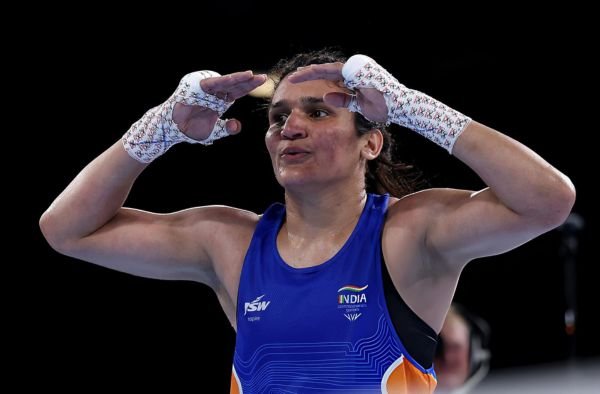
Wednesday at the Commonwealth Games was not merely another successful day in the ring. It was perhaps the clearest indication yet that Indian boxing has entered a new era. India won all five bouts it contested, with Narender Berwal, Ankush Yadav, Sakshi Chaudhary, Arundhati Choudhary and Sachin Siwach all progressing to the semifinals. Their victories took India’s tally of semifinalists to nine, already surpassing the seven medals the country secured at the Birmingham Commonwealth Games in 2022, where India finished with three gold, one silver and three bronze medals.
With both losing semi-finalists receiving bronze in Commonwealth boxing, India has already guaranteed itself at least nine medals in Glasgow. The numbers are impressive, but they tell only part of the story. What stood out throughout the day was the variety of victories. Each boxer won differently, highlighting the tactical diversity that now defines Indian boxing. There was no single blueprint for success. Instead, there was evidence of a programme capable of producing athletes who understand their own strengths and adapt accordingly.
Sakshi Chaudhary, competing in the women’s 51kg category after moving down from 54kg, delivered another masterclass in controlled boxing. Northern Ireland’s Caitlin Fryers attempted to unsettle her through relentless aggression and constant clinching, but Sakshi never abandoned her plan. “Her strategy was to fight from close range and she kept clinching. Mine was to box from long range which is my forte,” Sakshi told PTI after the bout.
That tactical clarity was evident throughout the contest. Making intelligent use of her height and reach, Sakshi dictated the distance with sharp jabs, straight punches and excellent footwork. Even when both fighters tumbled to the canvas during a clinch in the second round, she immediately regained composure and resumed control. The judges unanimously awarded her the contest 5-0, underlining her complete dominance.
Arundhati Choudhary’s route to the semifinals demanded a different approach altogether. Facing New Zealand’s Morgan Henderson in the women’s 70kg quarterfinal, she had to absorb sustained pressure before edging a hard-fought 3-1 victory. Unlike Sakshi’s relatively comfortable outing, Arundhati’s bout became a test of resilience and decision-making under pressure. She responded with maturity, ensuring India another guaranteed medal while demonstrating the mental toughness required during championship boxing.
If composure defined the women’s performances, precision characterised Sachin Siwach’s display. The former World Youth champion and current world No. 5 dismantled Botswana’s Treasure Moremi with clinical efficiency in the men’s 60kg quarterfinal. His unanimous 5-0 victory was built on timing rather than brute force. Every punch appeared calculated, every movement economical. Moremi rarely found a rhythm as Siwach controlled proceedings from the opening bell until the final decision. The performance reinforced why many consider him one of India’s brightest prospects heading towards the Los Angeles 2028 Olympic cycle.
Ankush Yadav was equally convincing. The World Boxing Cup Finals silver medallist overwhelmed Seychelles’ Jade Micock in the men’s 80kg category, using superior speed and movement to produce one of the most one-sided performances of the day. Four judges scored the bout 30-27 while the fifth awarded it 30-26, reflecting complete control from the Indian boxer. Micock simply could not cope with Yadav’s pace or accuracy, as India secured its fourth semifinal berth of the session.
The final act belonged to Narender Berwal, whose heavyweight contest against Samoa’s Michael Seko offered a dramatic contrast to the earlier bouts. It was messy, physical and frequently interrupted by the referee. Berwal even had two points deducted during the contest, setbacks that could easily have unsettled many boxers. Instead, the Asian Games bronze medallist responded by forcing two standing counts on his opponent, including one in the decisive final round. His 3-2 split decision victory demonstrated not just technical ability but also remarkable mental resilience under difficult circumstances.
Collectively, these performances reveal something larger than medal projections. For over two decades, Indian boxing has been associated with iconic individuals. M C Mary Kom inspired a generation of women to enter the sport. Vijender Singh transformed public perception after his Olympic medal in Beijing. Amit Panghal, Nikhat Zareen and Lovlina Borgohain each carried the torch during different phases of Indian boxing’s evolution.
Now, Glasgow suggests that the system itself has become the story. The presence of Lovlina Borgohain, Priya Ghanghas, Preeti Pawar and Jadumani Singh alongside the five quarterfinal winners reflects the remarkable depth Indian boxing has developed through sustained investment in grassroots competitions, international exposure and scientific coaching. Selection itself has become fiercely competitive, with multiple world medallists often battling simply to earn a place in the national squad.
This internal competition may well be India’s greatest competitive advantage. When athletes know that national selection is almost as demanding as international competition, complacency disappears. Every camp becomes meaningful. Every trial resembles a championship. The result is a squad that arrives at major events already accustomed to performing under pressure. Yet the Glasgow campaign also serves as a reminder that assured medals are not the ultimate objective.
Nine guaranteed podium finishes represent extraordinary consistency, but boxing history remembers champions more vividly than semifinalists. The challenge now is converting bronze guarantees into gold medals. That will require the same qualities displayed on Wednesday: tactical discipline, emotional control and the ability to execute under pressure against increasingly stronger opposition.
There is another reason why these performances matter. Indian sport has recently found itself grappling with uncomfortable conversations surrounding anti-doping violations across disciplines. Boxing, by contrast, has offered a refreshing narrative centred entirely on skill, preparation and performance. Every victory in Glasgow strengthens not only India’s medal tally but also the reputation of one of its most consistently successful sporting programmes.
There was a time when India celebrated isolated boxing heroes. Glasgow suggests that era is ending. The future belongs to a team capable of producing champions across weight categories, genders and generations. Wednesday’s flawless five-from-five record was not simply a perfect day in the ring. It was evidence that Indian boxing has finally evolved from relying on exceptional individuals to building an exceptional system.

