

Every successful sporting nation eventually reaches a point where individual brilliance gives way to collective excellence. The medals no longer depend on one superstar carrying expectations. Instead, they arrive in waves, produced by a system that consistently develops winners.
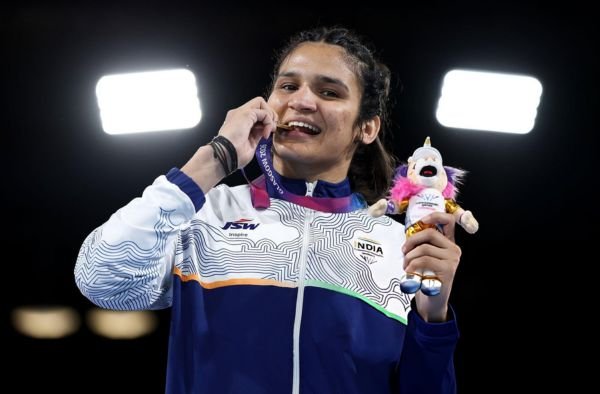
Indian boxing may have reached that moment in Glasgow. On a remarkable Saturday at the 2026 Commonwealth Games, the boxing ring became India’s biggest medal factory. Seven gold medals and three silver medals not only powered India’s rise to fourth place in the overall standings but also delivered the country’s greatest-ever boxing performance at the Commonwealth Games. More importantly, it offered a glimpse into a future where Indian boxing is no longer defined by isolated champions but by extraordinary depth across multiple weight categories.
The scenes inside the arena reflected that transformation. “Go for the gold! This is the round,” an animated head coach Santiago Nieva shouted to Priya Ghanghas as she prepared for the decisive moments of her women’s 60kg final against Canada’s Marie-Bathoul Al-Ahmadieh.
Those words became symbolic of India’s campaign. Before Priya stepped into the ring, Preeti Pawar, Jaismine Lamboria and Sakshi Chaudhary had already secured gold medals with commanding performances. Priya followed by overcoming a spirited Canadian challenge to win 4-1. Arundhati Choudhary then capped another memorable session, while Ankush Panghal and Sachin Siwach ensured that India’s dominance extended to the men’s events as well.
By the end of the day, 10 of India’s 14 boxers had reached the finals. Seven returned with gold medals, while Narender Berwal, Olympic medallist Lovlina Borgohain and Jadumani Singh added silver medals to complete a historic haul.
Numbers alone cannot explain why this campaign feels different. Indian boxing has enjoyed memorable Commonwealth Games before. Vijender Singh’s breakthrough medal at the 2008 Olympics transformed the sport’s visibility in India. Mary Kom inspired a generation with her extraordinary longevity. Lovlina Borgohain’s Olympic bronze further strengthened India’s reputation on the global stage.
Yet Glasgow represents something larger than individual success. For perhaps the first time, India demonstrated complete squad depth. Success came from both men and women, from experienced Olympians and first-time Commonwealth competitors, across nearly every weight division. This is what sustained sporting excellence looks like.
One of the defining features of this campaign was composure. Take Ankush Panghal’s men’s 80kg final. After falling behind in the opening round against England’s Dimeji Shittu, he refused to panic. Instead, he gradually increased his aggression, landed cleaner combinations and completely reversed the momentum to produce one of the Games’ finest comeback victories. It was less about power and more about tactical intelligence.
That maturity has become a hallmark of Indian boxing. Under High Performance Director Santiago Nieva, India has steadily moved away from relying purely on aggression. Technical refinement, defensive awareness, conditioning and ring management have become central to the programme. The Glasgow results suggest that years of investment in coaching structures and athlete development are finally bearing fruit.
The women’s contingent deserves particular recognition. Preeti Pawar dominated the 54kg final with a unanimous 5-0 verdict. Jaismine Lamboria, already the reigning world champion, once again showcased why she is regarded among the finest technicians in international boxing. Sakshi Chaudhary controlled her contest from the opening bell, while Priya Ghanghas displayed resilience under pressure before securing victory. Collectively, they underlined India’s growing authority in women’s boxing, an area where the country has quietly established itself as one of the world’s emerging powers.
Equally encouraging is the profile of the athletes themselves. Many of the medal winners belong to a generation nurtured through grassroots initiatives, national championships and international exposure from a young age. Their journeys have been shaped by structured competition rather than isolated talent alone. That distinction matters because sustainable success is built on systems, not surprises.
Of course, the inevitable question remains.
Can Commonwealth dominance translate into Olympic success?
The answer is not straightforward. Olympic boxing features stronger competition from nations such as Uzbekistan, Cuba, Kazakhstan and the United States, while professional judging standards leave little room for error. India has often found the transition difficult despite dominating regional competitions. But Glasgow suggests that the gap is narrowing.
The victories were not achieved through favourable draws or fortunate decisions. They were built on tactical discipline, technical superiority and mental resilience, qualities that travel well to the biggest stages.
There is also another encouraging takeaway. This historic campaign was not carried by one famous name. Lovlina Borgohain, India’s Olympic medallist, finished with silver. Yet the team still produced seven gold medals. That is perhaps the clearest evidence that Indian boxing has entered a new phase, where established stars coexist with emerging champions capable of carrying the sport forward. When the final bell rang in Glasgow, India had not merely collected medals.
It had announced that boxing has become one of the country’s most reliable high-performance sports. The ring no longer produces occasional heroes. It is beginning to produce champions in numbers. For a nation with Olympic ambitions, that may be the most valuable victory of all.

