

The first thing you notice from the upper tiers of Arthur Ashe Stadium is the noise. It rises from every direction, the rumble of the city mixing with conversations in the stands, aircraft overhead, trains in the distance and the constant movement surrounding the USTA Billie Jean King National Tennis Center.
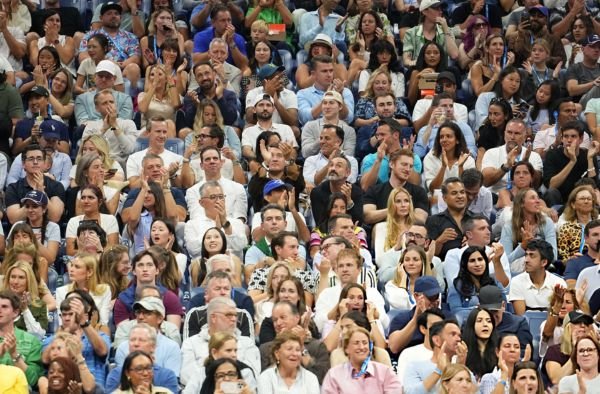
For decades, that noise has been part of the US Open‘s identity. New York was never supposed to sound like Wimbledon. The tournament has always embraced a louder, more restless personality, matching the city that hosts it. But at this year’s Open, the noise has become more than atmosphere. It has become a problem.
The controversy surrounding spectator behaviour has intensified during the 2026 tournament, with players complaining about distractions ranging from loud conversations and people moving during points to influencers filming content and even the smell of cannabis drifting onto court. The issue reached an early flashpoint during Naomi Osaka’s first-round match against Anastasia Zakharova, when a group of content creators inside Arthur Ashe Stadium became disruptive enough for the chair umpire to briefly stop play and ask them to quiet down.
The USTA has issued approximately 100 creator credentials this year, almost double the 54 issued in 2025, as the tournament looks to reach audiences beyond traditional tennis followers. That strategy has delivered visibility, but it has also produced uncomfortable questions about where entertainment ends and sporting etiquette begins.
Osaka, who has been one of the most outspoken players on the subject, acknowledged the value of bringing new audiences into tennis but argued that newcomers must understand the environment they are entering. “You want people to continue to grow the sport,” Osaka said. “I just think it has to be in a way that everyone knows the rules and the etiquette.”
The Japanese star was not alone. Coco Gauff also recognised the potential value of influencers and a new demographic, while other players have expressed frustration when filming, lights or conversations interfere with points. The debate has therefore moved beyond a simple argument about whether influencers belong at the US Open. It is increasingly about whether the tournament has provided enough guidance to those it has invited. Adrian Mannarino offered a particularly blunt assessment after his second-round defeat, describing the atmosphere as a “zoo”.
The French veteran pointed to spectators moving during points, noise and the smell of marijuana as examples of how the experience has changed.
World No. 1 Aryna Sabalenka encountered the cannabis issue herself. During her third-round match against Kamilla Rakhimova, she stopped play to complain about a strong smell drifting onto Louis Armstrong Stadium. She eventually won in straight sets, but later acknowledged that the odour was difficult to deal with while competing. The USTA has responded by reminding spectators of the basic rules of tennis attendance.
Its official guidance asks fans to avoid flash photography and ring lights, remain seated when players are serving and keep their voices down during points. The problem, however, goes deeper than a few badly behaved spectators.
The US Open has deliberately transformed itself into a sporting spectacle where tennis exists alongside fashion, celebrity, food, luxury hospitality and brand activations. The tournament’s commercial success has helped fuel its enormous growth, but that same commercialisation has changed the composition of the crowd.
Tennis is attracting people who may have discovered the sport through social media rather than through years of following the professional game. That is not necessarily a bad thing. In fact, it is exactly the kind of audience expansion the sport has been seeking. The United States recorded 27.3 million tennis participants in 2025, according to figures cited by The New York Times, demonstrating the sport’s growing reach. The US Open’s challenge is now converting that interest into a sustainable fan culture without alienating the players or long-time supporters.
That balancing act is becoming increasingly important. The tournament cannot simultaneously celebrate itself as an accessible, energetic celebration of New York and then demand that every new fan behave like a lifelong tennis traditionalist. The old US Open crowd was loud too. The difference is that today’s audience is also carrying smartphones, ring lights and social-media ambitions into the stadium. A spectator shouting from the upper deck is part of the familiar soundtrack. A bright ring light pointed toward the court during a point is something entirely different.
And that is where the organisers must draw the line. The US Open does not have an influencer problem. It has a transition problem. Tennis is attempting to expand its audience without losing the traditions that make the sport distinctive. Those goals should not be incompatible, but they require better management. The USTA deserves credit for trying to bring creators into the tournament and reach younger audiences.
Social media can introduce players to millions of people who might never have watched a full tennis match. But access without education is where the current experiment has gone wrong. The answer should not be to shut influencers out or turn the US Open into a sterile version of Wimbledon. New York’s energy is one of the reasons the tournament is special.
Instead, organisers need to establish clearer boundaries. Creators can film. Fans can cheer. Celebrities can attend. Newcomers can learn the game. But when a serve is about to be struck, the player must come first. The irony is that the US Open’s biggest strength may also be its biggest weakness. It has successfully made tennis feel like an event rather than simply a match. Now it must make sure the event never becomes bigger than the sport itself.

