
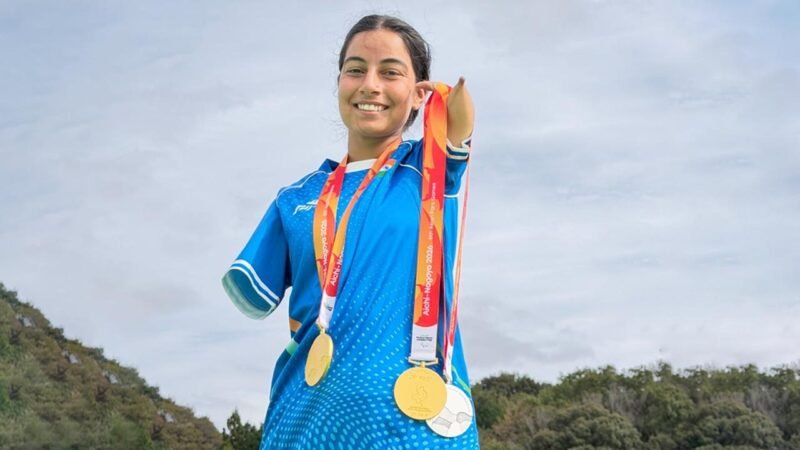

India concluded its historic campaign at the 2026 Aichi-Nagoya Asian Para Games with a record-breaking 114 medals, with individual excellence and collective resilience defining the country’s rise to fourth place in the overall standings. Among the standout performers were para-archer Sheetal Devi, para-badminton player Thulasimathi Murugesan and para-swimmer Himanshu Nandal, who each secured three medals to headline India’s successful campaign in Japan.
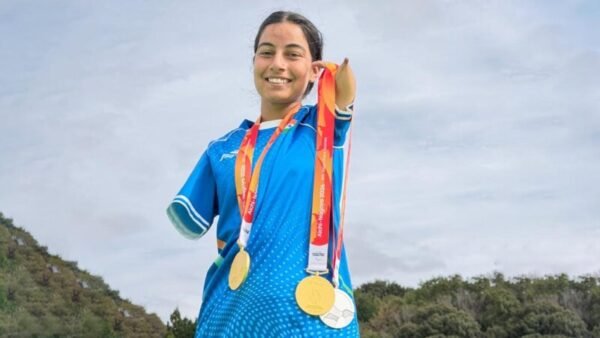
The Indian contingent finished the Games with 30 gold, 35 silver and 49 bronze medals, surpassing its previous best of 111 medals at the 2023 Hangzhou Asian Para Games, according to the supplied campaign figures. The result marked a significant step forward for Indian para-sport, with athletes delivering podium finishes across multiple disciplines and producing several record-breaking performances. Para-athletics emerged as the backbone of India’s medal campaign, contributing 65 medals, including 22 gold. Para-badminton added 16 medals, while para-swimming contributed 11.
India also collected medals in para-archery, para-shooting, para-table tennis, para-judo and para-powerlifting, underlining the breadth of its performance across the continental competition. While the overall medal tally reflected the strength of the Indian contingent, the performances of individual athletes offered a closer look at the consistency, composure and competitive depth behind the historic result. Sheetal Devi emerged as one of India’s leading performers at the Aichi-Nagoya Asian Para Games, finishing her campaign with two gold medals and one silver.
The reigning world champion and world number one in women’s compound archery secured gold in the compound women’s individual event and the compound mixed team event alongside Toman Kumar, while adding silver in the women’s compound doubles with Payal Nag. Devi’s campaign was marked by exceptional accuracy even before the medal rounds began. In the women’s compound qualification round, she scored 704 out of a possible 720 points, equalling the world record and improving her own Asian record.
She then partnered with Kumar in the mixed-team qualification round to record 1,402 points, surpassing the previous world record of 1,400. The 19-year-old subsequently converted those strong qualification performances into two gold medals. Devi and Kumar defeated Indonesia 151-148 in the compound mixed-team final before she overcame Singapore’s Nur Syahidah Alim 142-139 to retain her individual title. In the women’s doubles final, Devi and Nag finished second after losing 141-150 to China’s Xu Xueqing and Zhao Jing.
Her three-medal haul reinforced her position among India’s most influential para-athletes and demonstrated her ability to deliver under pressure across individual and team events. Thulasimathi Murugesan: Gold and two silver medals in para-badminton. Para-badminton player Thulasimathi Murugesan matched Devi’s three-medal achievement, finishing the tournament with one gold and two silver medals. Her campaign highlighted India’s strength in para-badminton, a discipline that contributed 16 medals to the country’s overall tally.
Murugesan secured gold in the women’s doubles SL3-SU5 category alongside Manasi Joshi, defeating China’s Qiuxia Yang and Zuxian Xiao 21-16, 21-13 in the final. The Indian pair maintained their composure throughout the match to seal the title in straight games. The Indian shuttler also reached the finals of the women’s singles SU5 and mixed doubles SL3-SU5 events. However, she had to settle for silver in both, including the mixed doubles final alongside Nitesh Kumar.
The demanding schedule required Murugesan to compete in three medal matches on the same day. Despite missing out on two titles, she ensured that her campaign ended with a gold medal, demonstrating consistency across multiple events. Her achievement also continued her record of winning three medals at consecutive editions of the Asian Para Games. Para-swimmer Himanshu Nandal completed India’s trio of three-medal performers with three bronze medals across his six events at the Aichi-Nagoya Games.
Competing in the S11 classification, which is designated for swimmers with the most severe visual impairments, Nandal secured bronze in the men’s 100m breaststroke, 100m freestyle and 400m freestyle. His performances contributed to India’s 11-medal return in para-swimming. Nandal also recorded two fourth-place finishes in the men’s 100m backstroke and 200m individual medley. Those results illustrated the competitiveness of his campaign, with the swimmer remaining close to the podium in multiple events.
His three bronze medals added to India’s growing presence in para-swimming, where podium finishes across different distances and strokes played an important role in the overall medal count. India’s record 114-medal campaign at the 2026 Asian Para Games is significant not simply because of the final tally, but because of the range of athletes and disciplines contributing to it. Sheetal Devi’s record-setting precision, Thulasimathi Murugesan’s consistency across three badminton events and Himanshu Nandal’s success in the pool represent different pathways to international excellence.
Para-athletics supplied the largest share of the medals, but performances in archery, badminton and swimming demonstrated that India’s success was not confined to one discipline. The next challenge will be to convert this continental progress into sustained performances at future world championships and Paralympic competitions. India’s fourth-place finish in Aichi-Nagoya represents an important milestone for the country’s para-sport movement. With 114 medals across gold, silver and bronze categories, the contingent delivered its most successful Asian Para Games campaign to date.
As the focus shifts to future international competitions, the performances of Devi, Murugesan and Nandal provide compelling examples of the consistency and competitive depth required to sustain India’s rise on the para-sport stage.

