

A national record that had survived generations finally fell in Nagoya, but Vithya Ramraj did not wait for a gold medal to rewrite Indian athletics history.
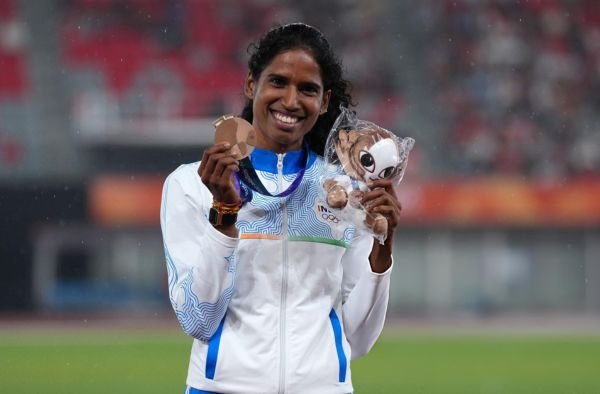
The Indian hurdler clocked a personal best of 54.75 seconds to win bronze in the women’s 400m hurdles at the 2026 Asian Games, breaking PT Usha’s 42-year-old national record of 55.42 seconds set at the 1984 Los Angeles Olympics. For Ramraj, the significance of the race stretched far beyond the colour of the medal. She had already equalled Usha’s mark at the 2023 Hangzhou Asian Games. Three years later, she finally went past it, taking 0.67 seconds off the previous national record in a race that also saw the Asian Games record fall.
UAE’s Mariam Kareem produced a Games record of 54.31 seconds to take gold, while Kazakhstan’s Adelina Zems claimed silver in a personal best of 54.58. Ramraj finished just 0.17 seconds behind the silver medal position. India’s Anu Raghavan also produced a personal best of 55.88 seconds to finish fifth. As she crossed the line, Ramraj initially had no confirmation of the record. She looked towards the giant screen before the time of 54.75 appeared. The realisation brought an emotional celebration as she danced with the Indian flag.
“When my coach said you have it in you to go (under) 55 seconds, I never believed it. But today I believed it. My coach is with me, my God is with me,” Ramraj said after the race. The moment also carried a symbolic passing of the baton. Usha, now president of the Indian Olympic Association, congratulated Ramraj and welcomed the breaking of the record. “Records are meant to be broken, and there is no greater reward for an athlete than to see the next generation go beyond the boundaries we once set,” Usha said.
Ramraj’s bronze was also her second medal of the Games, having earlier been part of India’s silver-winning mixed 4x400m relay team. The athletics track and field programme produced a broader medal rush for India. Murali Sreeshankar added silver in the men’s long jump with an 8.07m effort. China’s Yuhao Shi won gold with 8.17m, while Uzbekistan’s Anvar Anvarov took bronze with 8.06m. Sreeshankar’s campaign ended painfully after he injured his ankle during his fourth attempt and could not complete his final two jumps.
India then celebrated a double podium in the men’s javelin throw. Yashvir Singh produced a personal best of 85.72m on his sixth and final attempt to secure silver, while Rohit Yadav took bronze with 84.35m. Sri Lanka’s Rumesh Pathirage won gold with 88.33m. Gulveer Singh added another silver in the men’s 1500m, stopping the clock at a personal best of 3:36.72.
Parul Chaudhary also collected her second medal of the Games, winning bronze in the women’s 5000m in 15:14.61 after her 3000m steeplechase bronze. There was disappointment too. Avinash Sable finished fourth in the men’s 3000m steeplechase despite recording a season’s best 8:21.67, while Santosh Kumar Tamilarasan finished seventh in the men’s 400m hurdles. Seema Kaliramna missed the discus podium by finishing fourth with 59.88m.
The record mattered as much as the medal. India’s athletics campaign in Nagoya is increasingly becoming a story about performances that stretch beyond the podium. Ramraj’s bronze will enter the medal tally, but her 54.75 seconds could prove the more enduring number. For 42 years, Usha’s 55.42 had been the benchmark for Indian women’s 400m hurdles. Ramraj first matched it, then returned three years later and finally moved the national record forward.
The significance lies in the progression. A record once associated with one of India’s greatest athletes is now held by the next generation, while Ramraj’s performance gives Indian women’s hurdling another benchmark to chase. And with medals arriving across the track and field programme, Nagoya is providing India with more than a collection of podium finishes. It is producing new numbers, new milestones and, in Ramraj’s case, a new chapter in a record that had seemed almost untouchable.
