

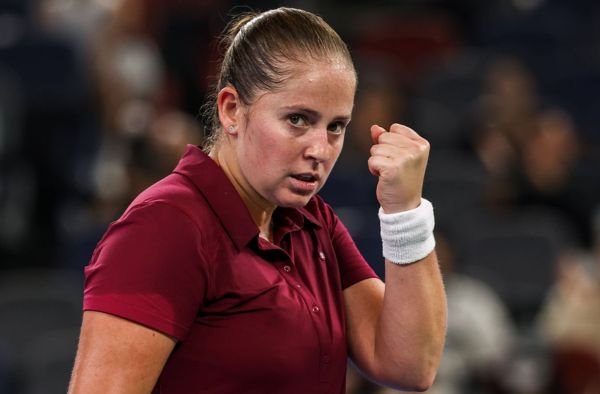
Jelena Ostapenko turned a match that appeared destined for Jessica Pegula into one of the standout upsets of the Wuhan Open 2026, saving three match points before rallying to defeat the second-seeded American 2-6, 7-6(7), 6-3 on Wednesday. The Latvian’s resilience under pressure proved decisive as she recovered from a set down to reach the round of 16 at the WTA 1000 tournament in China.
Pegula, who finished runner-up in Wuhan in 2025, returned to competitive action after more than a month away from the tour. The American had not played since losing in the US Open semifinals and had taken an extended break, missing tournaments in Singapore and Beijing following a demanding summer schedule. Her return initially looked promising. Pegula controlled the opening set, winning it 6-2 through consistent baseline play and effective shot placement. Ostapenko struggled to disrupt the American’s rhythm early on, but the former French Open champion gradually found her range as the contest developed.
The second set became the turning point. Pegula moved within touching distance of victory and had three match points in the tiebreak, but Ostapenko refused to surrender. The Latvian produced aggressive groundstrokes and an unexpected drop shot to escape the danger, eventually taking the tiebreak 9-7 and forcing a deciding set.
That escape changed the complexion of the match. With momentum shifting, Ostapenko continued to attack from the baseline, putting Pegula under increasing pressure and making the American work for every service game. The Latvian secured the decisive breaks in the third set and closed out a 6-3 victory after two hours and 23 minutes. The win was a significant achievement for Ostapenko, the 2017 French Open champion, who recorded her third Top 10 victory of the 2026 season. It also marked her first victory over a Top Five opponent since defeating Aryna Sabalenka in the Stuttgart final in 2025.
Ostapenko’s aggressive approach proves decisive. Ostapenko’s comeback was built on her willingness to take risks at crucial moments. Rather than retreating into defensive exchanges, she continued to attack Pegula’s court position and search for openings with powerful groundstrokes. The statistics reflected the Latvian’s aggressive approach. According to Tennis.com’s match data, Ostapenko struck 10 aces against Pegula’s two and won five of the seven break points she faced. She also won 69 per cent of points on her second serve, compared with 41 per cent for the American, an important difference in a match decided by narrow margins.
Ostapenko’s ability to stay composed while facing match points was especially notable. The WTA reported that this was the seventh time she had won a main-draw match after saving at least one match point, highlighting her capacity to remain competitive in difficult situations. For Pegula, the defeat was a disappointing end to her return to competition. Having reached the Wuhan final last year, the American arrived with the experience and ranking to be considered among the tournament favourites. However, after dominating the first set, she could not convert her opportunities in the tiebreak and struggled to regain control in the decider.
Iga Swiatek advances comfortably into the round of 16. Elsewhere at the Wuhan Open, Iga Swiatek progressed to the last 16 with a commanding 6-2, 6-1 victory over Magdalena Frech. The Polish star produced a controlled performance to move through without the drama that defined Ostapenko’s win.
Swiatek was scheduled to face either Ashlyn Krueger or Lanlana Tararudee in the next round. Her progress also carried significance in the closing weeks of the season, as she looked to strengthen her position in the race to qualify for the WTA Finals. The Wuhan Open, a WTA 1000 hard-court event held from October 12 to 18, has already produced major surprises, with both top seed Aryna Sabalenka and second seed Pegula eliminated in the second round.
Ostapenko’s resilience changes the Wuhan Open picture. Ostapenko’s victory was not simply an upset on the scoreboard. It was a demonstration of how quickly a match can change when a player continues to trust her strengths under pressure. Saving three match points against an opponent of Pegula’s calibre required both fearless shot-making and composure at the most critical stage of the contest. For Pegula, the loss will be frustrating given her strong start and the opportunities she had to finish the match. For Ostapenko, it offers renewed momentum and a chance to make a deeper run in Wuhan.
With the tournament’s top two seeds now out, the draw has opened up considerably. Ostapenko’s challenge will be to sustain the attacking tennis that carried her through this comeback as she pursues a place in the quarterfinals.

