

Alexandra Eala‘s first WTA Tour singles title was historic, but the manner in which she won it may prove even more important for her future.
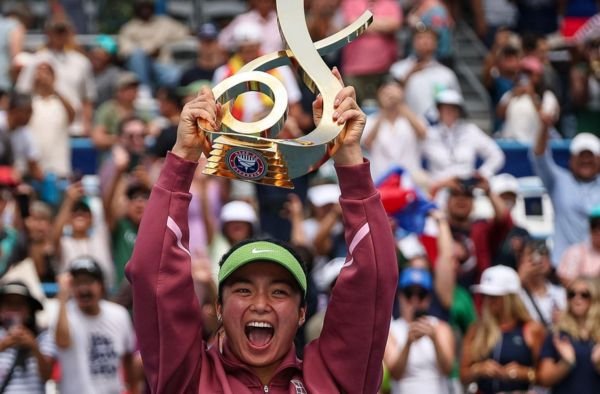
The 21-year-old Filipina defeated top seed Jessica Pegula 4-6, 6-4, 6-0 in a rain-interrupted final at the Mubadala Citi DC Open to become the first player from the Philippines to win a WTA Tour-level singles title. The victory also completed a remarkable run in Washington that included wins over Olympic champion Zheng Qinwen, defending champion Leylah Fernandez, Elina Svitolina and four-time Grand Slam champion Naomi Osaka before Eala overcame Pegula.
Yet the numbers and names only tell part of the story. What stood out was how Eala repeatedly managed to disrupt players who normally dictate matches with their serve and first strike. Against Osaka, in particular, she showed a willingness to stand remarkably close to the baseline, anticipate the direction of the serve and attack the ball before her opponent had time to establish a point.
For Kim Clijsters, that was one of the clearest signs that Eala’s game has evolved. Speaking on her Love All podcast, the former world No. 1 identified Eala’s anticipation and return positioning as perhaps the most important tactical development in her game. “Her anticipation. I don’t think I noticed it as much as maybe this week, where, especially Osaka, was, to me, the first time where I started noticing how well she’s reading her opponent’s serves.
Osaka can really hide her serve direction very well, and she, at times, is standing, like, a foot into the court and still getting to the return on time and to the serve. Like, first serves, like, good kick serves from Osaka.” That observation is particularly important because returning serve is one of the clearest areas where a young player can begin to close the gap against more experienced opponents.
A powerful server can dictate the opening shot. A great returner can take that advantage away. Eala is increasingly trying to do exactly that. Clijsters believes the left-handed Eala also benefits from a combination of placement, variety and unpredictability rather than relying solely on raw power.
“So, that, to me, I think, when it comes down to a tactical difference that she made this week, or that she’s made over the last few months, and that stood out for me this week, is her serve return positioning, and the way that she’s been able to attack, first and second serves of good servers, and made it really tough. You know, she’s a left-hander, so we know that that’s always a little bit tricky for a lot of players.
Placing her serve better. It’s not the hardest serve, which she places it well; good variety. So, yeah, a lot of great things I feel like that she’s been adding on to, and that she’s been improving over time.” The distinction is crucial. Eala does not need to overpower every opponent if she can prevent them from playing their preferred tennis.
That has become increasingly evident throughout 2026. The season has seen Eala transform from a promising young player into someone increasingly comfortable challenging the established hierarchy. Her Wimbledon campaign brought her a first main-draw victory at the All England Club, while earlier in the grass-court season she defeated Donna Vekic in Berlin after saving 12 of 14 break points.
Her rise has also not been entirely linear, which makes the Washington breakthrough more instructive. At Queen’s, Iva Jovic defeated her in straight sets, exposing some of the vulnerabilities in Eala’s aggressive baseline game. WTA’s match report noted that Eala’s 12 winners were outweighed by 19 unforced errors as Jovic successfully matched her pace.
The lesson appears to have been absorbed. Eala has increasingly embraced a style based on taking the ball early, particularly off the return. The comparison with Andre Agassi is understandable. Like the American great, Eala often tries to take away time rather than simply trying to hit the hardest ball. By striking on the rise, she prevents opponents from comfortably moving behind the baseline and constructing points.
That becomes particularly dangerous against big servers. A return landed deep and early can immediately turn a defensive situation into an attacking one. Even when the return does not produce an outright winner, it can force the server to hit the next ball from an uncomfortable position.
The Washington final offered another demonstration of Eala’s resilience. Pegula won the opening set 6-4, and the match was then suspended by rain before being completed the following day. Eala returned to the court and took control, winning 10 of the final 13 games and closing out the title with a 6-0 third set.
That comeback also underlined another development: Eala is becoming less interested in merely surviving against elite opponents and more willing to dictate against them. The tournament itself was an extraordinary test of that philosophy. Eala’s route to the title required her to beat players with dramatically different styles and résumés. Zheng brought Olympic pedigree and power. Fernandez arrived as the defending champion. Svitolina offered experience and tactical variety. Osaka brought one of the most recognisable serves and first-strike games in modern women’s tennis. Pegula, the top seed, represented consistency and elite baseline efficiency.
Eala found a way through all of them. That is why Clijsters’ observation about the return matters more than simply identifying one technical strength. It points towards a broader change in Eala’s mentality. She is playing with courage. The Filipina has previously described courage as an important word for her tennis this season, and her Washington campaign gave that idea a physical form. Standing close to the baseline against powerful servers is inherently risky. It demands anticipation, commitment and the confidence to trust the read.
But the reward is equally significant. The further Eala moves forward to receive, the less time she gives her opponent. The less time she gives her opponent, the more likely she is to control the next shot. And once she controls that first exchange, her aggressive groundstrokes become far more effective.
That could be the foundation of her next leap. Eala’s development has been shaped by the Rafa Nadal Academy, where she trained from a young age, and her junior résumé already offered clues about her potential. She won the US Open girls’ singles title in 2022 and has steadily transitioned from junior success to the demands of the professional tour.
But Washington was different. This was not simply a promising run. It was a WTA 500 title won against a field packed with established names. The tournament carried a $1.64 million total financial commitment and featured a 28-player singles draw, making Eala’s achievement even more significant. Her reward is a career-high ranking of No. 20, according to Reuters, putting her within striking distance of the world’s top 10. The ranking will attract attention. The trophy will attract headlines. But the return may be what ultimately sustains the rise.
Because the world’s best players will eventually study Eala too. They will adjust their serves, change their patterns and try to push her away from the baseline.
That is the next challenge. A breakthrough tells the tennis world that a player belongs. A tactical weapon helps a player stay there. For Eala, the Washington title may have been the moment the wider tennis world stopped asking whether she could beat the best and started asking a more difficult question: how do you stop a player who is already reading your next move?

