

Women’s ice hockey has its roots set in the late 19th-century in Canada, which gained its international recognition in 1990. The game was debut with the first-ever IIHF World Championship and at the 1998 Nagano Olympics. The sport has been dominated by teams like Canada and the USA, which led to the establishment of the Professional Women’s Hockey League (PWHL). The first women’s ice hockey game was played in 1897 in Alberta.
Preston’s Lord Stanley arrived at his Canadian residence, Rideau Hall, in 1888, along with his wife and four children, including three sons and a daughter, Lady Isobel. Besides the men, Stanley’s daughter Isobel, fell in love with the hockey sport. She encouraged her father to build an outdoor area to play in during the winter.
In 1890, Isobel became the first woman to be photographed while playing the game. She promoted the sport among women just the way her father did for the men’s game. On February 11, 1891, the first women’s ice hockey game was played in the Ottawa Citizen. With that, the first women’s club was formed at Queen’s University in Kingston, Ontario, named Love-me-Littles. A few years later, the team changed its name to Morning Glories.
In 1921, the University of Toronto won the first women’s national championship, defeating McGill. Preston’s Hilda Ranscombe and the Preston Rivulettes dominated the sport in the 1930s.
By the mid-1950s, nine-year-old Abby Hoffman entered the sports creation as a new speculation. She has changed her name to “Ab” and played in the boys’ team in Toronto. Later, she got expelled. But her parents fought back and won the case.
Later in 1966, Brown University created the first women’s ice hockey team in the United States, known as the Pembroke Pandas. The team went on to create history and led the way for more American college teams in the 1970s.
One of the important moments in women’s ice hockey history came in 1975 when Fran Rider set up the Ontario Women’s Ice Hockey Association. The group catered towards girls and women’s ice hockey, and their impact lasted so much that it led to the introduction of the Women’s World Championship in Brampton, Ontario, in April 2023.
Canada’s lineage in ice hockey is a credit to players Angela James, Hayley Wickenheiser, Marie-Philip Poulin, and Shirley Cameron. Edmonton’s Cameron had created her home team, named the Chimos, and led them to several national championships in the 1980s.
In 1982, the national championship ice hockey gam started in Canada as a credit to the OWHA and Cameron’s success. That same year, the Naisten SM-sarja was established in Finland. It was the first national league in Europe. Two years later, Sweden started their own national championship.
The first international Women’s World Championships was introduced in 1987 by Riderl, which was played in Toronto. The tournament featured eight teams. Followed by that came the IIHF European Women’s Championship in 1989 at Düsseldorf and Ratingen, Germany. Finland was the first winner of the event. The following year, IIHF hosted the first Women’s Worlds.
Later in 1992, Canada’s Manon Rheaume made history after playing an NHL exhibition game for the Tampa Bay Lightning. Twenty-five years later in 1997, the IIHF mandated all Women’s Worlds tournaments to be for women. With that, the IIH started a yearly World Women’s tournament. For the first time, women’s ice hockey was made a medal sport at the Olympic Games in Nagano.
In 1998, the NCAA introduced the Patty Kazmaier Award to honour the best women’s college hockey players of every year.
The next year in Canada, the first pro league called the National Women’s Hockey League was introduced, run under the OWHA. The Beatrice Aeros won the inaugural event, which was played in Brampton. Cassie Campbell and Geraldine Heaney were part of the winning team that time.
A year later, the NCAA played its first-ever national championship competition. In that event, the University of Minnesota-Duluth defeated St. Lawrence by 4-2.
The IIHF Hockey Development Camp and the Women’s High-Performance Camp have been a success since 2004. The initiative has provided young girls to learn and develop skills and a passion for the game.
By the mid-2000s, two dramatic incidents occurred in international hockey. In 2005, America won its first World Cup gold, defeating Canada by 1-0. The following year, the U.S. got knocked off by Sweden in the semi-finals of the Turin Olympics, and they went on to win a silver medal.
In the summer of 2010, at the post-Olympics international Summit in Toronto, IIHF provided $2 million for the growth and development of women’s hockey. Some money went for the World Girls’ Ice Hockey Weekend and the Global Girls’ Game introduced in 2011.
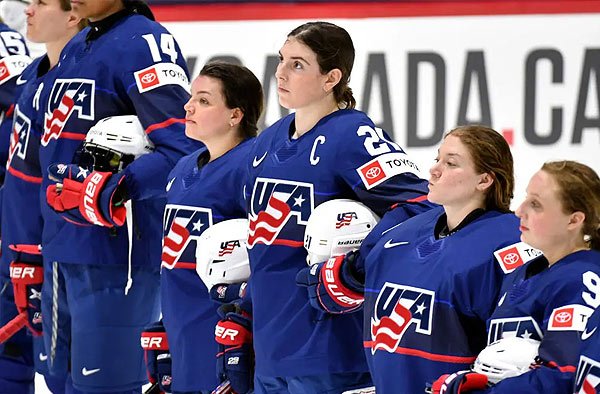
In the 2017 Women’s Worlds in Plymouth, Team USA went on to win gold through Hilary Knight’s golden goal against Canada.
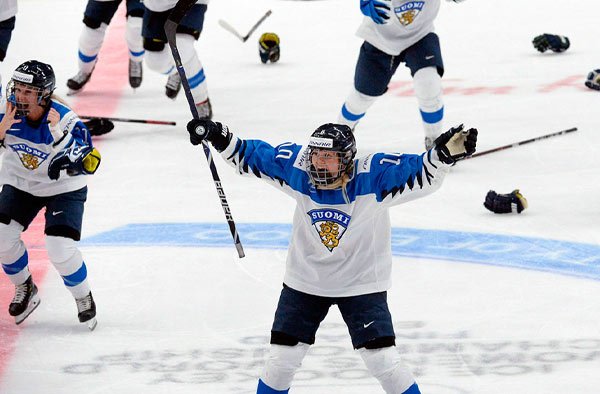
Playing a major role in women’s ice hockey growth, the organisation that started with the WW event with 10 teams went on to become an international league by 2019. Finland made history after qualifying for the finals game of the Women’s Worlds but they lost to the U.S. Canada won its first-ever bronze. Later in 2022, the IIHF made Women’s Worlds a yearly event. Sarah Nurse was a notable player that season who made it to the cover of EA alongside the NHL’s Trevor Zegras. She was a true representation of the women’s ice hockey sport.
Finally, in 2023, the IIHF conducted a Women’s Summit that brought over 100 delegates from across 50 countries to talk about women’s ice hockey.
The same year, 14-year-old Nela Lopusanova stunned the world with her impressive performance at the Women’s U18 in Sweden. The Slovenian had scored a lacrosse goal and one between the legs that named her the MVP of the tournament. She is the hope of the emerging young talents to become the future stars of women’s ice hockey.

