

India’s women’s badminton campaign at the Asian Games 2026 ended at the quarterfinal stage, and the scoreline told a story that was difficult to ignore. Japan’s strength in singles proved decisive, while India’s newest World Championships bronze-winning doubles pair delivered the performance that briefly kept the contest alive.
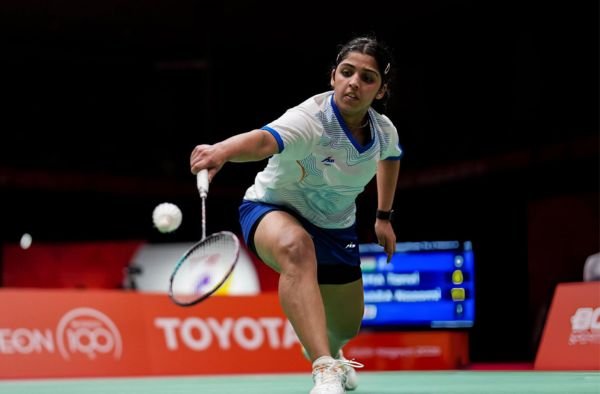
Hosts Japan defeated India 3-1 in the women’s team quarterfinal on Tuesday, ending India’s hopes of a medal in the team event. PV Sindhu, Unnati Hooda and Tanvi Sharma all lost their singles rubbers, while Treesa Jolly and Gayatri Gopichand produced India’s only victory in the first doubles match.
The tie began with one of the most anticipated contests of the afternoon as two-time Olympic medallist PV Sindhu faced world No. 3 Akane Yamaguchi. Sindhu made Japan work for the opening point. After trailing 13-17 in the first game, the Indian veteran produced a determined comeback, forcing Yamaguchi into longer rallies and eventually taking the game 23-21. The rallies frequently stretched beyond 30 shots, underlining the physical demands of the contest.
Yamaguchi, however, refused to allow Sindhu to dictate the match. The Japanese shuttler established a narrow advantage in the second game and held her nerve when Sindhu attempted another comeback. Yamaguchi levelled the contest at 21-18 before taking control of the decider. Sindhu struggled to regain the momentum she had built in the opening game.
Yamaguchi moved into a commanding 14-6 lead and eventually closed out the deciding game 21-11 to give Japan a 1-0 advantage. India were immediately under pressure. Teenager Unnati Hooda was given the task of restoring parity against Tomoka Miyazaki, the 2022 world junior champion and current world No. 7. Hooda remained competitive but could not convert the important moments, eventually losing 16-21, 18-21.
The result put Japan one victory away from the semifinals. With India’s back against the wall, Treesa Jolly and Gayatri Gopichand stepped onto court. The pair arrived in Nagoya carrying the confidence of their breakthrough bronze medal at the recent World Championships in New Delhi, and they produced another composed performance when their team needed it most. Treesa and Gayatri defeated Japan’s Yuki Fukushima and Mayu Matsumoto 21-17, 21-16, cutting the deficit to 1-2 and keeping India alive in the tie. It was then down to Tanvi Sharma.
The young Indian faced former world champion Nozomi Okuhara in the third singles rubber, knowing that defeat would send Japan into the semifinals. Okuhara controlled the contest from the outset, winning the opening game 21-12 before maintaining her advantage in the second. Tanvi could not find the turnaround India needed. Okuhara closed out the match 21-12, 21-10, sealing Japan’s 3-1 victory and ending India’s women’s team campaign.
India had entered the quarterfinal after a convincing 3-0 victory over Kazakhstan, with Sindhu, Hooda and Tanvi all winning their singles matches. But the jump in opposition quality against Japan exposed the difference between progressing through the early rounds and challenging for a medal. The defeat also ends India’s hopes of adding another women’s team badminton medal to its Asian Games record.
India previously won bronze in the women’s team event at the 2014 Games, while the country’s earlier medal in the event came at the 1982 Asian Games. For Sindhu, however, the Asian Games campaign is not over. The individual women’s singles event begins later in the competition, giving the two-time Olympic medallist another opportunity to compete for an individual medal. She arrives with encouraging form after defeating Yamaguchi in straight games to win the Japan Open earlier this year.
India’s quarterfinal exit was defined by the contrast between its singles and doubles performances. Treesa and Gayatri delivered exactly what India needed in the pressure moment, but by then Japan had already established a 2-0 lead through its singles strength. Sindhu pushed Yamaguchi hard for two games before the Japanese player pulled away, while Hooda and Tanvi were unable to produce the singles victories required to extend the tie.
For Indian badminton, the result is therefore both an immediate setback and a useful indicator of where the team stands against one of Asia’s strongest sides. The emergence of Treesa and Gayatri provides a significant positive, while the performances of the younger singles players offer valuable experience on a major stage.
Japan move into the semifinals on home soil. India, meanwhile, must regroup quickly, with the individual events still offering Sindhu and the rest of the squad another opportunity to challenge for medals.

