

India did not need all four boards firing to extend their winning run at the 2026 Chess Olympiad. Two decisive victories from Arjun Erigaisi and world champion D Gukesh were enough to settle a demanding fourth-round encounter against Spain, as the Indian men’s team secured a 3-1 victory and kept its perfect record intact in Samarkand.
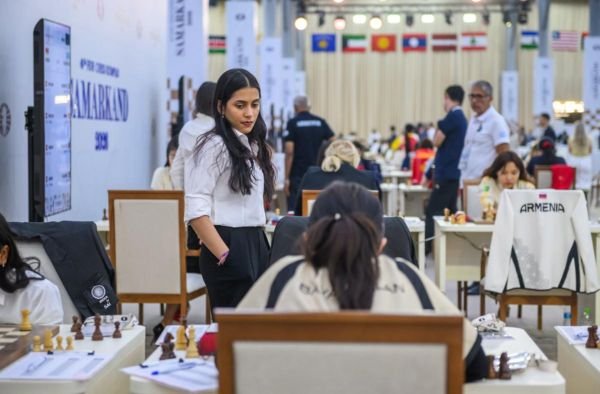
The result was India’s fourth consecutive match win at the Olympiad, with Praggnanandhaa and Nihal Sarin contributing solid draws on the remaining boards. More importantly, the victory keeps India among the unbeaten leaders in the Open section, alongside China, hosts Uzbekistan, Germany, Armenia, the United States, the Netherlands and Hungary after four rounds.
The decisive moments, however, came on the second and fourth boards. Arjun was the first Indian to put the team ahead, producing a sharp attacking display against Maksim Chigaev. The game emerged from a Queen’s Indian Defence by transposition, with neither side immediately conceding the initiative. But once the middlegame opened up, Arjun began to increase the pressure around the black king.
His attacking plan eventually became too difficult for Chigaev to contain. Arjun’s queen invasion on the seventh rank delivered the decisive blow and gave India the opening point of the match. FIDE’s official report described both Arjun and Gukesh as producing powerful attacking games to secure India’s 3-1 victory.
Gukesh then supplied the finish. Playing Black against experienced Spanish grandmaster Alexei Shirov, the world champion faced a Sicilian Taimanov and gradually took control of the position. Rather than allowing Shirov to dictate the terms of the middlegame, Gukesh seized the initiative and established control over the dark squares. Shirov attempted to generate counterplay by sacrificing a rook for a minor piece, but the compensation never developed into anything substantial.
Gukesh responded accurately, opened the centre and converted the advantage in 42 moves. The victory was particularly notable given the context surrounding Gukesh’s recent rating fluctuations. After briefly slipping below the 2700 mark, the 20-year-old world champion has responded on the board with consecutive victories, underlining the difference between a temporary rating movement and his ability to produce results in team competition.
The official FIDE results confirm the fourth-round scoreline: David Anton Guijarro drew with Praggnanandhaa, Chigaev lost to Arjun, Jaime Santos Latasa drew with Nihal Sarin, and Shirov lost to Gukesh. While the men’s team grabbed the headlines, India’s women produced an almost identical result. The defending champions defeated Mongolia 3-1, also making it four wins from four rounds. The first two boards ended in draws, with Koneru Humpy sharing the point with Mungunzul Bat-Erdene and R Vaishali drawing against Munkhzu Turmunkh.
The decisive points came from the younger players. Divya Deshmukh defeated Bayasgalan Khishigbaatar with the black pieces, while B Savitha Shri continued her remarkable start by defeating experienced international master Batkhuyag Munguntuul. Savitha now has four wins from four games, maintaining a perfect individual score. India’s double success is significant because the country entered Samarkand as defending champion in both sections, having won gold in both competitions at the 2024 Budapest Olympiad.
The 2026 edition is also a record-breaking event, with 206 teams in the Open section and 189 in the women’s competition. Four rounds in, India’s strength is not simply that both teams remain unbeaten. It is the way different players are taking responsibility at different moments. For the men’s team, Praggnanandhaa and Nihal did not need to force victories after Arjun and Gukesh had created the decisive advantage.
In an Olympiad, where four boards collectively determine the match, knowing when to press and when to secure the half-point can be as important as finding a spectacular combination. Gukesh’s performance against Shirov was equally significant. The world champion did not need a complicated tactical fireworks display. Once he gained control, he maintained the pressure, neutralised his opponent’s counterplay and converted the advantage cleanly.
The women are displaying a similar balance. Humpy and Vaishali provided the stability on the upper boards, while Divya and Savitha delivered the decisive wins. India now moves into the next phase of the Olympiad with both teams carrying four wins from four rounds. The field, however, is beginning to tighten. FIDE notes that several heavyweight teams remain perfect, meaning the margin for error will become increasingly small as the tournament progresses.
The next test will therefore be less about maintaining momentum and more about surviving the pressure that comes with being among the teams everyone wants to beat. India has started perfectly. The real Olympiad battle is only beginning.

