

Some captaincy eras end in disappointment. Harmanpreet Kaur’s ends with the Indian women’s cricket team having achieved the landmark victory that generations before her had chased. India’s long-serving captain has stepped down from her position across all three formats, bringing an end to one of the most influential leadership chapters in the history of Indian women’s cricket. The announcement came after a BCCI review meeting in Guwahati involving Harmanpreet, vice-captain Smriti Mandhana and head coach Amol Muzumdar. BCCI secretary Devajit Saikia chaired the meeting as the board assessed the team’s recent trajectory and the road ahead.
Harmanpreet, however, did not frame her departure as an exit from international cricket. Instead, her message was about rediscovering the player underneath the captain. “Today, I step down as captain of the Indian Women’s Cricket Team across all formats,” she posted on her instagram account. “This is not an easy decision. It carries years of memories, emotions, sacrifices, and moments that will stay with me for the rest of my life,” Harmanpreet said in a lengthy statement. Then came the line that perhaps best captures the next phase of her career. “Now, I’m ready to play for the love of the game again. Captaincy ends. The journey continues,” she added.
From the 2017 heartbreak to World Cup glory. Harmanpreet’s captaincy has stretched across a transformative period for Indian women’s cricket. She took over the T20I captaincy in 2016, assumed full-time ODI leadership in 2022 following Mithali Raj’s retirement and became India’s all-format captain in 2023. But her leadership story cannot be measured simply by the number of matches she captained. Her career became synonymous with the rise of women’s cricket in India, particularly after her unforgettable 171 against Australia in the 2017 Women’s World Cup semi-final. That innings helped push the Indian women’s team into a new era of visibility and belief. For years, Harmanpreet and India came close to the biggest prize without crossing the final hurdle.
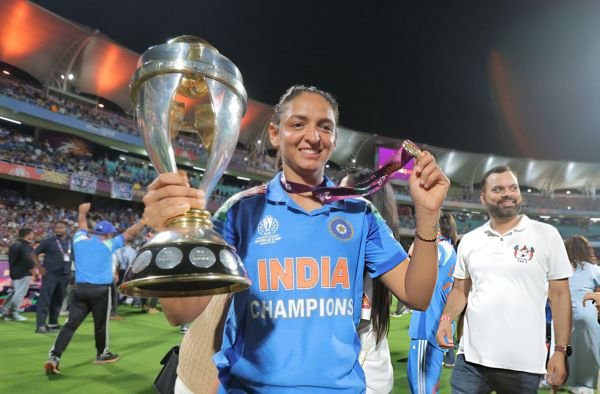
That changed in 2025. Under Harmanpreet’s leadership, India won its maiden ICC Women’s Cricket World Cup, defeating South Africa in the final. The achievement was historic and represented the culmination of years of progress in the women’s game. The BCCI itself described the 2025 World Cup triumph as a seminal moment for Indian women’s cricket. By February 2026, Harmanpreet had also become the most-capped women’s international cricketer in history, surpassing New Zealand’s Suzie Bates with her 356th international appearance. Her final chapter as captain ends with another gold.
If the World Cup was the defining peak of Harmanpreet’s captaincy, the 2026 Asian Games provided an equally fitting final chapter. India retained the women’s cricket gold medal in Aichi-Nagoya, defeating Sri Lanka by 147 runs in the final. Harmanpreet’s side posted 216/3, powered by Smriti Mandhana’s 79 off 45 balls, before India’s bowlers restricted Sri Lanka to seal another major title. Harmanpreet had been officially retained as India’s captain for the Asian Games, with Mandhana continuing as vice-captain. The victory meant India successfully defended the Asian Games women’s cricket title and added another gold medal to Harmanpreet’s leadership legacy.
It also strengthened the sense that her decision is not about leaving a team in crisis. “Because I genuinely believe my team is in a good place,” she said. That belief is central to her decision. ‘I feel I have done my duty’ Harmanpreet’s statement was less about retirement and more about relinquishing responsibility. “I leave the captaincy today with a heart full of emotions, but also with PEACE. Because I genuinely believe My team is in a good place. A team with talent, character, belief and a future that I am incredibly excited to watch and be a part of.”
“I feel I have done my duty. I gave this team everything I had. I carried the responsibility with pride, and I will always be grateful for the privilege of leading Indian women’s cricket. Now, it is time for me to turn the page,” Harmanpreet wrote on Instagram. The words reflect the weight of the job she has carried for nearly a decade. Captaincy in international cricket is not only about setting fields or making tactical calls. For Harmanpreet, it meant carrying expectations that grew with every Indian victory, every near miss and every major tournament. She has now chosen to remove that layer of responsibility while remaining available as a player.
That could prove significant for both Harmanpreet and India. A new leadership phase begins. The immediate question will be who succeeds Harmanpreet as India’s next all-format captain.
Smriti Mandhana, who has served as vice-captain and has been central to India’s recent successes, will naturally emerge as one of the strongest candidates. But the transition will ultimately depend on the selectors and team management. What is certain is that India now enters a new leadership cycle with an enviable pool of experience and emerging talent. The Women’s Premier League has added depth to the domestic pathway, while players such as Mandhana, Deepti Sharma, Jemimah Rodrigues, Richa Ghosh and a growing group of younger cricketers have helped expand India’s options.
Harmanpreet’s own legacy has been built partly on creating that environment. Her leadership took Indian women’s cricket through heartbreak, criticism, major tournament pressure and finally historic success. Now she wants to experience the game from a different position. Not as the captain responsible for every decision, but as the batter and cricketer who can simply walk out with the bat, compete and enjoy the game. And perhaps that is the most important distinction in Harmanpreet Kaur’s announcement.
Harmanpreet Kaur’s resignation should not be viewed simply as the end of a captaincy. It is the closing of an era that helped transform the expectations surrounding Indian women’s cricket. She took over leadership when the team was still fighting for consistent recognition and leaves after leading India to its first Women’s Cricket World Cup title and another Asian Games gold. She also leaves behind a team that has more depth, more visibility and a stronger domestic ecosystem than the one she inherited. Her decision to step down immediately after another major title makes the timing particularly interesting. There is no farewell to international cricket here. There is no suggestion that Harmanpreet is walking away from the dressing room.
Instead, she is choosing to separate leadership from playing. For a cricketer who has spent years carrying Indian women’s cricket on her shoulders, the next phase could be about something much simpler: batting, competing and playing purely for the love of the game.
