

India moved one step closer to reclaiming regional supremacy after overcoming a spirited Bhutan side 1-0 in a tense SAFF Women’s Championship 2026 semifinal on Wednesday in Margao, Goa. While the scoreline may suggest a routine victory, the contest proved anything but straightforward as Bhutan’s disciplined defensive display pushed the five-time champions to their limits.
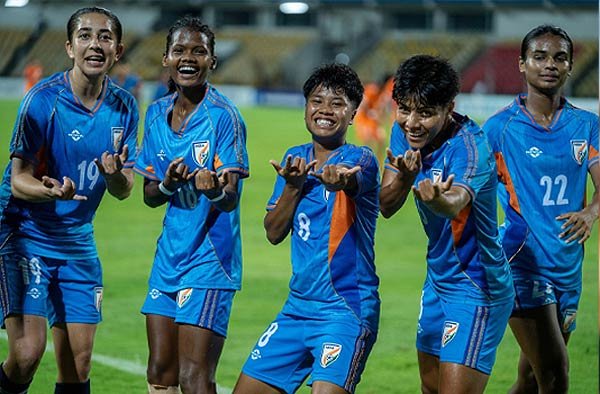
The victory sends the Blue Tigresses into their first SAFF Women’s Championship final since 2019, where they will face defending champions Bangladesh in what promises to be a highly anticipated title clash at the Pandit Jawaharlal Nehru Stadium on Saturday. Bangladesh booked its place in the final earlier in the day with a dramatic 2-1 victory over Nepal, courtesy of a late winner from substitute Sagorika.
Coming into the semifinal, India carried the weight of expectations. The hosts had looked unstoppable during the group stage, scoring 14 goals in just two matches, including an emphatic 11-0 win over the Maldives and an impressive 3-0 triumph over defending champions Bangladesh. Those performances established India as one of the tournament favourites and highlighted the attacking depth within coach Crispin Chhetri’s squad.
However, Bhutan arrived with a reputation for resilience. The Himalayan nation had reached the semifinals for a third consecutive edition and entered the match determined to challenge India’s dominance. Their defensive organisation and tactical discipline had been key features of their campaign, and those qualities were on full display against the hosts.
India enjoyed the majority of possession from the opening whistle and attempted to dictate the tempo through patient build-up play. Ranked 69th in the FIFA Women’s Rankings, the hosts repeatedly pushed forward in search of an early breakthrough. Karishma Shirvoikar, Soumya Guguloth and Aveka Singh all found opportunities inside the final third, but a combination of wayward finishing and determined Bhutanese defending kept the score level.
Bhutan’s compact defensive shape frustrated India throughout the first half. Whenever the hosts looked to create openings through the middle, Bhutan crowded the space and forced India into wide areas. The underdogs also showed flashes of attacking intent on the counterattack, creating moments of concern for the Indian defence whenever possession changed hands. Despite controlling proceedings, India entered halftime without a goal, a situation few would have predicted before kickoff. The goalless first half served as a reminder that knockout football often demands patience and composure, qualities India would need in abundance during the second period.
The breakthrough finally arrived shortly before the hour mark. Following sustained pressure around the Bhutan penalty area, Sanfida Nongrum found space and calmly converted to hand India the lead in the 58th minute. The goal sparked celebrations among the home supporters and relieved some of the growing tension surrounding the contest. For Nongrum, it was another significant milestone in her rapidly developing international career and a moment that ultimately proved decisive.
With the advantage secured, coach Crispin Chhetri turned to his experienced bench, introducing attacking reinforcements including Manisha Kalyan and Pyari Xaxa. The tactical changes were aimed at increasing India’s attacking threat and preventing Bhutan from building momentum in the closing stages.
Yet Bhutan refused to surrender. Rather than retreating deeper, they continued to search for an equaliser and remained dangerous on the break. Their determination reflected the growing progress of women’s football in the country, with the team demonstrating once again why it has become a consistent semifinal contender in South Asia.
India created several opportunities to extend the lead but failed to convert them, leaving the outcome uncertain until the final whistle. Bhutan also had moments where a single touch or pass could have altered the course of the match, but the finishing quality required to force extra time ultimately proved elusive.
When the final whistle sounded, relief was evident among the Indian players and coaching staff. The narrow victory may not have been as convincing as some of the team’s earlier performances, but it demonstrated a different side of India’s game: the ability to grind out results under pressure when attacking football alone is not enough.
Attention now turns to Saturday’s final against Bangladesh, a matchup rich with recent history. India defeated Bangladesh 3-0 during the group stage to end the defending champions’ unbeaten run, but knockout football often presents a different challenge altogether. Bangladesh will arrive full of confidence after reaching a third consecutive SAFF Women’s Championship final and pursuing an unprecedented third straight title.
For India, the mission is clear. One victory now stands between the Blue Tigresses and a sixth SAFF Women’s Championship crown, their first since 2019. After surviving a stern test from Bhutan, the hosts will hope to produce their best performance of the tournament when it matters most.

