

The Young Tigresses have turned their progress in Asian women’s football into another historic milestone. India defeated hosts Malaysia 4-0 at the MP Selayang Stadium to top Group E and qualify for the AFC U-17 Women’s Asian Cup 2027, becoming the first Indian team at any women’s age level to qualify for consecutive editions of the continental championship.
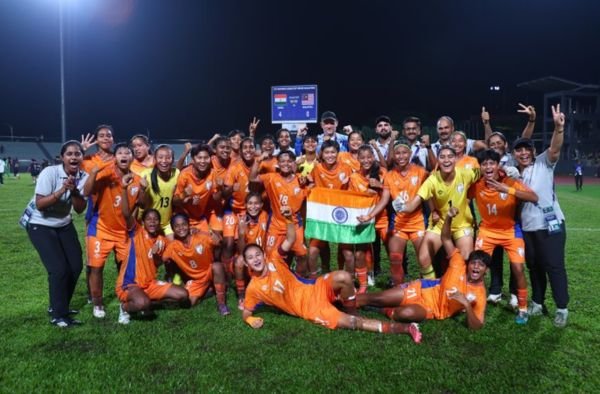
Redima Devi Chingkhamayum opened the scoring with a superb long-range effort in the 29th minute, setting the tone for India’s decisive performance. Pritika Barman doubled the advantage shortly after the interval, Anushka Kumari added a third with another strike from outside the box, and Nidhi Pawan Kumar completed the emphatic victory late in the match.
The result confirmed India’s place in the tournament for the second consecutive edition, following the team’s historic run to the quarterfinals at the AFC U-17 Women’s Asian Cup China 2026. The achievement represents another significant step for a young side seeking to establish India as a more consistent force in Asian women’s football.
With qualification on the line, India approached the contest with attacking intent, knowing that only the group winners would advance from the qualifiers. The pressure was considerable, but the Young Tigresses responded with an assured display against the home side. Redima broke the deadlock in the 29th minute, finding the net with a dipping strike from the edge of the penalty area.
Her effort gave India a deserved lead and rewarded the team’s attacking approach after a competitive opening period. Malaysia had the backing of the home crowd, but India maintained its composure and carried the advantage into half-time. The visitors’ defensive discipline was equally important, preventing Malaysia from finding a route back into the contest.
India strengthened its grip on the match soon after the restart. Pritika Barman made it 2-0 in the 51st minute, finishing from close range to give the visitors breathing room. Anushka Kumari then produced another important moment six minutes later. The forward struck from outside the box in the 57th minute, extending India’s advantage to three goals and putting the contest firmly in the Young Tigresses’ control.
Anushka’s goal added to an outstanding qualifying campaign. She had scored five times in India’s record-breaking 14-0 victory over Iraq in the opening match before scoring both goals in the 2-0 win against Syria. Her contribution against Malaysia further underlined her importance to the team’s attacking threat.
India continued to press even with a comfortable lead. Nidhi Pawan Kumar sealed the result in the 87th minute, rounding the Malaysian goalkeeper before calmly slotting the ball into an unguarded net. The fourth goal completed a convincing performance, ensuring India finished the group stage with maximum points and an unblemished defensive record.
Under head coach Joakim Alexandersson, India won all three Group E matches to finish with nine points. The campaign began with a remarkable 14-0 victory over Iraq on October 5, followed by a disciplined 2-0 win against Syria on October 8. The final match against Malaysia was the most significant test because it directly determined which team would claim the group’s qualification spot. India responded with another controlled performance, combining attacking efficiency with defensive organisation.
The team scored 20 goals across its three qualifying matches and did not concede once. That record highlights both the depth of India’s attacking options and the effectiveness of its defensive structure. The squad also benefited from continuity, with 13 players from the previous edition returning for the 2027 qualifying campaign. That experience appears to have helped the Young Tigresses handle the pressure of a decisive away fixture.
India’s quarterfinal appearance in the 2026 edition marked the country’s best-ever finish in the competition. Although the team lost 3-0 to China in the last eight, the campaign gave the players valuable experience against Asia’s leading youth sides.
