

India’s women’s hockey team had spent the opening three matches of the Asian Games turning scoreboards into goal charts. Against Japan, however, the challenge was different. There was no 15 or 20-goal margin, but there was control, composure and the kind of tactical discipline India will need when the medals are decided. The eighth-ranked Indian side defeated hosts Japan 3-1 at the Gifu Prefectural Green Stadium on Friday to register its fourth consecutive Pool B victory and secure a place in the semifinals of the Aichi-Nagoya Asian Games. Lalremsiami, Ishika Chaudhary and Navneet Kaur scored for India, while Shiho Kobayakawa pulled one back for Japan.
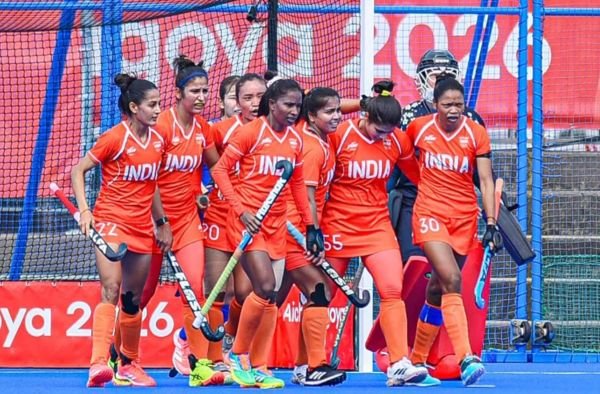
The result was particularly significant because Japan provided India’s first substantial test of the tournament. India had entered the contest after three overwhelming victories, defeating Uzbekistan 19-0, Indonesia 17-1 and Thailand 20-1. Those results had produced an extraordinary 56 goals, but Japan offered a more organised defence and a greater threat in transition. India nevertheless started on the front foot. The breakthrough arrived in the fifth minute. Navneet Kaur’s attempt created danger inside the Japanese circle and, after goalkeeper Yu Kudo made the initial intervention, Lalremsiami reacted quickest to the loose ball and found the back of the net.
Japan immediately looked for a response. Maho Ueno tested India’s defence with a penalty-corner opportunity, but goalkeeper Bichu Devi Kharibam was alert, while the Japanese side struggled to sustain pressure against India’s compact defensive structure. India continued to control possession and territory as the second quarter progressed. Japan relied largely on counter-attacks, but India’s midfield and defensive organisation prevented the hosts from creating a consistent stream of chances. The pressure eventually produced a second goal in the 30th minute.
Navneet’s direct penalty-corner attempt was blocked by the Japanese defence, but the rebound fell perfectly for Ishika Chaudhary. The defender kept her composure and converted to send India into half-time with a 2-0 advantage. Japan needed a fast start after the break. Instead, India extended its lead. Six minutes into the third quarter, Navneet produced one of the moments of the match. Receiving the ball inside the circle, she moved to her right before lifting the ball over Kudo to make it 3-0. For a team that had scored freely throughout the competition, India were now showing another dimension. Rather than chasing goals recklessly, they controlled the tempo and forced Japan to play without sustained attacking rhythm.
The hosts finally found a way through in the 46th minute. Shiho Kobayakawa unleashed a powerful tomahawk that found the gap to goalkeeper Savita Punia’s left, reducing the deficit to 3-1 and giving the home crowd renewed hope. The goal briefly shifted the momentum. Japan pushed forward and created further pressure, but India’s defence held firm. Savita made an important intervention late in the match, while India also successfully defended another Japanese penalty corner. The final hooter confirmed India’s fourth win in as many matches and, more importantly, their progression to the knockout stage. India will now complete their Pool B campaign against Singapore on Sunday.
The victory also strengthens India’s position in the group. Japan entered the contest as the second-ranked side in Pool B and, according to reports, is ranked 11th in the world, making Friday’s result India’s first significant test against a strong Asian opponent. India’s squad, led by captain Salima Tete and coached by Sjoerd Marijne, was selected with a mix of experience and emerging talent. Hockey India had highlighted that balance when announcing the Asian Games squad, with veterans such as Savita and Navneet alongside younger players including Ishika, Deepika and Beauty Dungdung. India entered the tournament looking to improve on the bronze medal won at the 2023 Hangzhou Asian Games.
The team’s larger target in Japan is the gold medal and a return to the top of the Asian women’s hockey hierarchy. The most important part of India’s 3-1 victory was not the scoreline. It was the manner in which the team adapted. The opening three matches were essentially goalfests. Against Japan, India had to demonstrate that it could win without relying on overwhelming attacking numbers. The answer was encouraging. The Indian side controlled possession, defended with structure and punished Japan at crucial moments. Lalremsiami provided the early breakthrough, Ishika capitalised on a rebound and Navneet produced the individual brilliance that created breathing room.
Japan’s late goal tested India’s composure, but the response was controlled rather than frantic. That could prove valuable when India enter the knockout phase, where margins will become smaller and one defensive error can decide a medal. The next challenge is to maintain that balance. India have already shown they can score in abundance. Against Japan, they showed they can also manage a competitive contest. The semifinal will demand both. For now, four matches have brought four victories, and India have moved from being the tournament’s most prolific attacking side to looking like a team increasingly comfortable with the pressure of a gold-medal campaign.

