

Every sporting nation has defining moments that alter not just a medal tally but the way it sees itself. For India, Sharmila Dhankar’s gold medal in the women’s shot put F57 event at the 2026 Commonwealth Games is one such moment. It is easy to celebrate the statistics. A season best throw of 9.81 metres. India’s first ever gold medal in Commonwealth Games para athletics. An end to a 20 year wait for a para athletics medal at the Games. Yet the true significance of her achievement lies beyond numbers. It represents the rise of India’s para sports ecosystem and a reminder that extraordinary champions are often forged far away from elite academies and sporting privilege.
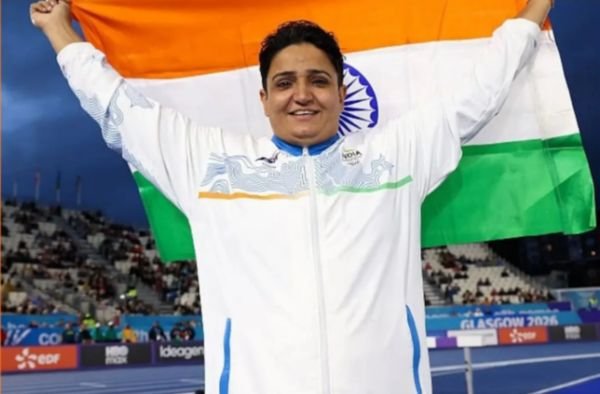
At 40, when many athletes begin thinking about retirement, Sharmila produced the defining performance of her career in Glasgow. Competing in the F57 classification for athletes with lower limb impairments, limb deficiencies or reduced muscle power, she delivered a composed and commanding performance that secured India’s first ever Commonwealth Games para athletics gold. Her throw was not only enough to top the podium but also to place her name permanently in Indian sporting history.
The celebrations became even more memorable when fellow Indian Shilpa Shyla was upgraded to the bronze medal following an official review of the results. For the first time, India celebrated a double podium finish in para athletics at the Commonwealth Games, highlighting the growing depth of talent within the country’s para athletics programme.
Prime Minister Narendra Modi acknowledged the scale of the achievement, writing on X, “History has been created in Glasgow! Congratulations to Sharmila for a very special Gold in the Women’s Shot Put F57 event and also for a season-best throw. This remarkable performance ends a two decade long wait for a Para Athletics Gold at the Commonwealth Games. My best wishes for the endeavours ahead.”
Behind that historic throw is a life that demanded resilience long before it demanded athletic excellence. Born in Chhithroli village in Haryana, Sharmila contracted polio at the age of two, leaving her with an impairment in her left leg. Growing up in a financially struggling family, opportunities were scarce and expectations were modest. Her personal life became even more difficult after she entered an abusive marriage at a young age, enduring years of violence before finally rebuilding her life with the support of her family.
Her second marriage to businessman Ajit Singh marked a turning point. Rather than viewing disability as a limitation, Ajit encouraged Sharmila to discover a new purpose through sport. Under coach Tek Chand, she entered para athletics in 2020, remarkably late by elite sporting standards. Within a year, she had become a national champion, proving that talent can emerge regardless of age when opportunity meets determination.
Her rise has been remarkably rapid. She represented India at the Birmingham Commonwealth Games in 2022, narrowly missing the podium with a fourth place finish. The disappointment became motivation rather than heartbreak. Earlier this year, she announced herself on the international stage by winning gold in the shot put and bronze in the discus throw at the Fazza International Para Athletics Championship in Dubai, signalling that Glasgow could become her breakthrough moment.
Her journey also reflects the sacrifices that many Indian athletes continue to make away from public attention. Reports have highlighted that her family sold their home to support her sporting ambitions, choosing uncertainty in pursuit of excellence. Those decisions rarely feature on medal tables, but they often determine whether an athlete reaches one.
Sharmila’s triumph also arrives at an important moment for Indian para sports. The country has steadily invested in high performance training, international exposure and specialised coaching over the past decade. The success of Indian para athletes at the Paralympics, World Championships and international competitions has demonstrated that with sustained institutional support, India can consistently compete among the world’s best. Hosting the 2025 World Para Athletics Championships further strengthened the country’s commitment to inclusive sport and expanded opportunities for emerging athletes.
Yet stories like Sharmila’s also reveal the work that remains. Many para athletes still battle financial insecurity, limited sponsorship opportunities and inadequate access to infrastructure, particularly in rural India. Their victories should not merely become inspirational headlines. They should become catalysts for stronger policy, greater corporate investment and wider public recognition.
The Commonwealth Games have always celebrated more than sporting excellence. They reward perseverance, resilience and the ability to overcome circumstances that appear impossible. Few athletes embody those ideals better than Sharmila Dhankar. Her gold medal is not simply India’s first in Commonwealth Games para athletics. It is proof that champions are not always discovered through perfect systems. Sometimes they emerge because someone refuses to surrender to hardship.
On a remarkable evening in Glasgow, a woman who began her sporting journey only six years ago did far more than win a gold medal. She challenged assumptions about disability, age and opportunity. She reminded India that history often belongs to those who have already won far greater battles before they ever step into the arena.

