

In sport, failure often exposes realities that medals conveniently conceal. India’s artistic gymnastics campaign at the 2026 Commonwealth Games ended without a single medal, prompting familiar questions about performance and expectations. But focusing only on the empty medal tally misses the deeper issue. India’s gymnastics challenge is not simply about athletes falling short on the competition floor. It is about a sporting system that continues to ask world class performances from a discipline that has never received world class investment.
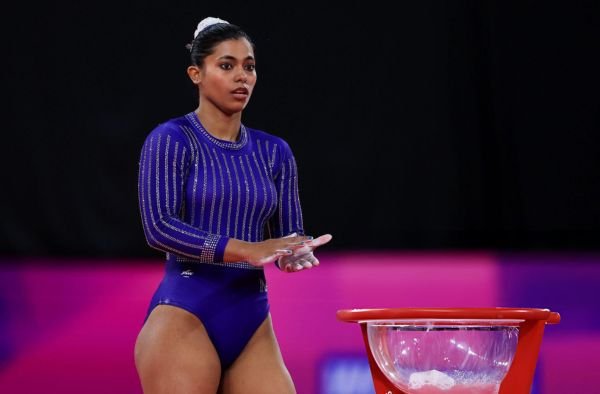
The eight member Indian artistic gymnastics contingent returned from Glasgow empty-handed, with debutant Protistha Samanta delivering the country’s best performance by finishing seventh in the women’s vault final. She had qualified for the final with a score of 13.025 before recording 12.883 in the medal round. It was India’s only top eight finish in artistic gymnastics at the Games.
For many observers, the disappointment centred around Pranati Nayak. The Olympian and three time Asian Championships bronze medallist arrived in Glasgow carrying India’s biggest medal hopes in the women’s vault. Competing in her fourth Commonwealth Games, she narrowly missed qualification for the final after scoring 12.575 in the qualifying round. It was a result that ended India’s hopes before the medal contest had even begun.
Elsewhere, the results reflected a team still searching for consistency on the international stage. In the women’s all-around qualification, Protistha Samanta finished 27th, Eshita Rewale placed 28th and Nishka Agarwal ended 34th, as India finished ninth in the women’s team standings. The men’s team placed seventh in the team competition, while Tapan Mohanty reached the men’s all-around final and finished 15th after improving through qualification. Yogeshwar Singh qualified as a reserve but did not compete in the final. While these performances demonstrated competitiveness, they also underlined the sizeable gap separating Indian gymnasts from the world’s leading programmes.
The result is particularly disappointing because India has shown before that success in artistic gymnastics is possible. The country has won only three Commonwealth Games medals in the sport. Ashish Kumar became India’s first gymnastics medallist by winning silver in the men’s vault and bronze in the floor exercise at the 2010 Delhi Commonwealth Games. Four years later, Dipa Karmakar’s historic bronze in the women’s vault at Glasgow transformed the sport’s visibility in India and inspired a new generation of young gymnasts.
That generation was expected to build on Dipa’s legacy. Instead, twelve years later, India finds itself asking many of the same questions. The absence of medals in Glasgow cannot simply be attributed to one disappointing competition. Gymnastics is among the world’s most technically demanding sports. Athletes begin training as children, spending over a decade mastering routines that are judged to fractions of a point. Nations such as Great Britain, Australia and Canada have built sophisticated pathways that combine sports science, elite coaching, injury prevention and consistent international competition. India, despite producing exceptional individual talents, still relies heavily on isolated centres of excellence rather than a nationwide development structure.
The contrast becomes even sharper when examining India’s sporting priorities. Cricket dominates infrastructure, sponsorship and media attention. Olympic sports receive greater visibility every four years, but gymnastics often remains on the margins. Funding arrives in phases, international exposure is limited and coaching depth continues to lag behind leading nations. Athletes frequently spend more time overcoming logistical challenges than refining routines capable of winning medals. Yet there were encouraging signs in Glasgow that deserve recognition.
Protistha Samanta, competing in her maiden Commonwealth Games, handled the pressure of an international final with composure. At just 22 years old, she represents the next phase of Indian gymnastics and has already shown she belongs on major championship stages. Likewise, Tapan Mohanty’s qualification for the men’s all-around final reflects gradual progress in a discipline where India has traditionally struggled to compete consistently.
It is also worth remembering that the Glasgow Commonwealth Games were unlike previous editions. The streamlined programme featured only a limited number of sports after the event was scaled down, reducing opportunities for many nations to build broader momentum across disciplines. For India’s relatively small contingent, every missed medal carried greater significance than it might have in a full scale Games.
The real lesson from Glasgow is not that Indian gymnastics has regressed. It is that the sport has reached a crossroads. Individual brilliance can occasionally produce history, as Dipa Karmakar demonstrated in 2014. Sustainable success, however, requires something much larger than exceptional individuals. It requires stronger grassroots programmes, modern training infrastructure, specialised coaching, greater international exposure and long term athlete support that extends well beyond Olympic cycles.
Countries that consistently produce gymnastics champions do not rely on miracle performances. They build systems that make excellence predictable. India has already shown it can transform sporting disciplines through sustained investment. Shooting, wrestling, boxing, badminton and athletics have all benefited from improved planning over the past decade. There is no reason gymnastics cannot follow a similar trajectory if it receives the same institutional commitment.
Glasgow will be remembered as a medal-less campaign for India’s artistic gymnasts. But history suggests that setbacks often become turning points. The question now is whether Indian gymnastics treats this disappointment as another forgotten result or as the catalyst for meaningful reform. Because the next Dipa Karmakar or Ashish Kumar may already be training in a small gym somewhere in India. Whether they stand on a Commonwealth podium in the future will depend less on talent and far more on the system waiting to support them.

